



Your SPM system sees the world through a keyhole. Open the door.
Bruviti’s AI Operating Layer sits on top of your existing SPM system and writes better decisions back automatically. No rip and replace.
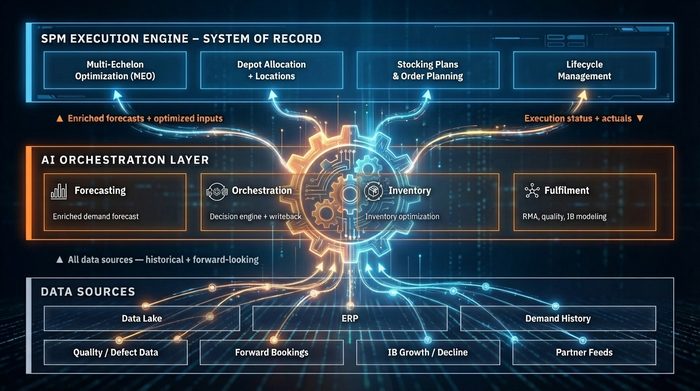
Service parts management systems optimize supply response from a demand signal. The AI Operating Layer expands that signal, connecting quality data, field intelligence, IoT and forward bookings that your SPM was never designed to see.
How enterprises broke through the forecast accuracy ceiling
The reference architecture behind the results, six use cases with published metrics and a 90-day path from pilot to production. 16 pages.
What your SPM sees, and what it doesn’t
Your install base isn’t static. Your forecast shouldn’t be either.
Shipment history alone gives 50 to 70% accuracy on intermittent parts. Planner overrides help about half the time. The tail SKUs that cause the most expensive surprises are the ones with the least data.
The AI layer expands the demand signal: install base evolution, quality trends, forward bookings and peer learning across ontologically similar parts. Every part at every location gets a forecast, not just the ones a planner has time to review.
An enterprise semiconductor equipment manufacturer saw forecast error drop from 17 to 18% to under 3%, recovering over $2M annually.
Read the use case →If the fix can’t happen on arrival, the truck shouldn’t leave.
>50% of failed first fixes are parts-related. Every repeat truck roll costs $200 to $300. The problem isn’t the technician. It’s what was on the truck.
The AI layer changes what happens before dispatch:
- +Normalizes free-text symptoms across thousands of prior service events
- +Ranks probable parts by equipment model, failure history and catalog
- +Checks live inventory, applies warranty and safety gates
- +Delivers a ranked picklist in under two minutes
A part doesn’t fail without warning. The warning is in the data.
Calendar-based maintenance replaces parts too early or too late. When a failure does surprise you, rush orders run 3 to 4x the normal cost and drive unplanned downtime across the operation.
Survival analysis on your install base predicts when individual components will reach end of life. When a health index crosses its threshold, work orders are created and replacement parts reserved for just-in-time delivery.
Read the use case →Related articles

From 50% to 90%+ Forecast Accuracy
What changes when intermittent demand meets expanded signal and full-scale modeling.
The Four Structural Gaps in Modern SPM Systems
Signal, scale, integration and execution: why each one compounds the others.

Why Your SPM Needs an AI Operating Layer
The demand signal boundary problem and what to do about it.
Frequently asked questions
What is an AI operating layer for service parts management?
It sits on top of existing SPM systems and brings in demand signals that traditional planning systems weren’t designed to ingest: quality data, IoT sensors, field intelligence and CRM data. It enriches the demand signal feeding the SPM and automates the path from recommendation to execution.
How does AI improve service parts forecast accuracy?
70 to 90% of a typical service parts catalog has intermittent demand, where traditional methods reach only 50 to 70% accuracy. Most limits are input problems, not model problems. Expanding the signal with quality trends, lifecycle indicators, field intelligence and forward bookings improves the forecast input to the planning system.
Do we have to replace our SPM system?
No. The AI Operating Layer complements your existing SPM system, enriching its demand signal and automating execution of its recommendations. No migration or replacement is required.
What is the demand signal boundary problem?
Most SPM systems consume historical shipments and basic install base data. Quality signals, forward bookings, lifecycle shifts, IoT data and field technician intelligence sit outside that boundary, which puts a structural ceiling on planning accuracy.
Does our data need to be clean first?
No. The AI Operating Layer works with your data as it is, including missing fields, inconsistent formats and legacy systems.
Can it run on premise?
Yes. It can run entirely in your environment with full data sovereignty, so no data leaves your infrastructure.
How long does deployment take?
Typically 4 to 8 weeks to production. Forward-deployed engineers embed with your planning team for discovery, configuration, integration with your SPM, validation against your KPIs and go-live.