
Evaluation Framework
The Bruviti AIP treats evaluations as the AI equivalent of unit tests and compliance audits combined. Every AI output — from routing decisions to context product compilation to end-user task completion — passes through a continuous evaluation pipeline with defined pass/fail gates before reaching production.
Why Evaluations Are Non-Negotiable
Enterprise AI systems operate in environments where incorrect outputs have real consequences: wrong parts shipped, incorrect diagnostic procedures followed, misrouted service requests escalating into SLA breaches. Unlike consumer AI where a poor response is an inconvenience, enterprise AI failures cascade through operational systems.
Evaluations provide three things that enterprise deployments require:
- Reproducible proof — numbers-driven evidence that the system does what the business needs, testable across data changes, model updates, and regulatory shifts
- Release gates — automated pass/fail decisions that prevent regressions from reaching production when models, data, or configurations change
- Drift detection — continuous monitoring that catches degradation before it affects users, triggering retraining or rollback when performance drops below thresholds
Continuous Evaluation Pipeline
The evaluation pipeline operates as a continuous loop: business requirements define eval criteria, evals validate model and code changes, validated changes deploy to production, production monitoring feeds back into requirements refinement.
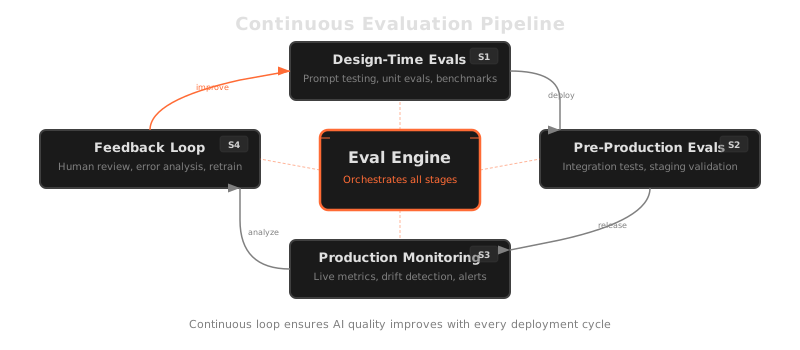
The pipeline is not a one-time quality check — it runs continuously. Every model change, every data update, every configuration modification triggers the relevant portion of the eval suite. This ensures that improvements to one capability do not degrade another.
Eval Dimensions
The evaluation framework tests AI outputs across six dimensions. Each dimension has specific test types, defined thresholds, and automated tooling.
| Dimension | What Is Tested | How It Is Tested |
|---|---|---|
| Functional Accuracy | Task-specific correctness scores, cost and latency budgets | Built-in eval templates with custom metrics, scored against labeled test sets |
| Fairness & Bias | Demographic parity, counterfactual consistency | Automated bias detection across protected attributes, counterfactual test generation |
| Robustness & Security | Adversarial input handling, prompt injection resistance | Red team simulations, adversarial test suites, security gate enforcement |
| Explainability | Decision transparency, feature attribution | SHAP value computation, decision path logging, interpretability analysis |
| Privacy & Compliance | PII leakage, data residency, regulatory compliance | Automated PII scanning, compliance rule checks, data flow auditing |
| Operational Health | Performance degradation, data drift, concept drift | Real-time monitoring, statistical drift tests, auto-escalation alerts |
Eval coverage is not optional: All six dimensions are evaluated for every production deployment. A system that passes accuracy checks but fails security probes does not ship. A system that passes all pre-production gates but shows drift in production triggers automated intervention. There is no dimension that can be skipped.
Three-Layer Evaluation Architecture
The platform implements evaluations at three architectural layers, each testing a different aspect of the AI pipeline.
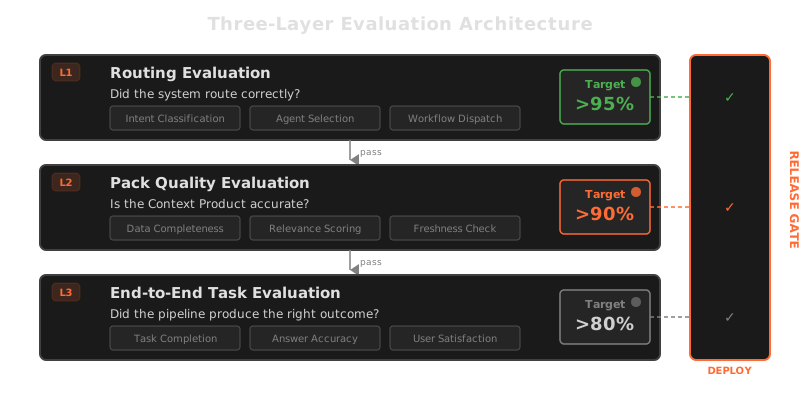
Layer 1: Routing Evaluation
Tests whether the system correctly interpreted the user's intent and routed the request to the appropriate workflow. Routing evaluation catches errors at the earliest possible point — before any context retrieval or generation occurs.
Test cases include ambiguous queries (does the router disambiguate correctly?), multi-intent requests (does the router decompose and route each intent?), and out-of-scope requests (does the router correctly identify requests it cannot handle?).
Layer 2: Pack Quality Evaluation
Tests whether the context products delivered by the pipeline are accurate, complete, and current. This layer validates the output of the context engineering system independent of how it was triggered.
Evaluation checks include:
- Factual accuracy — do the entity cards, procedure cards, and playbooks contain correct information as validated against source data?
- Completeness — are all required fields populated? Are referenced parts, tools, and prerequisites included?
- Currency — is this the latest version of the context product? Have any source documents been updated since the product was compiled?
- Applicability — is the product scoped to the correct equipment model, revision, and operating conditions?
Layer 3: End-to-End Task Evaluation
Tests whether the full pipeline — from user query through routing, retrieval, and response generation — produced the correct outcome. This is the most comprehensive evaluation layer and the final gate before production release.
End-to-end test cases are built from real service scenarios: a technician diagnosing a specific fault, an agent answering a parts availability question, a field service visit requiring a complete service pack. The evaluation checks the final output against the known correct answer, accounting for acceptable variations in phrasing and presentation.
Evaluation Scorecard
Each evaluation run produces a scorecard — a structured summary of pass/fail status across all dimensions and layers. The scorecard serves as the release gate: all required thresholds must pass before a change can reach production.
| Metric | Threshold | Gate Type |
|---|---|---|
| Routing accuracy | >95% | Hard gate — below threshold blocks release |
| Retrieval precision | >90% | Hard gate — below threshold blocks release |
| Context relevance | >85% | Hard gate — below threshold blocks release |
| Task completion | >80% | Hard gate — below threshold blocks release |
| Security probes | 0 critical findings | Hard gate — any critical finding blocks release |
| Bias detection | Within defined parity bounds | Hard gate — out-of-bounds blocks release |
The scorecard uses a red/yellow/green status system. Red (below hard gate threshold) blocks release. Yellow (above threshold but below target) allows release with a review flag. Green (at or above target) is a clean pass. The scorecard is versioned and archived — every production release has a corresponding scorecard that can be retrieved for audit purposes.
Evaluation Through the Lifecycle
Evaluations are not a single checkpoint — they operate at every stage of the system lifecycle.
Design-Time Evaluations
Before any code is written, business requirements are mapped to measurable test criteria. Success criteria are defined with stakeholders — what does "correct" mean for each task type? Eval datasets are created from real-world scenarios representative of the target operating conditions. These design-time artifacts become the foundation for all subsequent evaluation.
Pre-Production Gates
Every model change, code change, or configuration update triggers the full eval suite. The automated scorecard produces a go/no-go decision. Changes that pass all gates are promoted to production. Changes that fail any hard gate are blocked and returned for remediation. The eval results from each iteration are tracked — typical development cycles show pass rates progressing from initial generation through successive refinement iterations until all gates are met.
Production Monitoring
Once deployed, continuous evaluation runs on live data. Production monitoring checks the same dimensions as pre-production testing but against real user interactions rather than test datasets. Drift detection identifies when production performance diverges from the baseline established during pre-production evaluation.
Feedback Integration
Production results flow back into the eval system. New edge cases discovered in production become test cases for future releases. Failure patterns are analyzed and added to the eval dataset so that known failure modes are explicitly tested in pre-production. This creates a continuously improving eval suite that becomes more comprehensive over time.
MLOps: Model Registry, Testing, and Rollback
The evaluation framework integrates with the platform's MLOps infrastructure to provide end-to-end model lifecycle management.
Model Registry
Every trained model is registered with full metadata: training data version, hyperparameters, eval scorecard results, training timestamp, and lineage (which previous model version it was derived from). The registry provides semantic versioning so that any production model can be traced back to its exact training configuration and evaluation results.
A/B Testing
New model versions can be deployed alongside existing versions with traffic splitting. The evaluation framework monitors both versions in parallel, comparing their scorecard metrics on identical inputs. Promotion from A/B test to full deployment requires the new version to meet or exceed the existing version's scores across all eval dimensions.
Auto-Retraining
When drift detection identifies performance degradation beyond defined thresholds, the system can trigger automatic retraining. The retraining pipeline uses the latest data, produces a new model version, runs the full eval suite, and promotes the retrained model only if it passes all gates. This closed-loop operation maintains production quality without manual intervention.
Rollback
If a deployed model version exhibits unexpected behavior that was not caught by pre-production evaluation (e.g., a new data pattern in production), the system supports immediate rollback to the previous registered version. Rollback restores the previous model, its configuration, and its associated context products — returning the system to a known-good state. All training runs are logged for reproducibility, ensuring that the rolled-back state can be exactly replicated if needed.
Drift Detection and Production Monitoring
Production monitoring extends the evaluation framework into live operations, watching for two types of drift that can degrade performance over time.
Data Drift
Data drift occurs when the distribution of production inputs diverges from the distribution of training data. For example, if the platform was trained on service data for Model A and Model B, but a new Model C is deployed in the field, the incoming queries now include an entity type the model has not seen. Statistical drift tests compare the production input distribution against the training baseline and flag significant divergences.
Concept Drift
Concept drift occurs when the relationship between inputs and correct outputs changes. For example, a design revision to a component may change its failure pattern from wear-out (β > 1) to random (β ≈ 1), making the existing Weibull parameters incorrect even though the input data looks similar. Concept drift is detected by monitoring prediction accuracy against actual outcomes over time — a sustained decline in accuracy despite stable input distributions signals concept drift.
Monitoring Response
When drift is detected, the system responds through a tiered escalation:
- Alert — drift detected but within warning bounds. The operations team is notified and monitoring frequency increases.
- Auto-retrain — drift exceeds warning bounds. Automatic retraining is triggered with the latest data, and the retrained model must pass all eval gates before promotion.
- Rollback — drift exceeds critical bounds or auto-retrained model fails eval gates. Immediate rollback to the last known-good version, with escalation to the engineering team for investigation.
Evaluations as continuous assurance: The evaluation framework is not a quality gate that fires once at deployment. It is a continuous monitoring system that watches every production interaction, detects degradation before users are affected, and triggers automated correction. The scorecard is not a snapshot — it is a living metric that reflects the system's current production performance.