Why Your Service Parts Management (SPM) Needs an AI Operating Layer
Adding the intelligence capability your planning system was never designed to have
SPM by Design
SPM systems evolved from operations research. They were designed to optimize supply response: multi-echelon stocking, replenishment policies, service level trade-offs. That's what they do well.
But that optimization is only as good as the inputs shaping it. Across a large service network, demand is influenced by forces the planning engine never sees: an engineering change notice that shifts failure patterns, a wave of contract renewals that changes entitlement mix, an installed base that's growing in one region and declining in another. When those drivers aren't visible, the engine optimizes from a partial picture.
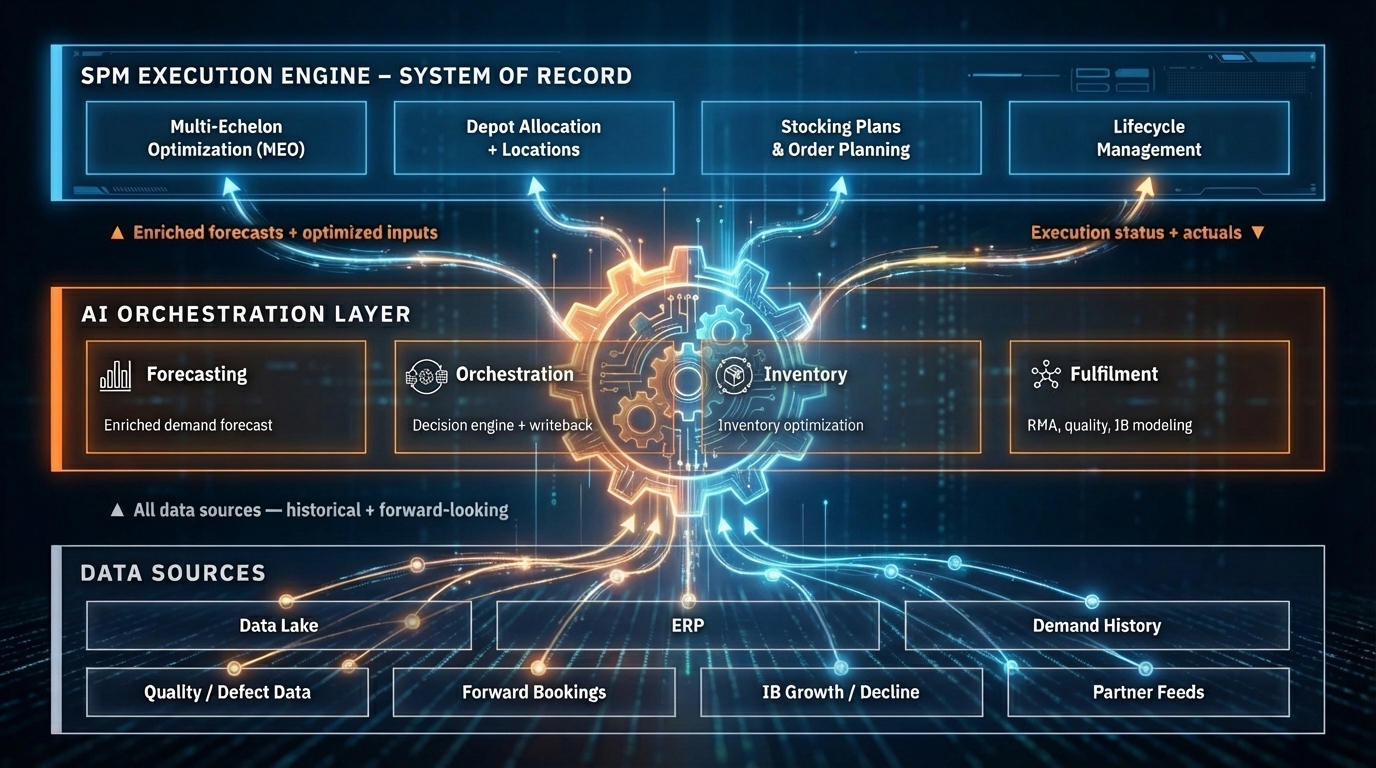
An AI operating layer makes that full picture visible and actionable. It aggregates signals from across the service operation and translates them into updated demand expectations and policy adjustments that flow directly into SPM. No rip and replace. No major change management program. SPM continues to do what it was built to do. It just operates with broader awareness.
Design Limitations Exposed
In a single-depot environment, historical demand and installed base counts may be sufficient inputs for effective planning. Across hundreds of depots, thousands of SKUs, multiple lifecycle stages, and mixed contract models, the gaps become structural.
Demand Signal Boundary: SPM forecasting works from historical demand, failure rates, and installed base counts. Demand drivers that sit outside those predefined inputs, and there are many, don't reach the planning engine. It optimizes from a partial view.
Scale and Dimensionality Ceiling: The part-location-time-condition matrix at scale exceeds what SPM platforms can process in batch windows. Planners segment, subset, and extrapolate. Multi-echelon logic, the core value proposition, ends up applied to a fraction of the portfolio.
Signal Integration Rigidity: Incorporating a new data source that could improve forecast accuracy typically means a re-integration project measured in months, not a configuration change. The system can't keep pace with the data landscape.
Recommendation to Execution Gap: SPM produces stocking plans. Translating those into changed execution still requires planner intervention, manual overrides, and separate workflows. The system computes the answer but doesn't close the loop.
How an AI Operating Layer Changes the Game
Each of the limitations above has a common root: SPM can only act on what it can see, within the computational boundaries it was designed around. An AI operating layer removes those boundaries.
Complete demand signal formation: The AI layer aggregates the signals that SPM was never designed to ingest: quality notifications, warranty claim patterns, field action bulletins, product configuration changes, and usage condition data. It combines them into adjusted demand inputs that reflect what's actually driving parts consumption, not just what happened last quarter. The planning engine sees what it couldn't see before, and forecast accuracy improves because the inputs finally match reality.
Full scale modeling without subsetting: Instead of forcing planners to choose which product lines get full planning attention, the AI layer handles demand modeling across the entire installed base and product portfolio: every SKU, every depot, every lifecycle stage. It produces adjusted demand inputs at full scope and feeds those into SPM for depot-level optimization. No more prioritized subsets. The service network gets planned as one network, and multi-echelon logic gets applied where it was always meant to: everywhere.
Rapid signal onboarding: When a new quality issue surfaces in a different system, or a shift in contract mix changes the demand profile for a product family, or a new product introduction creates forward demand with no history, the AI layer can incorporate those signals without re-architecting the SPM integration. Planning teams improve their forecast inputs continuously, rather than waiting for the next system upgrade cycle. Integration rigidity gives way to continuous improvement.
Closed loop execution: This is the critical architectural shift. The AI layer doesn't produce a dashboard or a report. It detects signal changes, updates demand inputs, adjusts policy parameters such as safety stock levels, reorder points, and stocking locations, and writes them back into SPM to change what's being ordered, moved, and positioned. The loop from intelligence to action closes. Planners shift from manually adjusting recommendations to managing exceptions and strategic decisions, the work that actually needs human judgment.
The Combined Architecture
The AI operating layer and the SPM platform are complementary, not competitive. Together they form a next-generation planning architecture where service supply chain intelligence and execution precision operate as one system.
| AI Operating Layer | SPM Platform |
|---|---|
| Quality, contract, and lifecycle optimization | Multi-echelon inventory |
| Causal demand formation | Depot-level allocation and stocking |
| Full install-base scale modeling | Service level vs. cost trade-offs |
| Continuous learning from new sources | Replenishment policy generation |
| Autonomous write-back to execution | Simulation and scenario planning |
The Outcome
The AI operating layer opens up the full picture, delivering planning and management capabilities that were previously out of reach. For example:
Predictive, multivariate demand forecasting. Demand modeled using survival analysis at part level, incorporating install base age, configuration, geography, usage conditions, and weather patterns. Accuracy driven by the full range of causal factors, not simplistic statistical trends.
Quality-driven demand prediction. Recall events, specific lot issues, and failure patterns that bleed outside known serial ranges feed directly into forward demand expectations before they show up as spikes in consumption history.
Steady state inventory optimization. Improved forecasting on the high volume, stable SKUs where most inventory investment sits, not just the highly volatile tail. Product aging, new shipments entering the installed base, and environmental factors like coastal versus indoor use become planning variables.
Repair versus replace decision support. Serial number level decisions on whether to repair or replace, factoring total landed cost, logistics routing, duty and VAT, expected repair yield, condition grading on receipt, supersession rules, engineering constraints, and customer technical requirements.
Autonomous insight discovery. The AI layer continuously interrogates the full dataset to surface patterns and areas of impact that no one asked it to look for: emerging failure modes, regional demand shifts, contract behavior that predicts future consumption. New insight is generated, not just reported.
More in This Series
This article is part of a three-part series on AI operating layers for service parts management:
- The Four Structural Gaps in Modern SPM Systems takes a deeper look at the architectural limitations that create these blind spots.
- From 50% to 90%+ Forecast Accuracy: What Changes With an AI Layer quantifies the accuracy improvement and downstream operational impact when the demand signal boundary is removed.
Bruviti builds AI operating layers for service supply chains. We'd love the opportunity to show you how we did it for our enterprise customers.