
Data Sovereignty & Security
The Bruviti AIP is architected for complete data sovereignty — every component, model, and byte of data remains within the enterprise perimeter. The platform operates with no external API calls, no cloud dependencies for core functionality, and full support for air-gapped deployments.
Security Architecture
The platform's security architecture is built on a single principle: everything runs inside the enterprise perimeter. Unlike platforms that offer "private" versions of public cloud services with data-in-transit protections layered on top, the AIP is designed from the ground up as a self-hosted platform where no data leaves the customer's infrastructure.
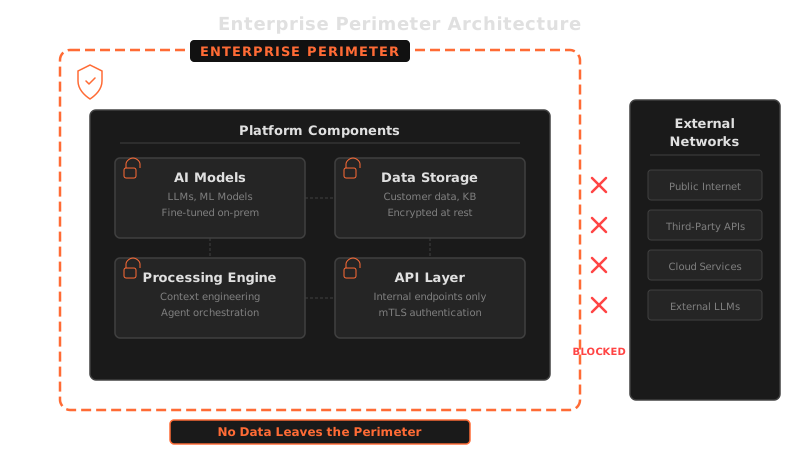
The self-contained architecture means the platform can operate in environments where external network access is restricted or prohibited entirely. This is a hard architectural constraint, not a configuration option — the platform does not contain code paths that call external services for core functionality.
Data Sovereignty
Data sovereignty covers four aspects of data control: residency, processing, model training, and operational independence.
Data Residency
All enterprise data remains on the customer's infrastructure. There are no external API calls for data processing — all NLP, entity extraction, embedding generation, and model inference run locally. This satisfies data residency requirements for regulated industries and jurisdictions with strict data localization laws.
On-Premise Processing
The full data ingestion pipeline — from raw document intake through intelligent understanding to knowledge fabric construction — executes on the customer's compute infrastructure. Processing does not depend on external cloud services, external LLM APIs, or any component hosted outside the enterprise perimeter.
Model Training Isolation
Models are trained exclusively on the customer's proprietary data, within the customer's infrastructure. Training data, model weights, learned patterns, and fine-tuning artifacts never leave the environment. Each customer's models improve using only their own data — there is no cross-customer learning, no shared model updates, and no aggregated training across deployments.
No External Dependencies
The platform's core functionality operates without external dependencies. The core framework (event messaging, state management, lifecycle control, security), the evaluation engine, code generation, the component library, and all development tools run locally. This means the platform remains fully operational even if external network connectivity is completely severed.
Air-gapped support: The platform supports deployment in fully air-gapped environments — networks with no external connectivity whatsoever. This is required for defense, intelligence, and critical infrastructure deployments where any external data path is prohibited by policy. See Deployment Architecture for air-gapped topology details.
Model Ownership & IP Protection
The platform's ownership model is explicit: everything generated within the customer's environment belongs to the customer.
| Asset | Ownership | What This Means |
|---|---|---|
| Trained models | Customer | Model weights, parameters, and fine-tuning artifacts are the customer's property. They can be exported, backed up, or migrated. |
| Generated code | Customer | All code generated by the platform's code generation engine is the customer's intellectual property. |
| Learned patterns | Customer | Business rules, domain patterns, and operational insights learned by the system remain proprietary to the customer. |
| Context products | Customer | All compiled context products (entity cards, procedure cards, playbooks, service packs) are customer assets. |
| Ontology customizations | Customer | Custom entity types, relationship types, and domain extensions to the ontology framework belong to the customer. |
There is no mechanism for learned insights, competitive advantages, or innovation patterns to leave the customer's control. The platform does not phone home, does not report usage analytics to external services, and does not share any aspect of the customer's deployment with other customers or with Bruviti.
AI Governance & Explainability
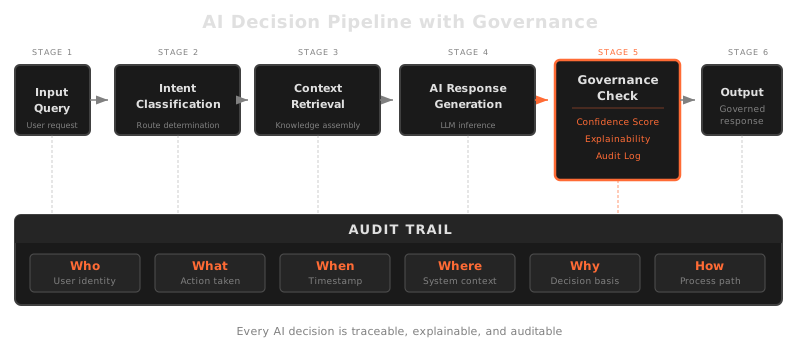
The platform implements a governance layer that ensures AI decisions are transparent, reviewable, and auditable.
Decision Transparency
Every AI decision produces a decision path — a structured record of what inputs were considered, what logic was applied, and why the specific output was selected. Decision paths are rendered as visual decision trees that business users can read without data science expertise. This transparency is not optional or configurable — it is built into the decision pipeline.
Confidence Scoring
Every AI output includes a confidence score that indicates the system's certainty in its decision. Confidence scores are calibrated against the evaluation framework's test results — a confidence score of 0.95 means the system produces correct outputs on similar inputs 95% of the time in evaluation testing. When confidence falls below a configurable threshold, the system can route to human review rather than proceeding automatically.
Human-in-the-Loop
The governance layer supports human review workflows at any decision point. Decisions can be configured to require human approval above certain impact thresholds, below certain confidence thresholds, or for specific decision categories. The review workflow presents the human reviewer with the decision, the explanation, the confidence score, and the relevant context — everything needed to make an informed approval or override.
Audit Trail
The platform maintains a comprehensive audit trail that logs every action with six dimensions of context.
| Dimension | What Is Recorded |
|---|---|
| Who | Who initiated the action — user identity, system process, or AI agent that triggered the event |
| What | What was done — the action performed, with before-state and after-state for all affected data |
| When | When it occurred — timestamp with millisecond precision, synchronized across all system components |
| Where | Where in the system — which component, workflow, task, and execution context generated the event |
| Why | Why it was done — the business context, triggering rules, and decision reasoning that led to the action |
| How validated | How it was validated — evaluation results, compliance checks, and approval records associated with the action |
Audit records include evaluation scorecards for every deployment, automated compliance test results stored immutably, continuous monitoring data, and pre-deployment validation reports. The audit trail is designed for regulatory review — every production change can be traced from business requirement through evaluation to deployment with complete evidence.
Compliance & Reporting
The platform provides automated compliance reporting through dashboards and scheduled report generation.
Executive Dashboards
Real-time dashboards display model performance and bias metrics, compliance status organized by regulation, audit findings with remediation status, and risk scoring with trend analysis. Dashboards are role-based — executives see aggregate status, compliance officers see regulatory detail, and engineering teams see technical metrics.
Automated Reporting
The reporting system generates scheduled compliance reports on configurable cadences, ad-hoc audit reports triggered by specific events or requests, external auditor packages formatted for third-party review, and regulatory filing support with required evidence attachments. Reports are generated from the audit trail and evaluation data — they are not manually authored but automatically assembled from the system's own records.
Edge & Offline Security
The platform's edge and offline architecture extends the security model to devices operating outside the enterprise network.
Micro Pack Security
Micro packs deployed to edge devices contain a subset of context products and a local SLM — both are encrypted at rest and in transit. The micro pack is signed and versioned; the edge device validates the signature before loading any pack. Tampered or expired packs are rejected and the device falls back to its last known-good pack until a valid replacement is synced.
Sync Protocol Security
When edge devices reconnect to the network, the sync protocol handles bidirectional data transfer: uploading locally collected data (service records, telemetry) and downloading updated packs. The sync protocol uses mutual TLS authentication, encrypts all data in transit, and performs conflict resolution for data modified during the offline period. Local data is not transmitted to any external endpoint — it syncs only with the enterprise's own infrastructure.
Local Inference Isolation
The local SLM running on edge devices operates in complete isolation — it does not make external API calls, does not send inference logs to external services, and does not require network connectivity to function. All inference happens on-device using the locally deployed model and micro pack data. This ensures that field service operations maintain full data sovereignty even when technicians are working in customer environments with no network access.
Defense in depth: The security architecture is layered — enterprise perimeter controls, encrypted storage, signed deployments, authenticated sync, and isolated local inference. Compromising one layer does not compromise the others. The platform does not rely on network security alone; every component enforces its own security boundaries.