
Deployment Architecture
The Bruviti AIP supports on-premise, private cloud, air-gapped, and edge/offline deployment topologies. A progressive disclosure model delivers micro context packs at the edge for offline operation and macro packs on-demand when connected.
Deployment Models
The platform is architected for complete autonomy — every component, every model, and every byte of data remains under enterprise control. Four deployment models are supported:
| Model | Description | Use Case |
|---|---|---|
| On-premise | Full platform deployed on enterprise-owned servers within the corporate data center. All processing, model training, and data storage occurs on local infrastructure. | Organizations with strict data residency requirements or existing data center investments |
| Private cloud | Deployed on dedicated cloud infrastructure (not shared tenancy). The enterprise controls the virtual private cloud, network configuration, and encryption keys. | Organizations requiring cloud elasticity while maintaining isolation from other tenants |
| Air-gapped | Fully isolated deployment with no inbound or outbound network connectivity. All updates, model packages, and data are transferred via physical media or secure one-way data diodes. | Defense, classified environments, critical infrastructure with network isolation mandates |
| Multi-region | Distributed deployment across multiple geographic regions with data sovereignty controls per region. Each region operates independently while supporting cross-region coordination where permitted. | Global enterprises subject to per-country data residency regulations (GDPR, data localization laws) |
No external dependencies: Unlike platforms that offer "private" versions of public cloud services, the Bruviti AIP requires no external API calls for operation. Models train on your data inside your infrastructure. Generated code stays in your environment. No data leaves the enterprise perimeter.
Deployment Architecture
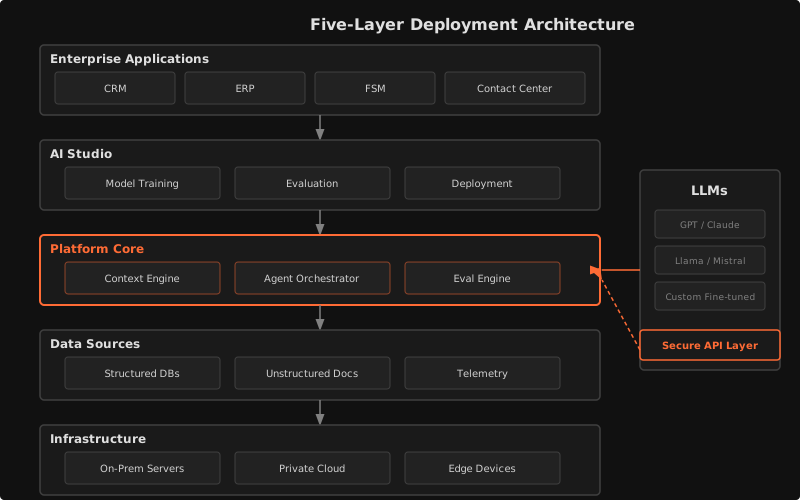
The platform is organized into five horizontal layers. Each layer communicates through well-defined interfaces, and all layers deploy within the enterprise perimeter.
Enterprise Applications Layer
The topmost layer integrates with existing enterprise systems: CRM (Salesforce, Microsoft Dynamics), ERP (SAP, Oracle), field service management (ServiceMax, IFS, ServiceNow), and contact center platforms (Genesys, Nice, Zendesk). The platform connects to these systems through pre-built connectors and APIs — it does not replace them.
AI Studio Layer
The AI Studio provides the interface for model lifecycle management: training models on enterprise data, evaluating model performance against defined benchmarks, managing model versions and deployments, and configuring agent behaviors. All model training and fine-tuning happens within the enterprise perimeter using enterprise-owned data.
Platform Core Layer
The operational center of the deployment, containing three primary engines:
- Context Engine — manages the knowledge fabric, compiles context products, and executes retrieval workflows (see Agentic Context Engineering)
- Agent Orchestrator — routes requests to agents, manages workflow execution, and coordinates parallel processing across the event bus
- Evaluation Engine — runs continuous evaluation pipelines, enforces quality gates, and monitors production performance (see Evaluation Framework)
Data Sources Layer
The platform ingests from multiple data source types: structured databases (parts inventories, service records, CRM data), unstructured documents (manuals, knowledge base articles, engineering specifications), and real-time telemetry streams from connected equipment and IoT sensors. Data remains in place where possible — the platform connects to existing data stores rather than requiring data migration.
Infrastructure Layer
The foundation layer encompasses the physical and virtual compute, storage, and networking resources. This includes on-premise servers, private cloud instances, and edge devices. The platform is infrastructure-agnostic — it runs on standard Linux-based compute with no vendor-specific hardware dependencies.
Edge & Offline Architecture
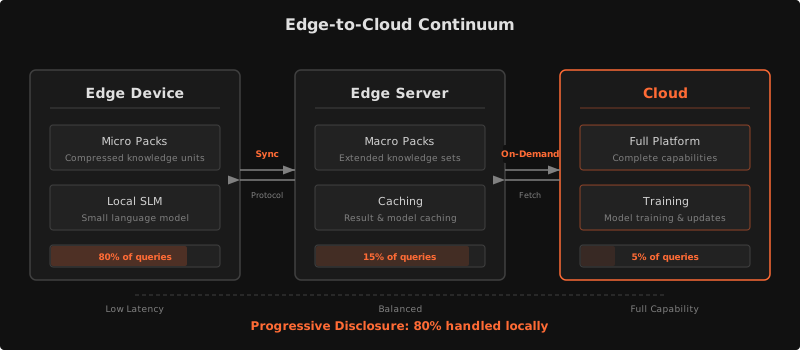
Field service and industrial environments frequently operate with intermittent or no network connectivity. The platform addresses this with a progressive disclosure architecture that distributes context intelligence across three tiers.
Progressive Disclosure Model
Rather than requiring full platform access for every operation, the architecture distributes precompiled context packs across deployment tiers based on usage frequency and scenario coverage:
- Micro packs — deployed locally on edge devices or field laptops. Contain precompiled context products for the most common service scenarios (typically covering ~80% of field situations). Paired with a lightweight local SLM for on-device inference.
- Macro packs — available on edge servers or when connected to the local network. Provide extended context coverage beyond what micro packs contain, with a caching layer for recently accessed content.
- Full platform — the complete knowledge base, model training infrastructure, and evaluation pipelines running in the data center or private cloud. Accessed when full connectivity is available.
Sync and Conflict Resolution
When devices reconnect after offline operation, a synchronization protocol handles bidirectional data exchange:
- Field-generated data (service records, observations, feedback) syncs upstream to the platform
- Updated context packs and model updates sync downstream to edge devices
- Conflict resolution rules manage cases where offline changes overlap with upstream updates
- Pack versioning ensures devices always receive the latest evaluated and approved context products
Offline-first design: The edge architecture is designed so that field technicians can operate productively without any network connection. Micro packs contain enough context for the most common equipment and procedures. When connectivity returns, the system syncs automatically — no manual intervention required.
On-Premise Topology
In a fully on-premise deployment, all platform components run within the enterprise data center. The topology consists of five self-contained subsystems:
| Subsystem | Function |
|---|---|
| Core Framework | Event-driven messaging infrastructure, state management and persistence, component lifecycle management, and security/access control. Handles all inter-component communication. |
| Evaluation Engine | Continuous testing and validation built into every workflow. Runs routing evaluations, pack quality evaluations, and end-to-end task evaluations. Enforces quality gates before production release. |
| Code Generation | On-premise code generation system that produces agent, workflow, and task implementations from requirements specifications. Models learn from enterprise patterns and generate code that stays within the environment. |
| Component Library | Pre-built agents, workflows, tasks, and tools deployed within the enterprise perimeter. Includes database connectors, API integrations, file processors, and pre-trained ML models. Extended with enterprise-specific components. |
| Development Tools | Workflow designer, component discovery interface, testing and evaluation framework, and performance monitoring dashboards. No external dependencies — all development tooling operates on-premise. |
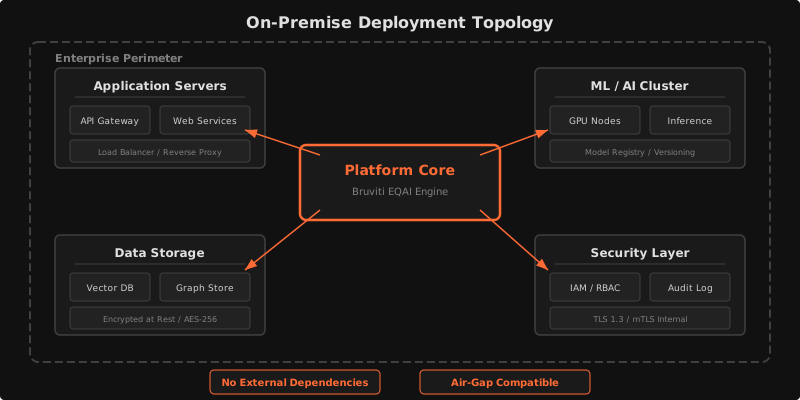
Each subsystem is independently deployable and scalable. In resource-constrained environments, subsystems can share compute. In high-throughput environments, each subsystem scales to dedicated hardware.
Infrastructure Components
The deployment architecture includes several infrastructure components that sit alongside the platform core and enable secure communication between layers.
LLM Integration
Large language models are deployed within the infrastructure layer, accessed through a secure API layer that enforces authentication, rate limiting, and audit logging. The platform supports multiple LLM deployment patterns:
- On-premise LLMs — open-weight models (e.g., Llama, Mistral) deployed on enterprise GPU infrastructure. Full control over model weights, no data leaves the environment.
- Private cloud LLMs — models hosted in the enterprise's dedicated cloud environment with network isolation and encryption at rest/in transit.
- Edge SLMs — small language models optimized for edge device hardware. Used for local inference in the progressive disclosure architecture.
Secure API Layer
All inter-layer communication passes through a secure API layer that provides:
- Authentication and authorization for every API call
- Encrypted transport (TLS) for all data in transit
- Request/response audit logging for compliance and debugging
- Rate limiting and throttling to protect downstream services
- API versioning to support rolling upgrades without downtime
Model Registry
A central registry tracks all deployed models, their versions, performance metrics, and lineage. The registry supports:
- Version management — multiple model versions can be deployed simultaneously for A/B testing or gradual rollout
- Rollback — any model version can be rolled back to a previous version if performance degrades
- Lineage tracking — traces which training data and parameters produced each model version
- Evaluation gates — models must pass defined evaluation thresholds before promotion to production
Model independence: The platform is not locked to any specific LLM provider. Models can be swapped, upgraded, or replaced without changes to the application layer. The secure API layer abstracts model endpoints, so agents and workflows interact with a consistent interface regardless of the underlying model.