



Your fab is air-gapped for a reason. Your AI should be too.
Bruviti’s AI Operating Layer runs entirely inside your facility perimeter: inference, reasoning, knowledge base and model improvement, with no external connectivity required.
Semiconductor fabs, memory manufacturing facilities and precision equipment floors operate under constraints that cloud AI was never designed to meet. Equipment telemetry, process data and fault history cannot leave the facility, yet the AI still has to answer in seconds and keep improving. The AI Operating Layer was architected from day one to be data sovereign and air-gappable, so every production operation runs locally.
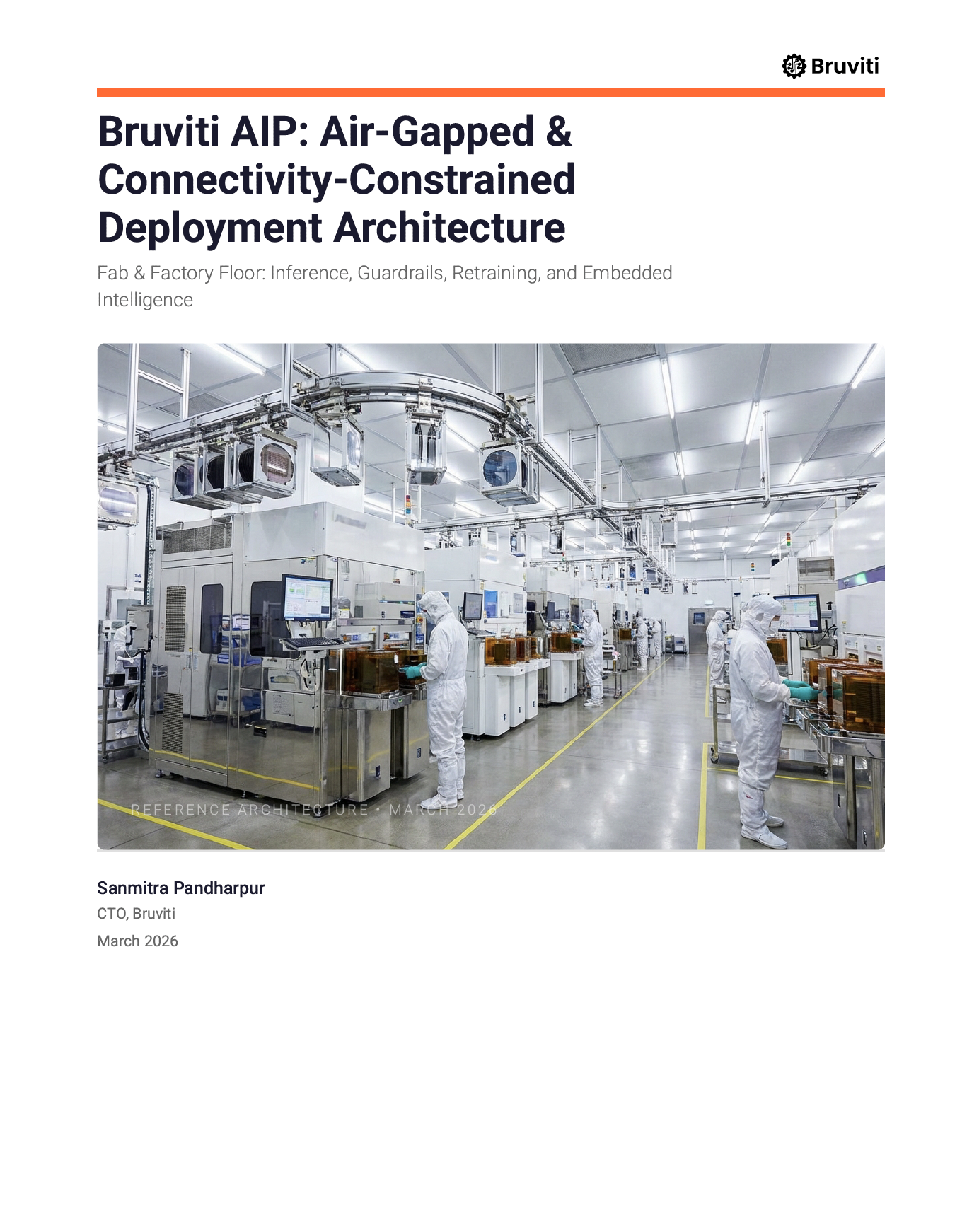
How inference, guardrails and retraining work without a network connection
The deployment questions that stop AI projects in air-gapped facilities: hardware requirements, data sovereignty, model drift and compliance controls. 17 pages that answer all of them, with the architecture to back it up.
A four-layer architecture with zero external dependencies
Inference, retrieval, monitoring and model improvement all run inside the facility. Data flows inbound only.
Protocols
OPC-UA
SECS/GEM
Modbus TCP
Historians
OSIsoft PI
Aveva
Honeywell PHD
Feeds
MES
LIMS
Models
Quantized language models
Tuned for industrial inference
Knowledge
Local vector store
Facility-specific retrieval
Hardware
1–2U rack unit
NVIDIA L4 or equivalent
Monitoring
KPI baselines
Degradation detection
Retraining
Structured requests
No human monitoring
Audit
Every decision logged
Confidence scores
Updates
LoRA adapters
Base model unchanged
Delivery
Scheduled sync windows
Secure USB
Security
Signed artifacts
Validated before deployment
Related articles

Frequently asked questions
How does AI work in an air-gapped manufacturing environment?
All inference, reasoning and knowledge base operations run on hardened rack-mounted servers inside the facility perimeter. Local vector stores hold equipment manuals, fault histories and process documentation. No internet connectivity is required for any production AI operation.
Can AI models improve without internet connectivity?
Yes. KPI guardrails monitor model performance and detect degradation automatically, then generate structured retraining requests. Updates arrive as LoRA adapters of 10 to 50MB through scheduled connectivity windows or secure USB, so models improve on a cycle of days to weeks rather than months.
Does any data leave the facility?
No. Equipment telemetry, process data and fault history stay inside your infrastructure. Outbound sync contains only anonymized operational metadata, and all model artifacts are cryptographically signed and validated before deployment.
What deployment options exist for AI in semiconductor fabs?
The same architecture adapts to the full connectivity spectrum: fully air-gapped with updates via secure USB, scheduled sync windows during maintenance periods, segmented DMZ with a controlled relay, or intermittent connectivity with store-and-forward.
How does air-gapped deployment meet ITAR and EAR compliance?
Controlled technical data never transits commercial internet infrastructure and the facility keeps full custody of its data. NIST SP 800-82 OT/IT separation is enforced architecturally, and Bruviti is SOC 2 Type II certified.
What hardware is needed for on-premise inference?
A typical deployment uses a 1U or 2U rack-mounted server with an NVIDIA L4 or equivalent GPU. Optional ARM-based edge nodes can run closer to equipment. Quantized models remove the need for cloud-scale GPU clusters.
How long does deployment take?
Phase 1 deploys in 6 weeks. Forward-deployed engineers embed with your facility team, and the system is validated against your historical fault case library before go-live.