
Network downtime costs millions per hour. Your inventory system needs telemetry-driven forecasting, not spreadsheet guesswork.
Bruviti deployment data shows AI parts forecasting for network equipment hits 85% auto extraction accuracy from manuals and BOMs, so builders skip manual catalog tagging. The pipeline ingests existing parts data, structures it automatically, and feeds a demand model that improves planning without a hand-built taxonomy first.
Inventory systems run on monthly sales reports, ignoring SNMP traps, syslog streams, and firmware error patterns that predict component failures weeks before they happen.
Closed inventory platforms force you to accept black-box algorithms that can't account for firmware releases, EOL product transitions, or seasonal traffic spikes in your customer base.
Regional warehouses operate as independent systems with no unified API, forcing you to build separate connectors for each location's Oracle or SAP instance.
Bruviti's SDK gives you Python and TypeScript libraries to build demand forecasting pipelines that ingest SNMP telemetry, parse syslog error patterns, and train models on historical failure data. The platform provides pre-trained foundation models for network device degradation, but you own the training loop. Feed it your firmware release schedules, customer install base demographics, and seasonal usage patterns. The API returns location-specific demand forecasts that integrate directly with SAP MM or Oracle Inventory via standard REST endpoints.
The architecture is headless by design. Deploy the forecasting engine in your own AWS or Azure environment, or use Bruviti's managed inference tier. Either way, your data never leaves your control. Models export to ONNX, so you can run predictions in your existing microservices without API dependencies. Update the model weekly using your CI/CD pipeline, not a vendor's release schedule.

Forecasts router and switch component demand by warehouse location using device telemetry, firmware release cycles, and regional traffic patterns to optimize stock placement.
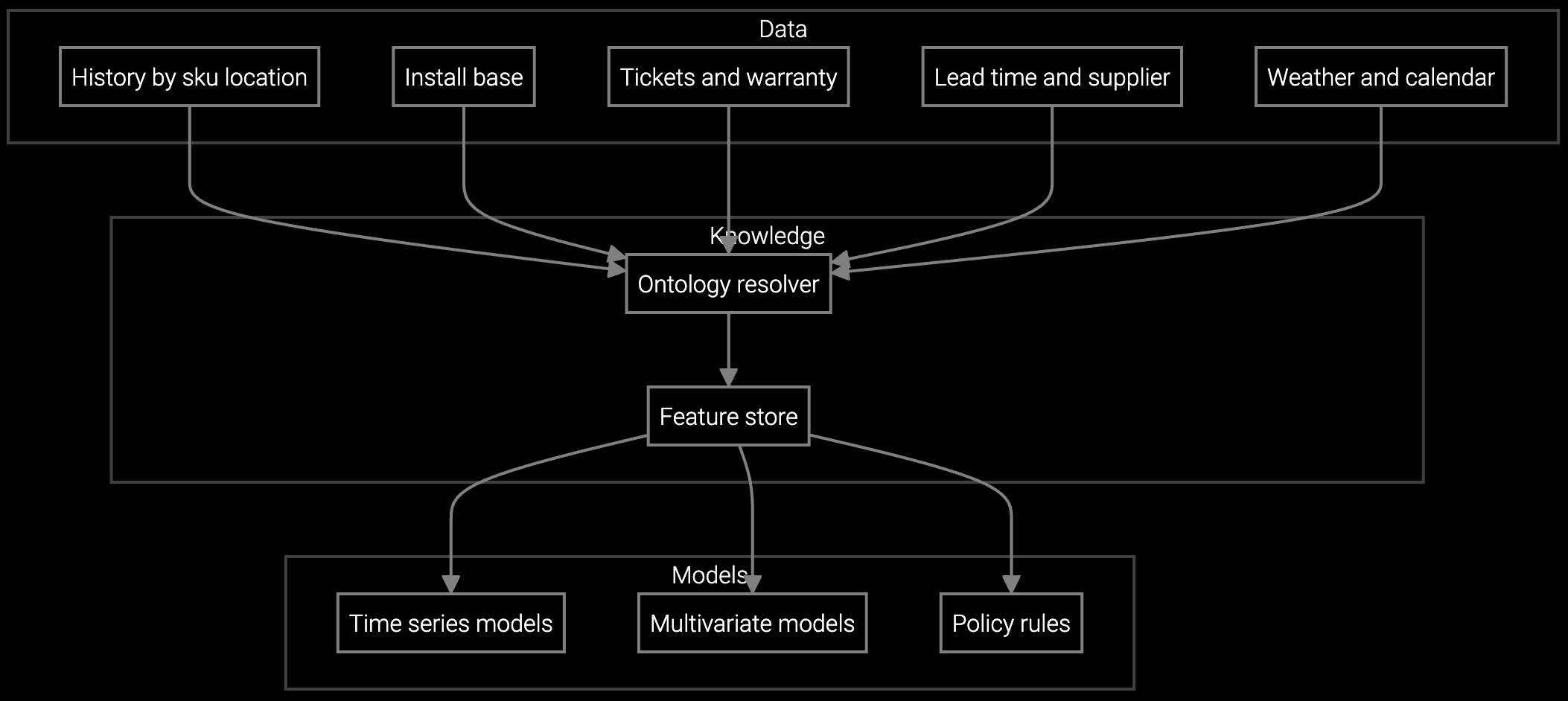
Projects power supply, fan, and line card consumption based on installed base age, error log patterns, and firmware vulnerability schedules for network equipment fleets.

Identify network hardware components from field photos to accelerate RMA processing and parts ordering when device labels are damaged or missing from older equipment.
Network equipment OEMs manage tens of thousands of SKUs across router chassis, switch modules, transceiver types, and firmware-specific components. A single 5G base station failure can trigger demand for 40+ different parts depending on the error signature. Traditional inventory systems treat each SKU independently, missing the correlation between SNMP temperature warnings and power supply failures three weeks later.
Deploy Bruviti's forecasting API by first ingesting six months of historical syslog and SNMP trap data from your NOC. Train initial models on power supply, fan, and transceiver failure patterns, then expand to line cards and chassis components. Use the SDK to build custom feature pipelines that incorporate firmware CVE release schedules and customer SLA tiers. High-priority customers with five-nines SLA contracts drive different parts positioning than best-effort installations.
The platform ingests SNMP traps, syslog streams, firmware error logs, and historical RMA records. You can optionally feed customer install base demographics, warranty contract data, and firmware release schedules to improve forecast accuracy. All data connectors use REST APIs with standard authentication.
Yes. The Python SDK exposes the training loop, so you can add custom features like firmware version, device uptime, temperature trends, or customer SLA tier. The platform provides pre-trained foundation models for common network device failure patterns, but you control feature engineering and model retraining frequency.
The API returns forecast outputs as JSON objects with part number, location, time window, and confidence intervals. You write the connector to your ERP system using standard REST calls. Bruviti provides sample Python and TypeScript code for SAP MM and Oracle Inventory integrations, but you own the data pipeline and can deploy it in your own cloud environment.
All models export to ONNX format, so you can run inference without Bruviti's API once trained. The SDK uses open-source Python libraries, and you can switch to another ML platform by retraining on the same data. Your telemetry pipelines and ERP connectors remain independent of Bruviti's infrastructure.
Most network equipment OEMs complete a pilot in 6-8 weeks. Week 1-2: Connect telemetry sources and load historical data. Week 3-4: Train initial models on high-volume parts. Week 5-6: Build ERP integration and validate forecasts. Week 7-8: Run parallel with existing system and measure accuracy improvement.

SPM systems optimize supply response but miss demand signals outside their inputs. An AI operating layer makes the full picture visible and actionable.

Advanced techniques for accurate parts forecasting.

AI-driven spare parts optimization for field service.
Get API access and technical documentation to build telemetry-driven demand forecasting for your network equipment parts inventory.
Request API Keys