
Network downtime costs customers millions per hour—your technicians need AI that integrates without ripping out existing FSM systems.
AI-assisted dispatch cuts pre-dispatch prep to under 2 minutes and reduces parts returns by 25%, per Bruviti deployment data. Network equipment OEMs wire fault data, parts prediction, and technician guidance into one workflow so the right part and fix reach the right tech on the first visit, before the truck rolls.
Proprietary field service management systems trap you in closed ecosystems. Adding AI requires vendor-specific plugins with limited customization. Your team can't extend functionality or integrate with modern telemetry streams.
Network equipment OEMs run on complex SAP and Oracle stacks. Field service AI must pull from parts inventory, warranty entitlements, and service history across fragmented databases. Building custom ETL pipelines consumes engineering resources.
Pre-trained models for parts prediction and failure detection don't account for your specific router firmware versions or SNMP trap patterns. When predictions fail, you can't retrain or inspect the model logic.
Bruviti provides API-first field service AI that integrates with existing FSM systems through Python and TypeScript SDKs. Ingest telemetry from SNMP traps, syslog streams, and warranty databases using standard data connectors. Deploy predictive models for parts forecasting and technician guidance without ripping out ServiceMax, Oracle Field Service, or custom dispatch systems.
The platform exposes RESTful endpoints for work order enrichment, parts prediction, and knowledge retrieval. Your developers build custom mobile apps for technicians using standard HTTP calls—no proprietary mobile SDKs required. Retrain models on your specific router configurations and failure patterns using open Python libraries. All training data and model weights stay in your environment.

Predict which router components technicians will need based on error logs and warranty history before dispatch to customer NOCs.
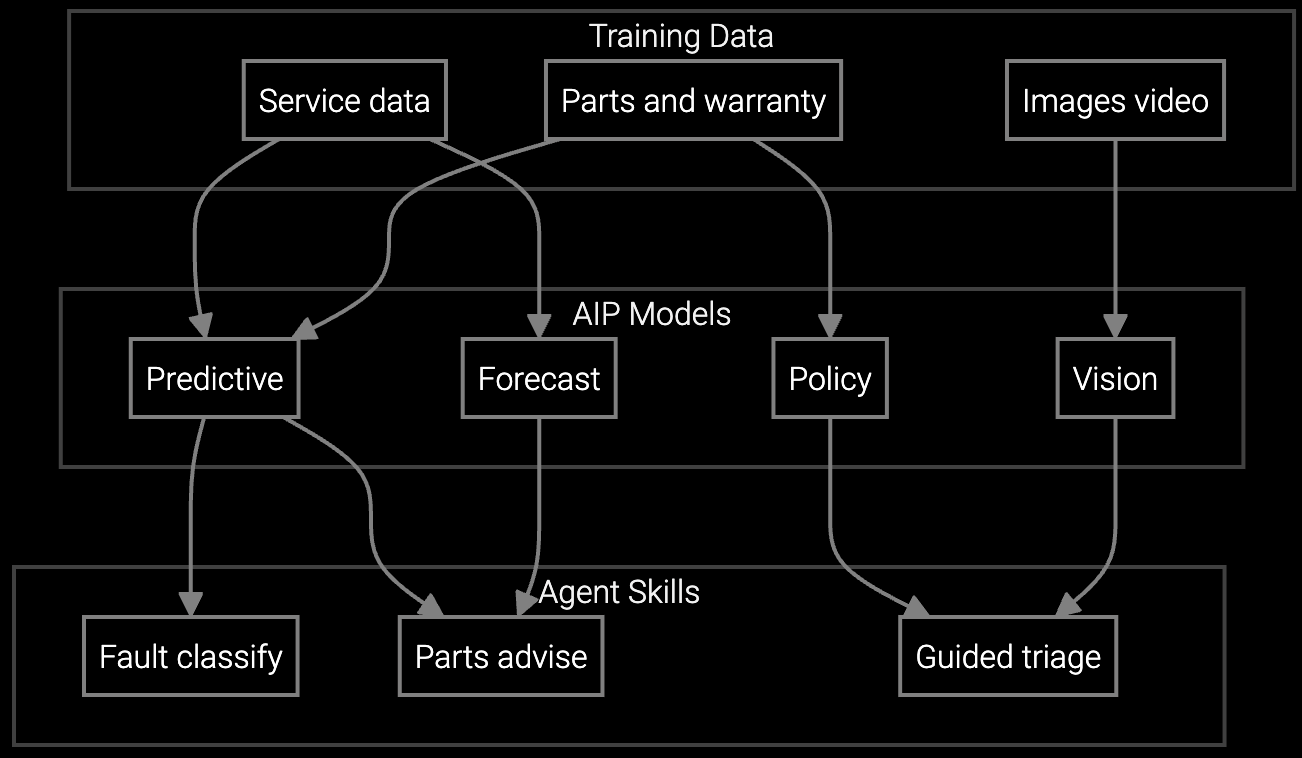
Mobile copilot surfaces firmware rollback procedures and SNMP diagnostic commands during on-site escalations at data centers.

Correlate current switch symptoms with historical failure patterns in your network engineering knowledge base for faster diagnosis.
Network equipment generates syslog events, SNMP traps, and firmware crash dumps at massive scale. Field service AI must ingest this telemetry in real time to predict component failures before customer-impacting outages. Standard FSM systems weren't built for streaming log analysis or firmware vulnerability correlation.
Bruviti's data connectors parse syslog streams and SNMP trap databases using configurable Python adapters. Map MIB objects and error codes to parts consumption patterns without writing custom ETL jobs. Deploy streaming pipelines that flag anomalous PoE behavior or optical transceiver degradation hours before technician dispatch. Your developers control the data flow using standard Apache Kafka or RabbitMQ integrations.
Bruviti provides native SDKs for Python and TypeScript with full API coverage. REST APIs support any language with HTTP client libraries. All endpoints use OpenAPI 3.0 specifications for auto-generated client code in additional languages.
Bruviti exposes webhook endpoints and polling APIs for work order enrichment. Pre-built connectors for ServiceMax and Oracle Field Service sync technician assignments, parts inventory, and job status bidirectionally. Your developers configure field mappings using JSON configuration files without custom code.
Yes. Bruviti provides Python libraries for model retraining using your proprietary telemetry data and failure histories. Train custom models for specific product lines or firmware versions. All training happens in your environment—model weights and training data never leave your infrastructure.
Parts prediction models ingest warranty entitlements, historical parts consumption, error logs, and firmware versions. Optional data sources include SNMP trap histories, environmental sensors, and technician debrief notes. The platform provides data quality dashboards showing coverage gaps and prediction confidence scores.
Pilot deployments with pre-built connectors and standard telemetry sources take 4-6 weeks from kickoff to production. Custom integrations with legacy ERP systems or proprietary FSM platforms may extend timelines to 8-12 weeks. Bruviti provides technical architects to accelerate data pipeline setup during initial implementation.

How AI bridges the knowledge gap as experienced technicians retire.

Generative AI solutions for preserving institutional knowledge.

AI-powered parts prediction for higher FTFR.
Talk to our technical architects about Python SDKs, API architecture, and deployment options for your FSM stack.
Schedule Technical Deep Dive