
Manual case classification delays resolution when network downtime costs thousands per minute.
Bruviti auto-summarizes 85% of network support cases in under 7 seconds, per Bruviti deployment data. AI-powered case routing reads each ticket, pulls the device context, and hands agents a ready summary so they resolve faster instead of re-reading history. Implementation wires into your existing case system without rebuilding the support stack.
Case data lives in Salesforce, telemetry in Splunk, device configs in NetBox, and SNMP traps in Nagios. Building a unified view requires custom ETL pipelines and constant schema reconciliation.
Generic NLP models fail on network equipment terminology. Training custom classifiers on firmware versions, CVE references, and device families demands domain-specific feature engineering.
Support SLAs demand sub-second routing decisions. Batch processing and heavyweight model inference introduce unacceptable delays for critical network outages.
The platform exposes a REST API endpoint that accepts case payloads from your CRM webhook. The request body includes case description, customer account ID, and optional telemetry context. The classifier returns routing recommendations with confidence scores in JSON format.
Training happens via Python SDK. You ingest historical case data labeled with resolution teams, then fine-tune a pretrained language model on network equipment vocabulary. The SDK handles feature extraction from device logs, SNMP trap patterns, and firmware version strings without custom NLP engineering.
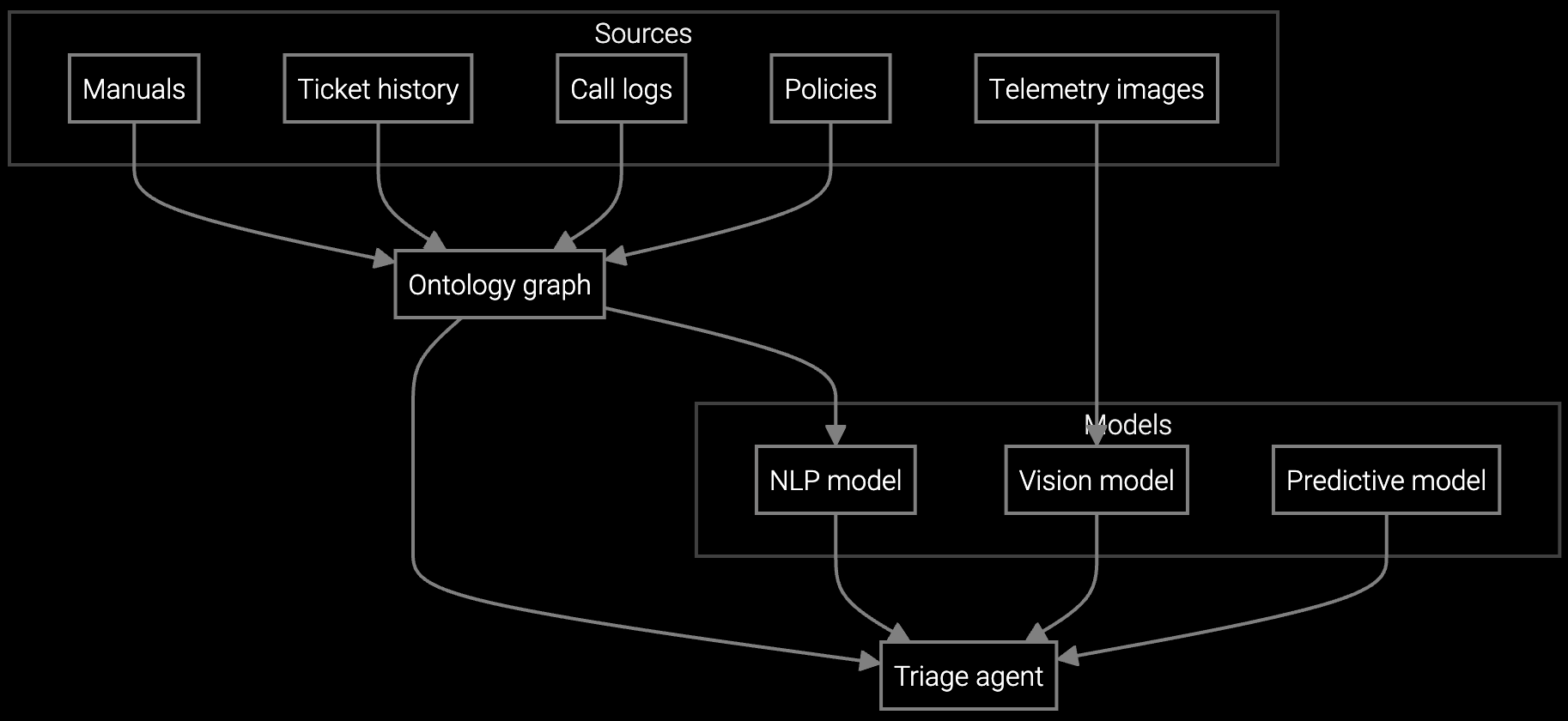
Autonomous case classification analyzes SNMP traps, syslog patterns, and device firmware versions to route network equipment issues to hardware, software, or configuration teams.

AI reads customer emails describing network outages, correlates device telemetry from your NOC, and drafts responses with diagnostic steps specific to the affected router or switch model.
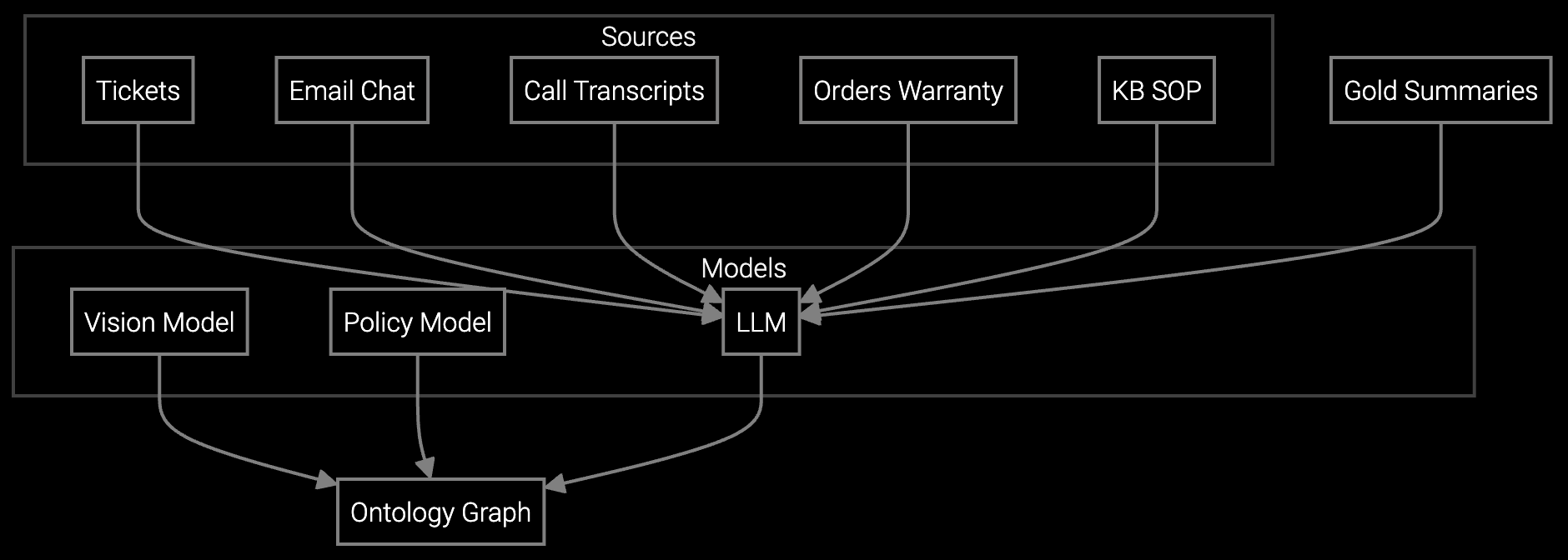
Instantly generates summaries from multi-channel case histories including chat logs, email threads, and RMA documentation so agents understand complex escalations without reading everything.
Network equipment support generates structured telemetry from SNMP polling, syslog streams, and device APIs. The platform ingests these via webhook listeners or batch ETL jobs. Case classification uses both unstructured text (customer descriptions) and structured signals (trap OIDs, error codes) to determine routing.
For network OEMs, the highest-value training data comes from cases where firmware CVEs, configuration drift, or capacity saturation drove the root cause. Labeling these accurately improves classifier precision on hardware versus software issues.
The platform provides Python and TypeScript SDKs for model training and inference. REST APIs accept standard JSON payloads, so any language with HTTP client libraries can integrate for case routing.
Bruviti uses standard REST APIs and open data formats. You can export trained models as ONNX files and run inference in your own environment. No proprietary runtimes or closed-source dependencies are required.
Yes. The Python SDK supports incremental training where you add new labeled cases to the existing corpus and retrigger fine-tuning. Updated models deploy via API version management without downtime.
API response times are typically under 300ms for case classification requests. Latency depends on payload size and network round-trip time, but the inference engine is optimized for sub-second decisions.
The model uses subword tokenization to infer meaning from device families, firmware versions, and CVE identifiers even when exact strings are novel. You can also provide custom vocabulary lists during training to improve handling of proprietary product names.

Understanding and optimizing the issue resolution curve.

Part 1: The transformation of IT support with AI.

Part 2: Implementing AI in IT support.
Talk to our technical team about API access, SDK documentation, and sandbox environments.
Schedule Technical Demo