
Hyperscale operators lose $2M+ annually per facility to stockouts and expedited shipping when predictive models fail.
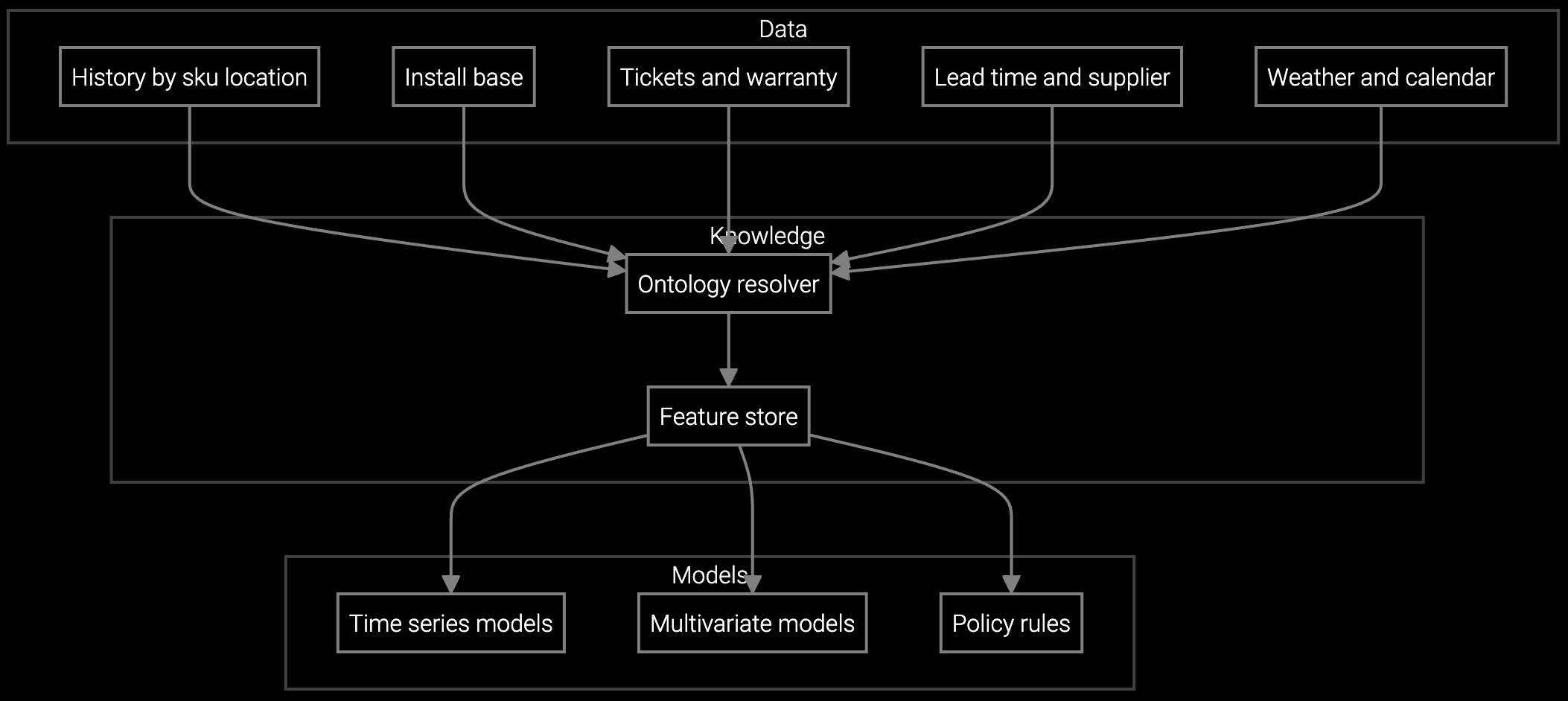
Bruviti deployment data shows AI-driven parts forecasting cuts planning cycle time by 80% for data center hardware. The system ingests install-base, failure, and consumption data, then forecasts demand per SKU so planners replan in hours, not days. Deployment data ties the speedup directly to automated demand modeling replacing manual spreadsheets.
SAP and Oracle connectors require custom code for every data field. Each IPMI vendor formats telemetry differently. Your team spends months building parsers instead of forecasting models.
Vendor-provided ML models predict drive failures but won't expose feature importance or accept your custom telemetry streams. When accuracy drops for new server generations, you're stuck waiting for vendor updates.
Each regional data center runs separate inventory systems. No API aggregates parts availability across locations. Engineers manually check six warehouses to find a power supply, delaying server repairs by 12+ hours.
Bruviti provides Python and TypeScript SDKs that ingest BMC telemetry (IPMI, Redfish, SNMP) and connect to existing ERP systems without vendor lock-in. The platform exposes REST APIs for failure prediction, demand forecasting, and multi-location inventory queries. Pre-trained models handle drive, memory, and power supply failures out of the box, but you control feature engineering and can retrain on your own telemetry data.
The headless architecture integrates with SAP, Oracle, and custom data lakes through standard connectors. Deploy models as containerized microservices in your infrastructure or use managed endpoints. Real-time inventory sync APIs aggregate parts availability across warehouses, returning substitute part suggestions when exact matches are unavailable. Webhook triggers automate reorder workflows when forecasted demand crosses threshold levels.

Forecast drive and memory demand by data center location using SMART telemetry and server age distributions, reducing expedited shipping costs by 62%.
Project power supply and cooling fan consumption based on thermal data and PUE trends across hyperscale facilities, optimizing regional warehouse stock levels.

Snap a photo of a failed DIMM or PDU component and get instant part number identification plus substitute compatibility checks across SKUs.
Data center OEMs manage spare parts across hundreds of customer facilities spanning multiple geographies. Drive failure rates vary by workload intensity and thermal conditions. Memory failures cluster in specific DIMM slots due to power distribution anomalies. Power supply longevity depends on PUE efficiency and load fluctuations.
The platform ingests BMC telemetry streams at scale, processing SMART data, thermal sensors, and voltage readings in real-time. Machine learning models correlate IPMI logs with historical RMA data to predict component-level failures 14-30 days ahead. Regional inventory APIs aggregate parts availability across warehouses, factoring in customer SLA requirements and shipping transit times when recommending stock positioning.
The Python SDK ingests IPMI, Redfish, SNMP, and Syslog streams from major BMC vendors including Dell iDRAC, HPE iLO, and Supermicro IPMI. Custom parsers can be added via the SDK for proprietary telemetry formats. All data is normalized to a standard schema before model inference.
Yes. Bruviti provides model training APIs that accept labeled failure events and custom feature sets. You can fine-tune pre-trained models or build new models from scratch using the platform's AutoML capabilities. All trained models export to ONNX format for deployment flexibility.
The inventory API connects to regional warehouse systems via REST endpoints or database replication. Real-time queries aggregate parts availability across locations, returning results ranked by shipping time and cost. The system suggests substitute parts when exact SKU matches are unavailable at the nearest warehouse.
All data pipelines run in Docker containers deployable to any Kubernetes cluster. Models export to standard formats including ONNX and TensorFlow SavedModel. APIs follow OpenAPI specifications. You retain full ownership of trained models and can migrate to self-hosted infrastructure at any time.
Most teams complete BMC telemetry ingestion and ERP connectivity within 4-6 weeks using pre-built SDKs. First forecasting models deploy to production in 8-12 weeks. The platform includes sandbox environments and sample data sets to accelerate proof-of-concept development.

SPM systems optimize supply response but miss demand signals outside their inputs. An AI operating layer makes the full picture visible and actionable.

Advanced techniques for accurate parts forecasting.

AI-driven spare parts optimization for field service.
Get SDK access and technical documentation to start integrating predictive inventory APIs with your data center infrastructure.
Access Developer Portal