
Chamber kits and consumables now cost $50M+ per fab to stock—yet stockouts still cascade into million-dollar downtime events.
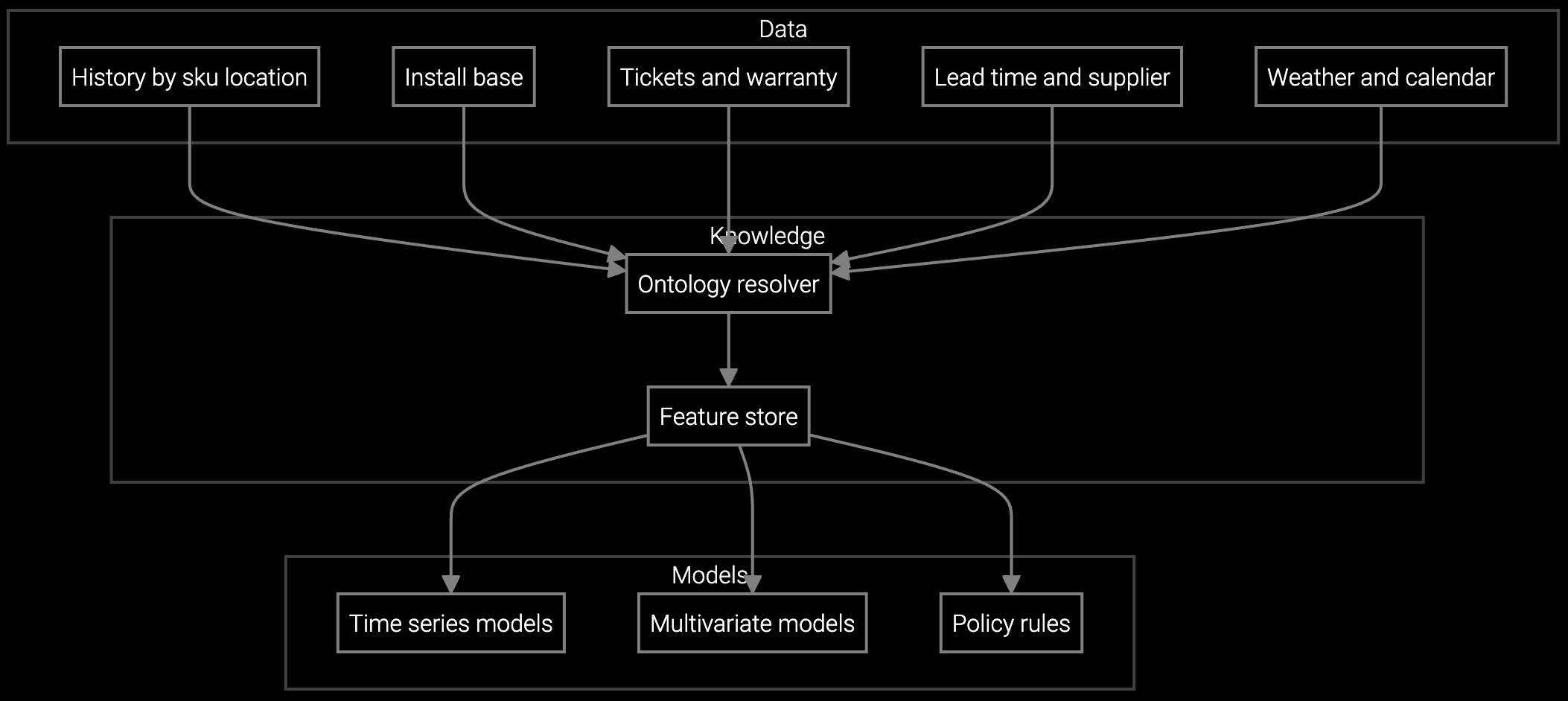
AI parts forecasting integrated with semiconductor fab systems cuts the planning cycle 80% faster, per Bruviti deployment data. Builders wire demand signals, ERP, and PO data into one forecasting layer so planners refresh service-parts plans in minutes instead of days, without ripping out existing inventory systems.
SAP MRP runs historical averages, but when process engineers tweak etch recipes to hit 3nm yield targets, chamber consumable burn rates shift overnight. Standard reorder points fail because they can't see what's changing in the fab.
Each fab runs its own Oracle instance with separate part numbering and no cross-site visibility. When Fab 2 stockouts a showerhead, Fab 4 might have three on the shelf—but no system connects them in time to prevent a $2M downtime event.
Vendor-hosted forecasting tools ingest your telemetry but won't let you retrain models when you launch a new product line. You can't extend the logic, can't export the weights, and can't switch without rebuilding everything from scratch.
Bruviti's platform exposes demand forecasting, substitute matching, and inventory optimization as REST endpoints that plug into your existing ERP stack. You send us chamber sensor telemetry, maintenance logs, and process engineer notes via JSON; we return demand predictions by part number, fab location, and time horizon. Our Python SDK lets your data engineers customize models for product-specific burn rates and retrain on new recipe data without breaking the integration.
Deploy the connector as a Docker container in your on-prem environment or call our API from SAP Cloud. Either way, you own the pipeline—swap us out for an in-house model when you're ready, or run Bruviti alongside legacy forecasting and blend the outputs. No proprietary data formats, no mandatory dashboards, just clean APIs returning structured predictions you can route wherever your planning logic lives.

Forecasts chamber kit and consumable demand by fab location and process recipe, optimizing stock levels while cutting carrying costs for high-value semiconductor components.
Projects consumable burn rates based on installed tool age, wafer throughput, and recipe complexity, preventing stockouts that cascade into million-dollar downtime.

Snap a photo of a showerhead or electrode assembly and instantly retrieve part numbers, substitute options, and cross-fab availability for rapid sourcing decisions.
Semiconductor tools generate 10,000+ sensor readings per wafer pass, and every recipe tweak shifts consumable consumption curves. Standard ERP forecasting averages historical data, missing the real-time process changes that drive chamber kit demand. Integrating AI forecasting means piping FDC (Fault Detection and Classification) telemetry, SECS/GEM equipment logs, and MES recipe parameters into the model—then reconciling those predictions with SAP MM planning buckets and Oracle's min/max logic.
The technical challenge is data schema alignment: your ERP tracks part numbers and lead times, but the AI model needs chamber runtime hours, plasma strike counts, and wafer starts by product node. The integration layer must transform fab telemetry into inventory signals, then map demand forecasts back to ERP reorder triggers without creating duplicate planning logic that drifts over time.
The platform ingests SECS/GEM equipment logs (chamber runtime, plasma strike counts), MES recipe parameters (etch time, gas flow rates), and maintenance history (PM intervals, kit replacement dates). You can stream this via REST API or batch-upload CSV files from your data lake. The Python SDK includes sample extractors for Applied Materials and Lam tools.
The forecasting model correlates recipe parameters (power, pressure, gas mix) with actual part replacement intervals. When process engineers update a recipe, the API accepts the new parameter set and projects the demand shift within 24 hours. Your data team can retrain models using our Python SDK to fine-tune sensitivity for specific product nodes or tool types.
Yes. The platform ships as a Docker container you can deploy in your fab's on-prem Kubernetes cluster. It connects to your local SAP or Oracle instance without routing data externally. Model updates are packaged as container images you pull and deploy on your schedule, keeping all telemetry and predictions inside your network.
The API uses standard JSON schema and doesn't require proprietary clients. Your integration code can point at a different endpoint without refactoring. The Python SDK is open-source, so you can replicate the data pipeline and substitute your own ML models. No lock-in—just clean interfaces you control.
Pilot deployments typically run 8–12 weeks. Week 1–2: Schema mapping and connector setup. Week 3–6: Model training on historical telemetry and validation against manual planner adjustments. Week 7–10: Side-by-side testing in production with human override. Week 11–12: Full cutover and rollout to additional fabs. Pre-built SAP connectors accelerate the first two phases significantly.

SPM systems optimize supply response but miss demand signals outside their inputs. An AI operating layer makes the full picture visible and actionable.

Advanced techniques for accurate parts forecasting.

AI-driven spare parts optimization for field service.
Talk to our integration team about API endpoints, data schemas, and deployment options for your ERP stack.
Schedule Technical Demo