
When $1M-per-hour downtime meets unpredictable chamber kit failures, reactive inventory planning becomes the bottleneck.
Implement demand forecasting models that analyze equipment sensor data, preventive maintenance schedules, and chamber kit usage patterns to predict part failures before they occur, maintaining optimal stock levels without excess carrying costs.
Etch and deposition chambers degrade non-linearly based on recipe intensity, process gas chemistry, and wafer throughput. Static reorder points miss the complexity, creating either stockouts or dead inventory.
Parts sit idle in one fab while another expedites overnight shipments. Without unified visibility and intelligent substitute matching, you pay twice for the same inventory problem.
RF generators, mass flow controllers, and vacuum components have 16-week lead times but 3-year shelf lives. Overstocking locks capital in parts that may never get used before EOL.
The platform ingests time-series data from tool sensors, SECS/GEM interfaces, and PM cycle logs to model component degradation trajectories. Instead of static safety stock rules, machine learning algorithms correlate process chamber hours, recipe transitions, and environmental conditions with historical part consumption. The models output location-specific demand forecasts with confidence intervals, enabling dynamic reorder points that adapt to actual equipment stress.
Developers connect via Python SDKs to integrate forecasts into SAP or Oracle inventory systems without rebuilding data pipelines. The architecture exposes REST APIs for substitute part matching, allowing custom logic to route availability checks across warehouse networks. Because models retrain on production data nightly, forecast accuracy improves as the fab scales or shifts product mix, without vendor dependencies or black-box tuning.

Forecasts chamber kit demand by correlating SECS/GEM process hours with historical replacement cycles across fab tool fleets.
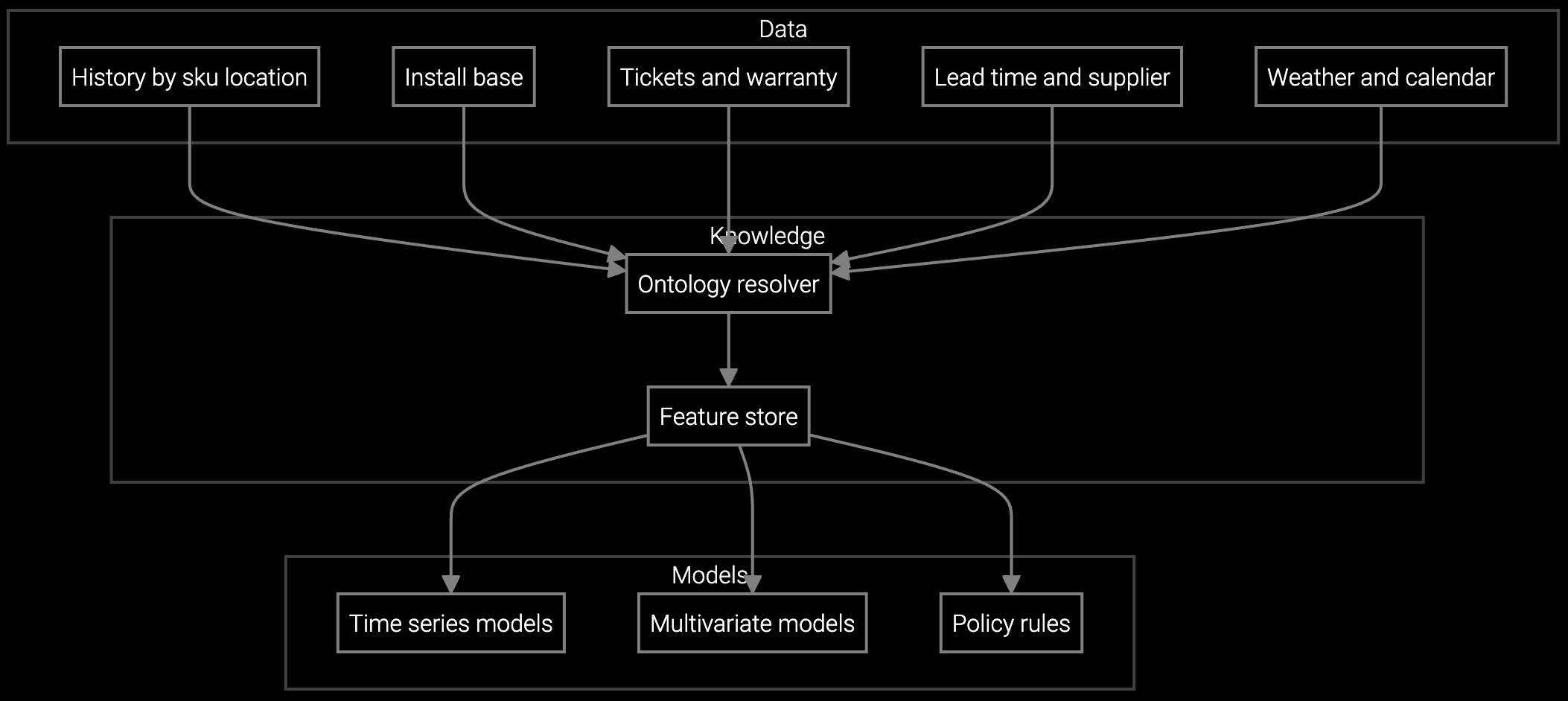
Projects consumable usage based on installed base age, wafer starts per week, and recipe complexity trends.

Snap a photo of a failed RF generator module and instantly retrieve part numbers, substitute options, and stock locations.
Leading-edge fabs generate 2TB of tool telemetry per day across lithography steppers, etch chambers, and metrology equipment. The platform's time-series ingestion layer handles SECS/GEM, OPC UA, and proprietary Equipment Data Collection formats without custom ETL scripting. Developers configure connectors via YAML, pointing to MQTT brokers or historian databases already in place.
For chamber kits on ASML lithography tools or Applied Materials etch systems, the models factor in exposure dose accumulation, wafer throughput by product node, and scheduled PM intervals. Because semiconductor recipes change as process engineers optimize for yield, the forecasting engine detects drift in consumption patterns and flags retraining triggers automatically, maintaining accuracy through ramp-to-volume transitions.
The platform uses transfer learning from similar tool families and bootstraps predictions from PM schedule data until enough actual failures accumulate. For entirely new equipment, you can seed models with OEM-recommended replacement intervals and the system refines as real telemetry arrives. This prevents cold-start forecast gaps during technology node transitions.
Yes. The Python SDK exposes training pipelines as functions you can call with custom datasets. Upload labeled failure events, trigger retraining via API, and deploy updated models to production endpoints. All model artifacts remain in your environment, preventing data leakage to third-party services.
The platform includes batch connectors for SAP IDoc, Oracle XML Gateway, and flat-file export formats. For legacy systems, you can schedule nightly forecast uploads and consume results via SFTP or database views. While real-time integration is ideal, batch modes still deliver significant carrying cost reductions compared to manual planning.
All forecast outputs follow open schema standards, and training data remains in your data lake. Model weights export as ONNX or PMML for portability. The architecture separates ingestion, inference, and inventory integration layers, so replacing the forecasting engine doesn't require rewriting SAP connectors or telemetry pipelines.
Yes. The substitute matching API uses equipment compatibility matrices and OEM cross-reference tables to suggest alternatives. You can extend matching logic with custom rules for fab-specific qualifications or supplier preferences. Substitutes appear inline with availability checks, reducing manual lookup time during urgent orders.

SPM systems optimize supply response but miss demand signals outside their inputs. An AI operating layer makes the full picture visible and actionable.

Advanced techniques for accurate parts forecasting.

AI-driven spare parts optimization for field service.
See how Bruviti's platform integrates with your telemetry infrastructure and ERP systems.
Schedule Technical Demo