
When a $1M/hour etch tool sits idle waiting for a chamber kit, every minute counts.
AI service-parts forecasting lifts fab fill rates to 95-98%+ and cuts stockouts by 40%, per Bruviti deployment data. Operators get model-driven reorder signals per SKU so critical parts are on the shelf when a tool goes down, ending the scramble for emergency expedites and missing components.
Process chamber components degrade unpredictably based on recipe parameters and wafer throughput. When a critical part fails without warning, your storeroom either has the replacement or your tool goes down.
Equipment vendors discontinue chamber parts without providing cross-reference guides. You're left searching maintenance logs and calling senior techs to figure out what actually fits.
Your fab has three storerooms plus a regional warehouse. Checking availability means opening four different systems while the service call timer runs.
The platform analyzes process telemetry from your deposition and etch tools to predict when chamber kits will need replacement. It learns the actual consumption patterns for showerheads, focus rings, and liner kits based on your specific recipes and throughput levels. When a part is approaching its end of life, the system flags it before the PM window arrives.
For EOL and discontinued parts, the platform matches substitutes by analyzing maintenance records showing what actually worked in past installations. Instead of searching through PDFs or calling vendors, you get instant cross-references based on real usage data. When multiple locations carry the same part, the system shows a unified view with current counts and transit times, eliminating the swivel-chair hunt across inventory systems.

Forecast chamber kit demand by fab location and production schedule, optimizing stock levels for high-value components while reducing carrying costs.

Snap a photo of a showerhead or liner kit to get instant part number identification and availability across your fab network.
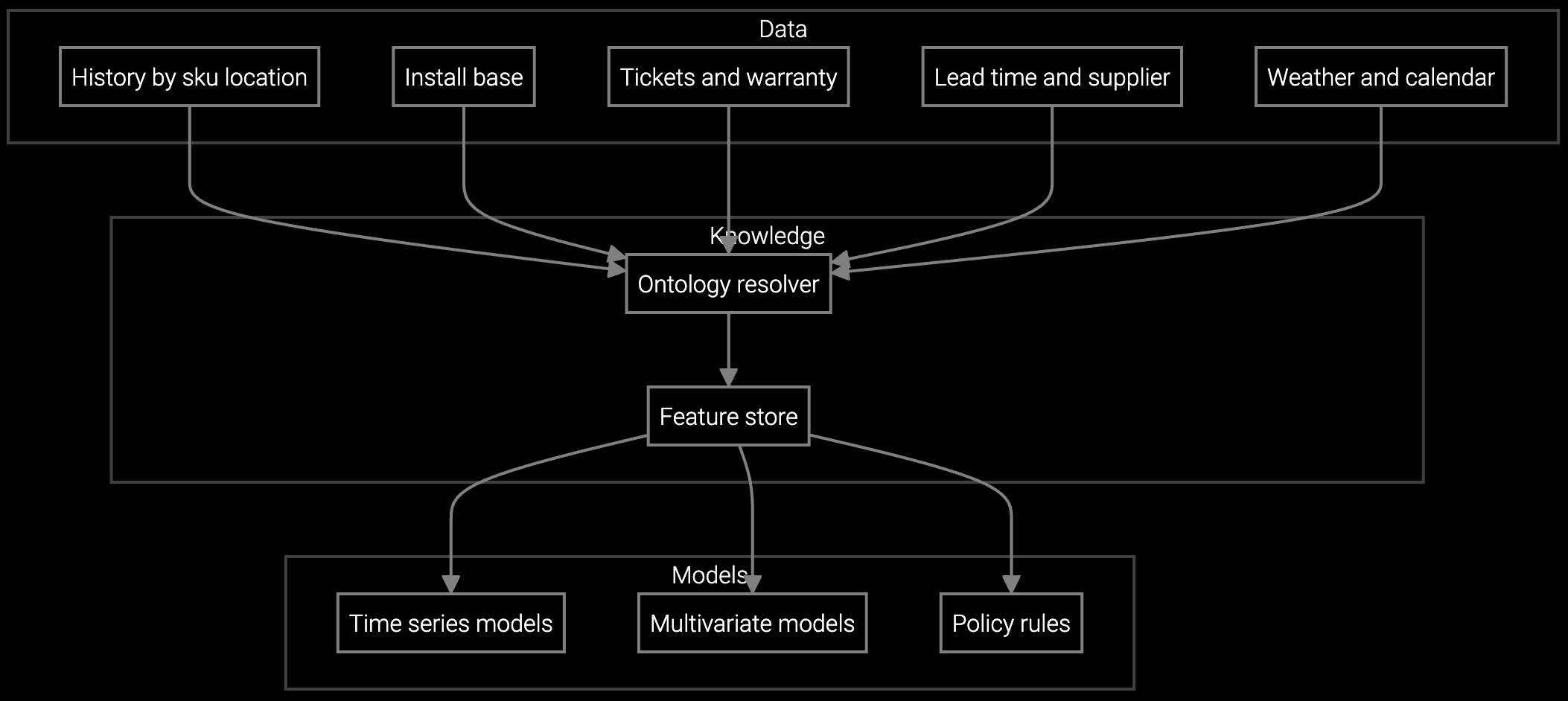
Project consumable needs based on tool runtime hours, wafer throughput, and recipe parameter intensity to prevent stockouts.
Semiconductor manufacturing equipment operates in an environment where nanometer-level precision and 95%+ tool availability targets leave zero margin for parts delays. A single missing showerhead or focus ring can cascade through the entire fab schedule, affecting wafer starts and delivery commitments.
Fab storerooms carry millions in chamber kits, liner assemblies, and process consumables across lithography, etch, deposition, and metrology tools. Forecasting demand is complicated by recipe variability, where aggressive etch parameters consume parts faster than conservative ones. Traditional min-max inventory rules break down when actual usage depends on which products are in production.
The platform ingests process telemetry including RF hours, plasma cycles, and wafer counts to model component degradation. It correlates this data with PM records showing actual replacement intervals, learning how different recipes accelerate wear. Predictions improve as the system observes more PM cycles across your tool fleet.
The system searches maintenance records and service logs to find instances where a substitute part was successfully used in the same tool model. It flags exact-fit replacements based on dimensional specs and material compatibility, then ranks options by usage frequency in similar configurations. You see what actually worked, not just what vendors claim might fit.
Yes. The platform connects to your ERP and warehouse management systems to display real-time inventory counts across all locations. When you search for a part, you see current stock at each site plus estimated transit times for internal transfers. This eliminates manually checking separate systems or calling storeroom staff.
The platform integrates with SAP, Oracle, and common ERP systems through standard APIs. It reads current inventory levels, open POs, and storeroom locations without requiring you to replace your existing setup. The AI layer sits on top of your current systems, adding intelligence without forcing a system swap.
Forecast accuracy improves with data volume. Initial predictions typically achieve 70-75% accuracy within 30 days by analyzing historical usage. After 90 days of observing your actual production mix and recipe variations, accuracy commonly reaches 85-90% for high-volume consumables like gas delivery components and chamber liners.

SPM systems optimize supply response but miss demand signals outside their inputs. An AI operating layer makes the full picture visible and actionable.

Advanced techniques for accurate parts forecasting.

AI-driven spare parts optimization for field service.
See how Bruviti unifies inventory visibility and predicts demand before stockouts occur.
Schedule Demo