
Fab downtime can cost $1M per hour. Technicians need answers in minutes, not hours of manual troubleshooting.
Bruviti deployment data shows mean time to repair dropping from 7 days to 2 with AI-guided diagnostics. When every minute of fab tool downtime costs thousands, operators use guided auto-triage that resolves 60% of faults and speeds resolution 20 to 30%, getting equipment back into production sooner.
Technicians spend hours manually reviewing process logs, sensor data, and chamber history to identify failure patterns. In high-precision lithography and etch tools, every minute searching is revenue lost.
When tools drift out of spec, technicians must manually compare current parameters against baseline recipes across hundreds of settings. Missing the right parameter extends downtime and risks yield loss.
Consumable parts like chamber kits fail unpredictably. Technicians arrive on-site without knowing which component failed, leading to multiple trips or extended downtime while waiting for parts.
The platform automatically analyzes tool telemetry, process logs, and chamber history the moment an alarm triggers. It correlates symptoms with known failure patterns—contamination events, recipe drift, consumable wear, thermal excursions—and presents the likely root cause with supporting evidence on your mobile device before you leave the shop floor.
You see the exact chamber component, the deviation from baseline, and the recommended fix. No manual log review. No guessing which parameter drifted. The system has already done the correlation work, so you arrive on-site with the right part and the correct procedure. First-time fix rate goes up because diagnosis happens in minutes, not hours.

Predicts which chamber components will fail based on process hours and telemetry trends, so technicians carry the right parts to lithography and etch tool sites.

Correlates current symptoms with historical failure patterns across your semiconductor tool fleet to identify root cause in minutes.
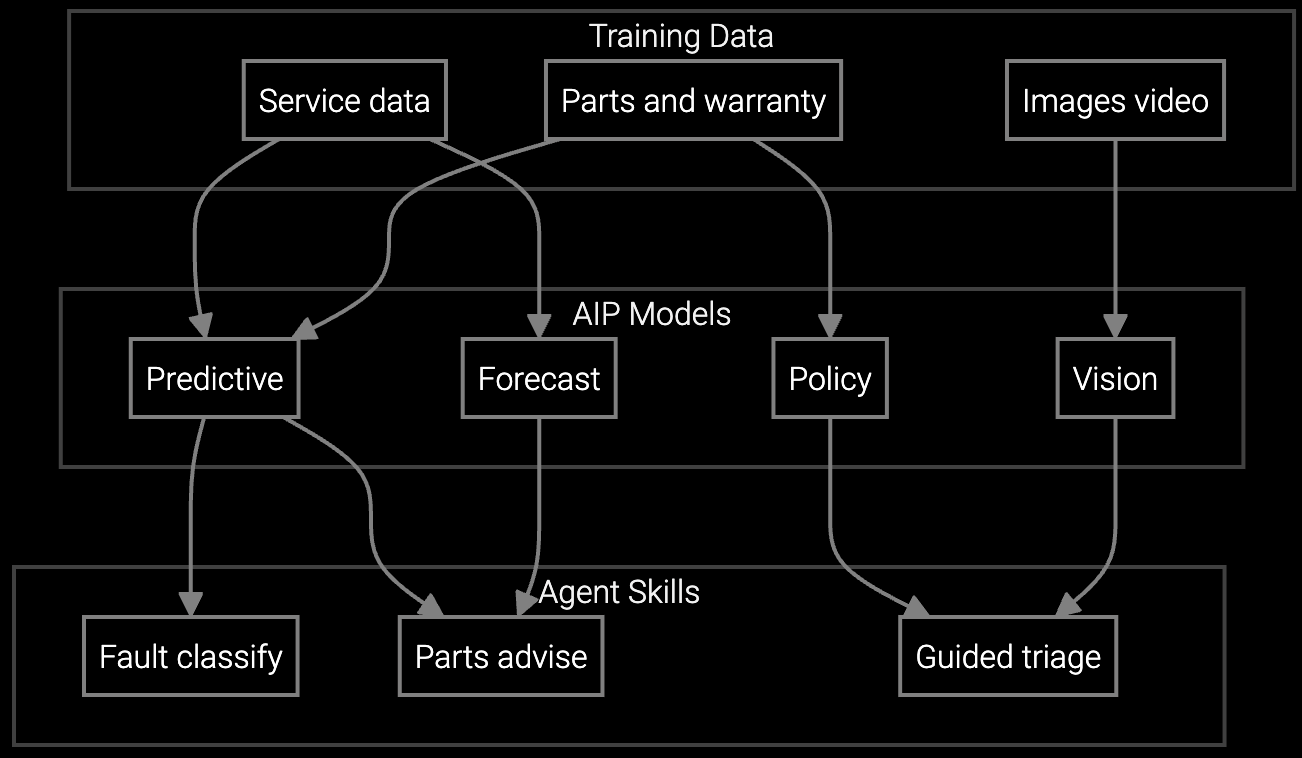
Mobile copilot provides real-time guidance on chamber maintenance procedures, recipe parameters, and diagnostic steps at the fab.
Semiconductor tools operate at nanometer precision with hundreds of interdependent process parameters. A single misaligned recipe setting or contamination event can cascade through the entire fab. OEMs service lithography systems, etch chambers, deposition tools, and metrology equipment where uptime targets exceed 95% and unplanned downtime cannot exceed 2% of production time.
Technicians must diagnose failures across chamber components, gas delivery systems, thermal controllers, and vacuum subsystems—often while the fab production team waits. The platform ingests telemetry from FOUP handlers, wafer sensors, chamber pressure monitors, and recipe execution logs to identify which subsystem failed and why, eliminating hours of manual investigation.
The system learns from your specific tool configurations, process recipes, and historical failure patterns. It builds correlation models based on your actual chamber history, sensor baselines, and maintenance records—not generic failure data. When a new alarm triggers, it compares current symptoms against past failures in your fleet to identify the most likely cause.
The platform presents root cause hypotheses ranked by probability with supporting evidence from logs and telemetry. You review the analysis and choose which path to investigate first. Over time, technician feedback on correct vs incorrect diagnoses improves the correlation models for your specific tool fleet.
Yes. The platform connects to CMMS systems to pull maintenance history and write back work order updates. It integrates with inventory systems to check part availability and trigger orders for predicted failures. Technicians see one interface combining diagnostic analysis, repair procedures, and parts status.
The mobile interface works offline with locally cached tool history, repair procedures, and diagnostic models. When connectivity is available, it syncs new telemetry and updates. Critical diagnostic results are delivered via push notification the moment analysis completes.
The system ingests SECS/GEM telemetry, chamber sensor streams, recipe execution logs, maintenance records, and parts replacement history. For lithography tools, it includes reticle inspection data and dose uniformity metrics. For etch and CVD chambers, it tracks gas flow rates, pressure profiles, and RF power stability.

How AI bridges the knowledge gap as experienced technicians retire.

Generative AI solutions for preserving institutional knowledge.

AI-powered parts prediction for higher FTFR.
Watch how automated root cause analysis turns hours of log review into minutes of targeted troubleshooting.
Schedule Demo