
When lithography tools fail at $1M+ per hour downtime, repeat truck rolls aren't just expensive—they cascade through fab schedules.
Low first-time fix rates stem from incomplete diagnostic data at dispatch, technician knowledge gaps, and unpredictable chamber component failures. AI-driven root cause analysis, parts prediction APIs, and mobile diagnostic SDKs reduce repeat visits by surfacing historical failure patterns and recommended parts before truck roll.
Technicians arrive on-site with incomplete equipment history, missing sensor telemetry, and no visibility into recent recipe changes or PM cycles. They troubleshoot from scratch instead of from root cause.
Chamber kits, RF generators, and consumables have unpredictable failure modes. Technicians guess based on symptoms, bring the wrong parts, and schedule return visits to complete the repair.
Senior technicians recognize failure signatures from years of EUV or etch tool experience. Junior technicians lack this pattern recognition, extending MTTR and requiring escalations for complex failures.
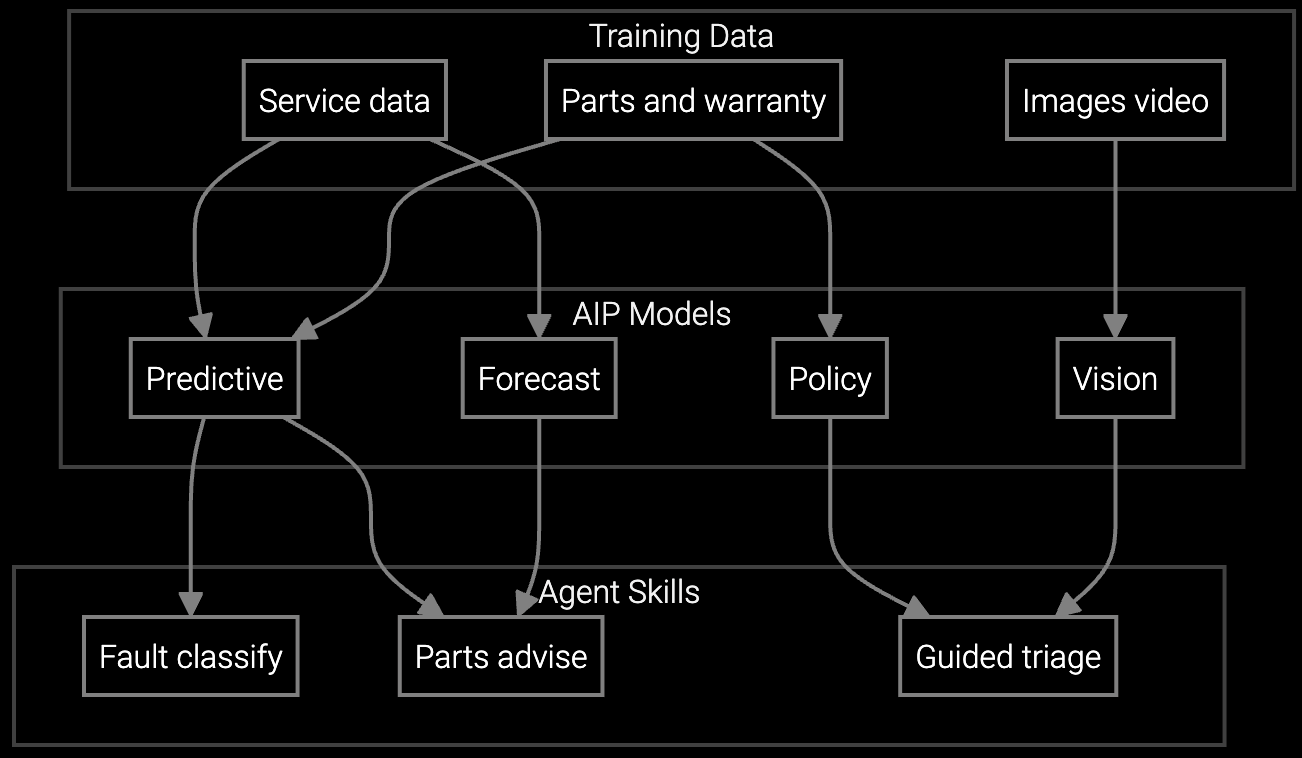
Bruviti's platform exposes REST APIs and Python SDKs that integrate with FSM systems, CMMS platforms, and custom dispatch logic. Before a technician is dispatched, the parts prediction API analyzes equipment telemetry, error logs, and historical failure patterns to recommend specific chamber components, consumables, or replacement modules likely needed for first-time fix.
Mobile diagnostic SDKs embed root cause analysis directly into technician apps. When a technician scans a tool serial number or error code on-site, the SDK queries the knowledge graph for similar failure signatures, retrieves troubleshooting steps from tribal knowledge capture, and surfaces relevant repair procedures. Developers control the data flow—no black-box decisions, full API access to model reasoning and confidence scores.

Predict which chamber kits, RF generators, and consumables are needed before dispatch to semiconductor fabs, reducing repeat visits for missing parts.

Correlate lithography tool error codes with historical failure patterns and tribal knowledge from senior technicians to identify root cause faster than manual troubleshooting.
Mobile copilot provides real-time guidance on EUV and etch tool repairs, delivering tribal knowledge and diagnostic recommendations directly on the fab floor.
Semiconductor equipment manufacturers face unique field service complexity: lithography tools, etch chambers, and deposition systems generate gigabytes of sensor telemetry per shift, yet technicians often arrive on-site with only an error code and customer complaint. Recipe drift, contamination sources, and chamber component wear create failure signatures invisible to generic FSM systems.
API integration with MES and FDC systems allows Bruviti to correlate process recipe changes, PM schedules, and wafer throughput metrics with equipment failures. Parts prediction models trained on chamber kit lifecycles, RF generator wear patterns, and gas delivery failures recommend specific components based on tool configuration and usage history—not just symptom matching.
Bruviti exposes REST APIs and webhooks for bidirectional data flow with FSM platforms. You can trigger parts prediction on work order creation, inject recommended parts into dispatch logic, and log FTF outcomes back to the knowledge graph for continuous learning. SDKs are available in Python and TypeScript for custom integrations.
Yes. The platform supports fine-tuning on your own telemetry feeds, failure logs, and parts consumption history. You control the training pipeline via API—specify which data sources to prioritize, set confidence thresholds, and validate model accuracy before deploying to production dispatch workflows.
The SDK requires equipment serial number, current error codes, and optionally recent sensor telemetry or maintenance logs. It queries the knowledge graph for similar failure signatures and retrieves troubleshooting steps. All data stays in your environment—the SDK doesn't send proprietary tool data to external servers unless you configure it to do so.
Knowledge capture happens passively through structured job completion forms, post-repair annotations, and optional voice-to-text debrief tools. Senior technicians tag which parts they replaced, what symptoms led to the diagnosis, and any non-obvious troubleshooting steps. This data feeds the knowledge graph without requiring separate interviews or training sessions.
Semiconductor OEMs using parts prediction APIs and mobile diagnostic SDKs report 18-22% FTF improvement within the first 90 days, with the largest gains on complex tools like lithography and plasma etch systems where part variability and failure mode diversity are highest. MTTR reductions average 25-35% for junior technicians gaining access to tribal knowledge on-site.

How AI bridges the knowledge gap as experienced technicians retire.

Generative AI solutions for preserving institutional knowledge.

AI-powered parts prediction for higher FTFR.
Explore Bruviti's field service APIs, SDKs, and integration options for semiconductor equipment manufacturers.
See API Documentation