
Every second truck roll to the same CNC machine or compressor costs you margin and damages customer trust.
Bruviti deployment data shows a 12% decrease in repeat service calls for industrial equipment after AI guides diagnosis and parts selection. Operators cut return trips by giving technicians the confirmed fault and correct parts before they leave, so the job gets done right the first time and trucks stop rolling twice.
Technician arrives with wrong bearing size or relay type. Customer waits days for second visit. Your dispatch team gets blamed for incomplete job prep.
Technician fixes surface symptom but misses root cause. Equipment fails again in weeks. You absorb second truck roll cost and SLA penalty.
Technician spends first 30 minutes hunting for equipment history. No visibility into past repairs, replacement cycles, or service notes from previous visits.
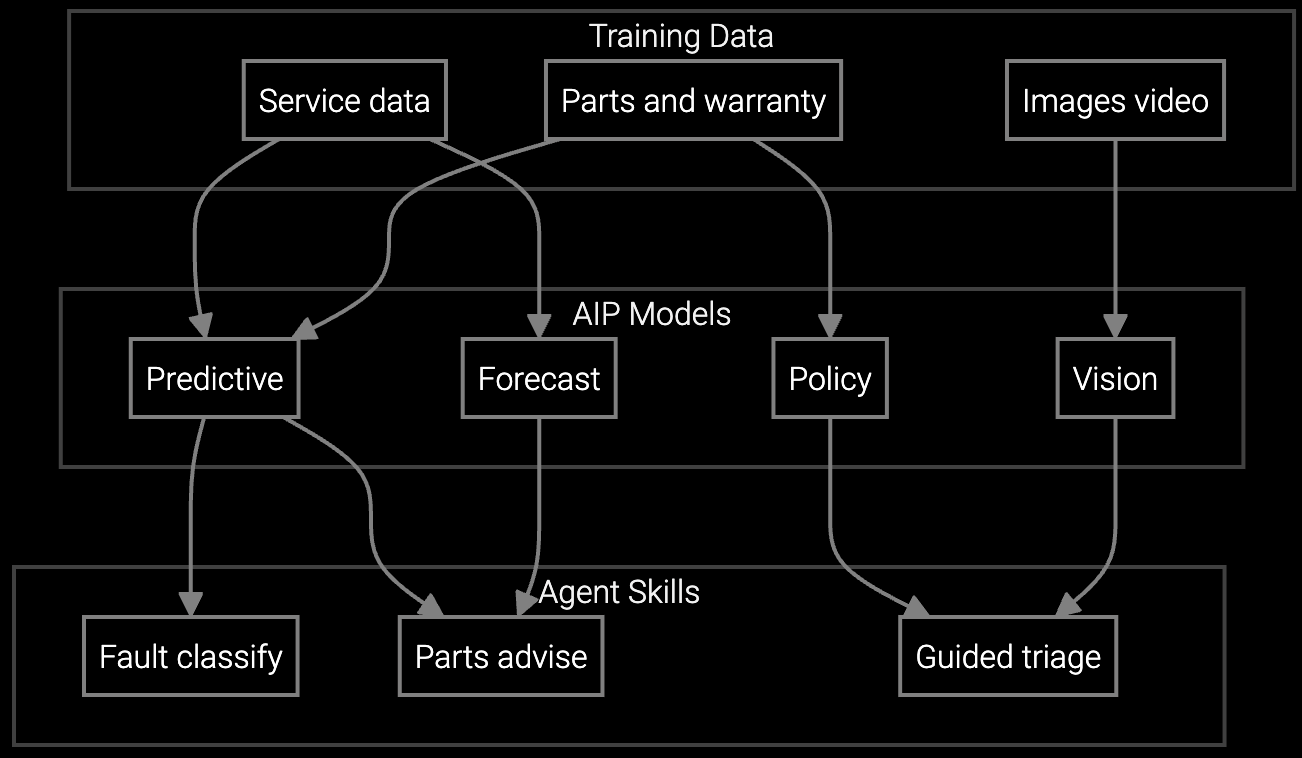
The platform analyzes equipment telemetry, failure history, and service patterns to predict which parts will be needed before your technician leaves the depot. It stages the right components in the truck and loads complete job context into a mobile app.
On-site, technicians get real-time diagnostic guidance that identifies root cause—not just symptoms. The system correlates sensor data with historical failure patterns and surfaces the exact repair procedure. No swivel-chair searching through PDF manuals or guessing at which gasket to replace first.

Pre-stage the right bearing sizes, seals, and relays for CNC machine repairs before dispatch, eliminating missing-parts callbacks on heavy machinery service.

Correlate vibration spikes, temperature anomalies, and run-hour patterns with historical pump and compressor failures to identify root cause on first visit.
Mobile copilot delivers repair procedures, torque specs, and diagnostic steps for industrial robots and automation systems directly to technician's tablet on-site.
Your customers run 24/7 production lines where a downed CNC machine or failed compressor costs $3,000 per hour in lost output. Second visits for the same failure destroy trust and trigger penalty clauses.
Industrial equipment has 10-30 year lifecycles with thousands of interchangeable parts across model variants. Technicians can't memorize every gasket dimension or bearing specification. They need the answer on arrival—not after calling the depot or scrolling through 500-page manuals.
The platform analyzes equipment telemetry, failure history, and service patterns to predict parts needs. It correlates sensor data like vibration spikes and temperature anomalies with historical failures on similar models, then flags likely replacement components before the technician leaves the depot.
The mobile app provides escalation paths to senior technicians and engineers who can review live telemetry and images from the site. Technicians can annotate unresolved cases directly in the app, which feeds learning loops to improve future diagnostics.
Yes. The platform ingests service history, warranty claims, and technician notes to identify failure patterns even without live telemetry. For older equipment, predictive parts staging relies on historical repair data and model-specific trends rather than real-time sensor feeds.
Most OEMs observe measurable improvement within 60 days of deployment. Initial gains come from better parts pre-staging, which eliminates missing-parts callbacks immediately. Diagnostic accuracy improves as the platform learns equipment-specific failure patterns over subsequent months.
Bruviti integrates with major FSM platforms via API to pull work orders, service history, and parts inventory data. Mobile guidance syncs with dispatch systems so technicians see predicted parts and diagnostic recommendations directly in their existing workflow.

How AI bridges the knowledge gap as experienced technicians retire.

Generative AI solutions for preserving institutional knowledge.

AI-powered parts prediction for higher FTFR.
See how predictive parts staging and mobile diagnostics eliminate repeat visits on your highest-volume equipment.
Schedule Demo