
Every repeat truck roll to a router or switch site costs your OEM $800+ and erodes customer trust in uptime guarantees.
AI parts prediction adds 10 to 15 first-time-fix percentage points and cuts repeat truck rolls 30%, per Bruviti deployment data. Network field service teams stop sending technicians back for the wrong part by predicting the exact parts a job needs before dispatch, turning return visits into first-visit closures.
Technician arrives at a data center to replace a failed line card but discovers the GBIC transceivers weren't included. Second truck roll scheduled. Customer waits another day for network restoration.
Work order shows "switch down" with no context. Technician doesn't know this unit has intermittent power supply issues or that firmware was patched last week. Diagnoses from scratch on-site.
Syslog showed memory parity errors three days before failure, but dispatch didn't correlate the pattern. Technician replaces NIC instead of DIMM. Device fails again within 48 hours.
The platform analyzes SNMP traps, syslog entries, and equipment telemetry to identify failure patterns before creating the work order. It cross-references the device serial number with historical service records, known firmware issues, and parts failure rates for that model and vintage.
Technicians receive a pre-built diagnostic summary on their mobile device: probable root cause based on error correlation, list of parts to bring (with confidence scores), and step-by-step repair procedures specific to the failure mode. The system pre-stages parts at the depot and auto-generates the checklist. No searching manuals in the van.

Predicts which network components (line cards, power supplies, transceivers) technicians need before dispatch based on error log patterns and historical failure data.

Correlates router symptoms (packet drops, interface flaps, CPU spikes) with historical failure patterns to identify root cause before technician arrives on-site.
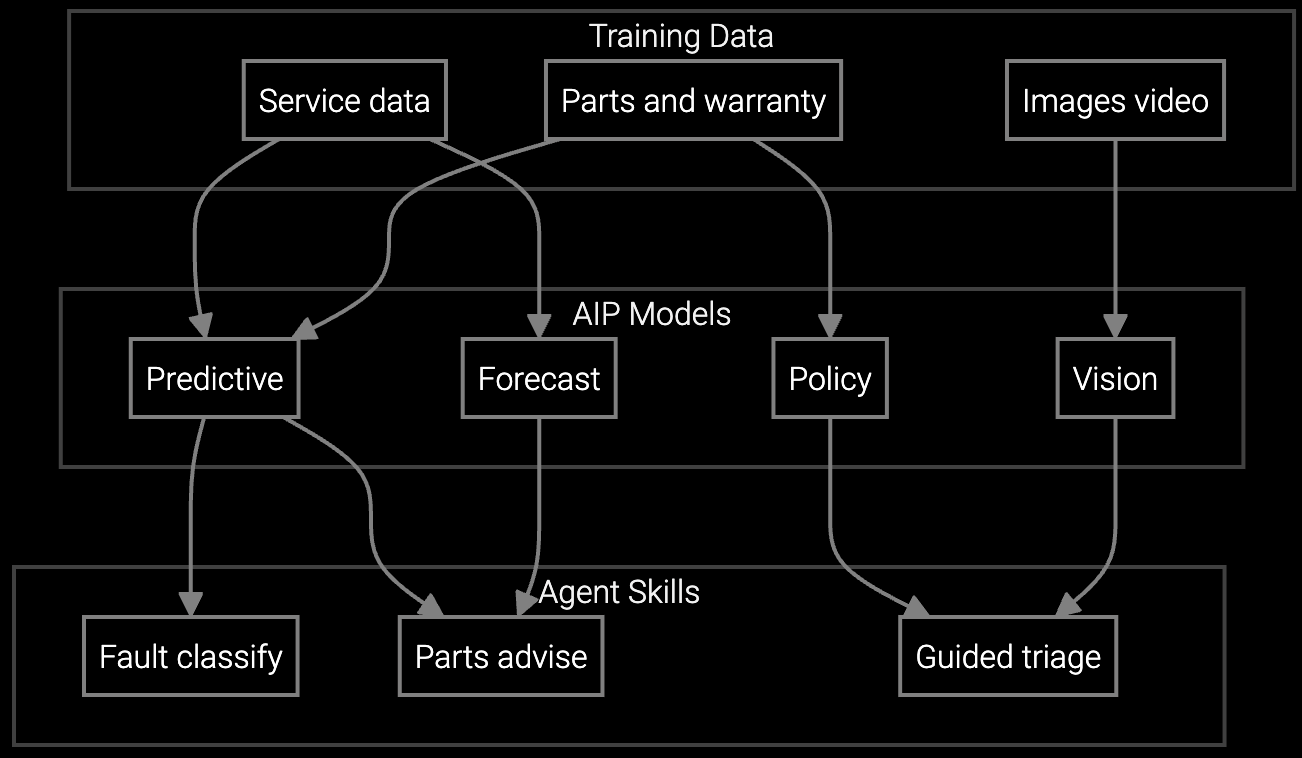
Mobile copilot provides real-time guidance for switch configurations, firmware rollback procedures, and diagnostic commands specific to the network device model at the customer site.
Network OEMs promise 99.999% availability SLAs to enterprise and carrier customers. A single failed router in a data center backbone can disrupt thousands of connections. Every hour of downtime triggers contractual penalties and damages customer trust.
Repeat truck rolls extend outages from hours to days. A technician arriving without the correct line card or transceiver can't restore service. The customer's NOC is down, their business operations are halted, and your OEM's reputation takes the hit. First-time fix isn't a nice-to-have metric—it's the difference between contract renewal and RFP season.
It analyzes syslog entries and SNMP traps from the device to identify failure signatures, then cross-references those patterns against historical service records for that model. For example, repetitive CRC errors on a specific interface combined with temperature warnings typically indicate a failing transceiver, not the line card. The system generates a parts list with confidence scores before dispatch.
The platform uses failure pattern libraries from similar devices in the same product family and firmware version. It also correlates error codes with known issues documented in technical bulletins and field advisories. Even on first-time failures, the system provides probable root cause and recommended diagnostic steps based on error log signatures.
Yes. The mobile interface displays the complete job context including failure timeline, suspected components, step-by-step procedures, and parts list. You can pull up configuration commands, firmware rollback instructions, and troubleshooting flowcharts without searching through PDFs or calling the NOC.
It integrates with your field service management platform via API. Work orders flow into the AI layer for enrichment with diagnostics, parts predictions, and repair guidance, then sync back to your FSM system. Technicians see the enhanced job context within their existing mobile app workflow.
Most network OEMs see measurable improvement within 60 days as the system ingests historical service data and begins correlating error logs with failure outcomes. By month three, first-time fix rates typically increase 15-20 percentage points as parts accuracy and diagnostic precision improve.

How AI bridges the knowledge gap as experienced technicians retire.

Generative AI solutions for preserving institutional knowledge.

AI-powered parts prediction for higher FTFR.
See how AI-assisted diagnostics eliminate repeat visits and improve first-time fix rates.
Schedule Demo