
Legacy machinery warranties carry 10-30 year obligations—strategic AI architecture determines whether you control costs or let them control you.
Industrial OEMs face a build-or-buy choice for warranty AI: custom models offer control but require ML expertise and labeled data; platforms like Bruviti provide pre-built claims validation with API flexibility, reducing NFF rates faster without vendor lock-in.
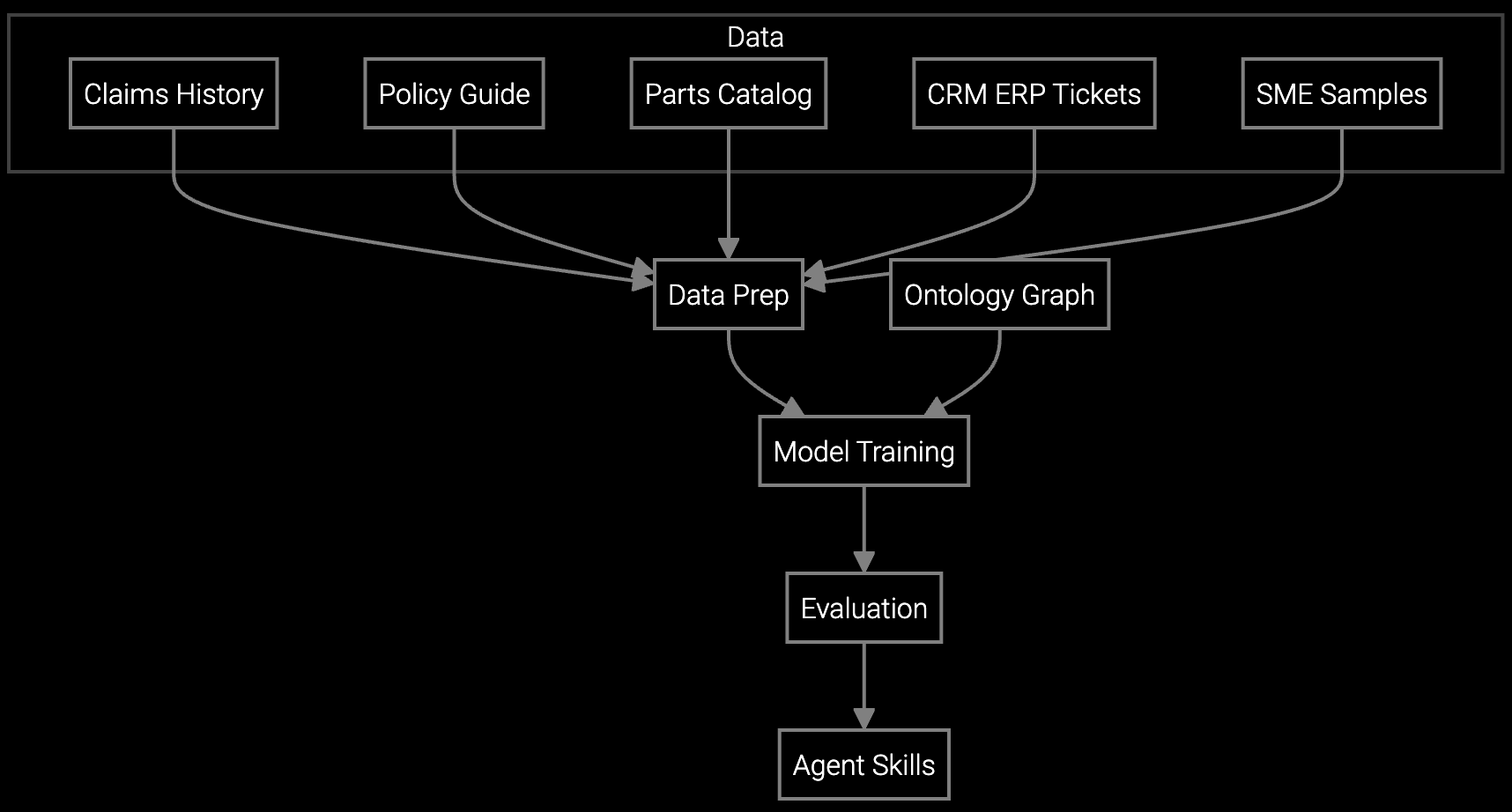
Building warranty fraud detection requires thousands of labeled claims. Most industrial OEMs lack tagged datasets distinguishing legitimate failures from NFF returns, delaying custom model deployment by 12-18 months.
Warranty systems span SAP, Oracle, and legacy databases. Building connectors to ingest claims data, entitlement history, and failure codes requires navigating decades of schema changes and undocumented field mappings.
Warranty claim patterns shift as equipment ages and new product lines launch. In-house models require continuous retraining, drift monitoring, and performance tuning—consuming data science resources indefinitely.
The best warranty AI strategy for industrial OEMs combines pre-trained models with open integration. Bruviti's platform delivers production-ready entitlement verification, fraud detection, and NFF classification trained on cross-industry claims data—eliminating the 18-month data prep cycle. Python and TypeScript SDKs expose claim validation logic as standard REST endpoints, letting your team customize rules, override decisions, and pipe results into existing ERP workflows.
This headless approach avoids vendor lock-in while preserving speed to value. You control the data layer, augment models with proprietary failure codes, and retrain classifiers on your equipment-specific patterns—all without managing infrastructure or hiring permanent ML ops staff. Deploy faster than build-from-scratch, customize deeper than closed SaaS.
Automatically classifies pump, compressor, and turbine failure modes from unstructured claim text, reducing manual coding time and improving warranty analytics accuracy.
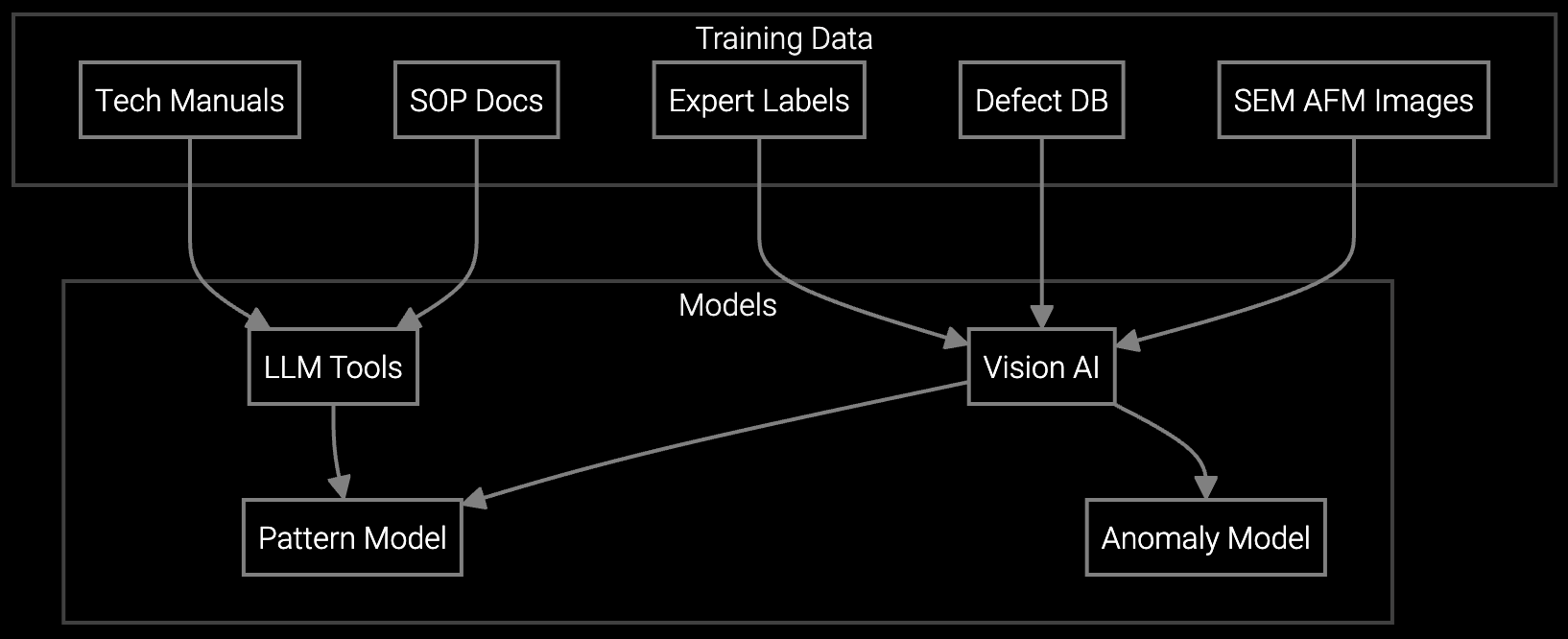
Analyzes microscopic failure images from returned industrial components, validating warranty claims and identifying root causes invisible to manual inspection.
Industrial equipment warranties span decades, creating unique AI strategy constraints. A CNC machine sold in 2010 may generate claims until 2040, requiring models that handle obsolete part numbers, undocumented field modifications, and evolving failure modes. Building custom AI means maintaining infrastructure longer than most software platforms survive.
Meanwhile, warranty reserves erode as equipment ages unpredictably. Pumps develop cavitation, compressors suffer bearing wear, and automation systems face thermal cycling stress—failure patterns your limited claims history can't predict. Pre-trained models see these patterns across thousands of OEMs, catching fraud and NFF trends your data alone would miss.
Effective fraud detection requires at least 10,000 labeled claims with confirmed fraud/legitimate tags. Most industrial OEMs lack this historical tagging, requiring 12-18 months of manual review before model training can begin. Pre-trained platforms bypass this cold-start problem.
API-first platforms like Bruviti expose claim validation as REST endpoints with Python/TypeScript SDKs. You can override decisions, add custom rules, and extract raw predictions—maintaining control without managing infrastructure. True lock-in only occurs with closed proprietary workflows.
Build-from-scratch typically takes 18-24 months including data prep, model training, integration, and testing. Platform deployment averages 60-90 days for basic entitlement verification and fraud detection, with customization adding 30-60 days depending on ERP complexity.
Building requires ML engineers experienced in NLP for claim text, computer vision for defect images, and time-series analysis for failure patterns—plus DevOps for model deployment and monitoring. If you're hiring this team from scratch, platform ROI typically wins.
Model drift is inevitable as equipment ages and new products launch. Custom models require permanent retraining pipelines and monitoring infrastructure. Platforms handle drift automatically across their customer base, while still allowing you to fine-tune on proprietary failure codes.
Software stocks lost nearly $1 trillion in value despite strong quarters. AI represents a paradigm shift, not an incremental software improvement.
Function-scoped AI improves local efficiency but workflow-native AI changes cost-to-serve. The P&L impact lives in the workflow itself.
Five key shifts from deploying nearly 100 enterprise AI workflow solutions and the GTM changes required to win in 2026.
Test Bruviti's warranty APIs on your claims data to compare deployment speed, accuracy, and integration effort against custom development.
Request Technical Demo