Distributed assets with decades-long lifecycles demand support workflows that scale across continents without manual handoffs.
Automate remote support workflows by integrating APIs that trigger guided troubleshooting, execute log analysis, and route escalations based on real-time equipment telemetry—reducing manual handoffs and session duration across distributed industrial assets.
Support engineers waste time manually authenticating to legacy SCADA systems, searching for PLC addresses, and navigating firewall rules before diagnostics even begin.
Engineers manually parse vibration data, temperature logs, and error codes across fragmented systems, delaying root cause identification for CNC machines and turbines.
When remote resolution fails, engineers manually document findings, duplicate case notes, and re-explain context to downstream teams—losing critical diagnostic details in translation.
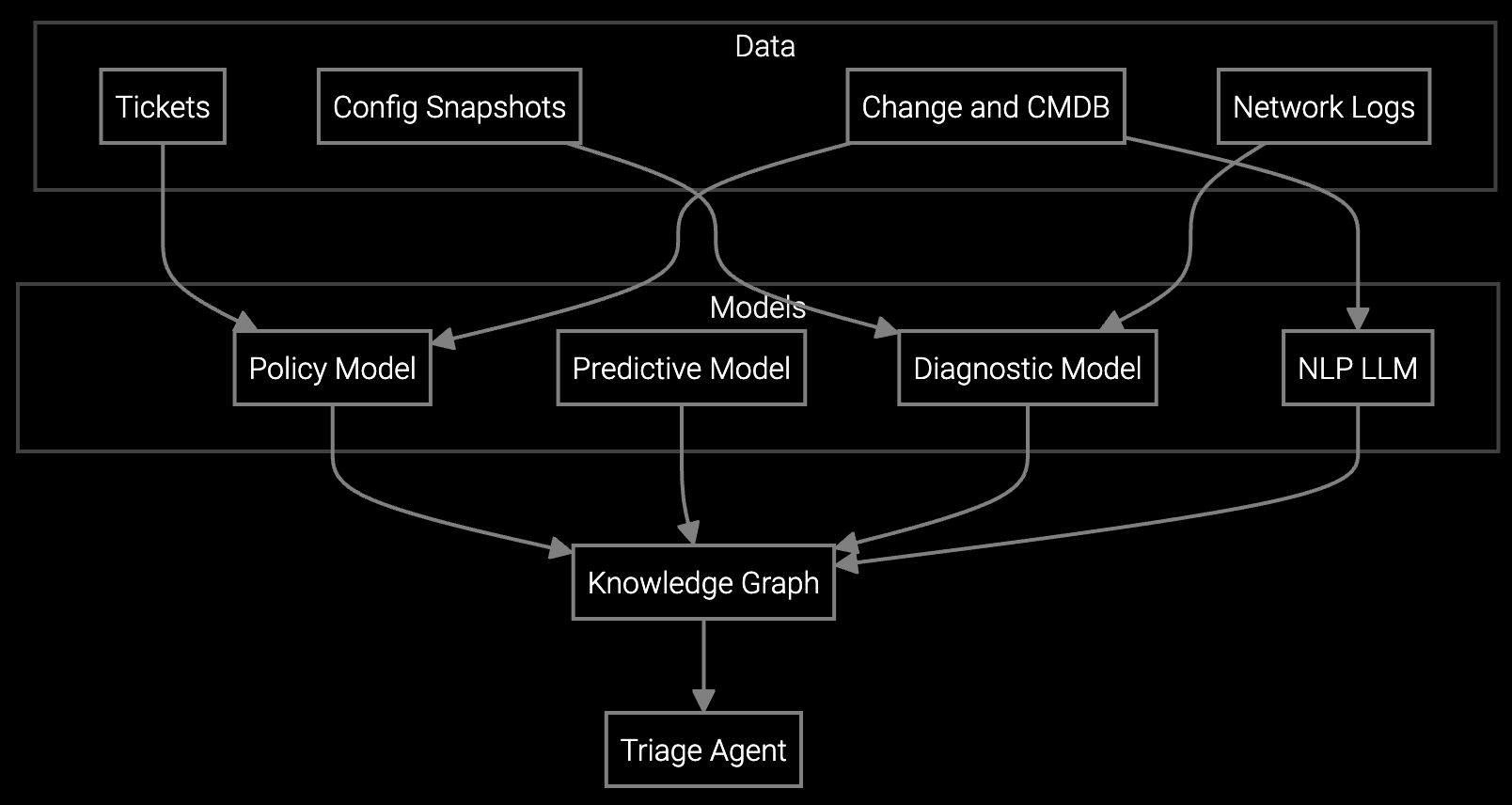
Bruviti's platform provides event-driven APIs that integrate with existing remote access tools, SCADA systems, and telemetry streams to automate the entire diagnostic workflow. Developers use Python SDKs to build custom triggers that initiate guided troubleshooting when vibration thresholds are crossed, execute root cause analysis on log files the moment they're ingested, and route escalations with full session context—no manual handoffs required.
The architecture is headless by design. RESTful endpoints accept telemetry from PLCs, IoT sensors, and condition monitoring systems, then return structured diagnostic recommendations in JSON. Support engineers review AI-generated resolution cases rather than starting from scratch. When escalation is necessary, the API packages complete session history, telemetry snapshots, and diagnostic findings into a single payload that downstream systems consume automatically. The result: workflows that scale across thousands of distributed assets without adding headcount.
Industrial OEMs support CNC machines, turbines, compressors, and automation systems deployed across factories, mines, and power plants worldwide. These assets generate continuous telemetry from vibration sensors, pressure transducers, and temperature probes—but most support engineers still manually log into SCADA systems, download CSV files, and parse error codes in spreadsheets. Workflow automation changes this by connecting telemetry streams directly to diagnostic APIs that execute root cause analysis the moment anomalies are detected.
The value compounds in industries with aging installed bases. A 15-year-old CNC machine generates the same log formats it did at commissioning, but tribal knowledge about interpreting those logs walks out the door when senior engineers retire. API-driven workflows codify that expertise into executable logic—when bearing temperature exceeds threshold X and vibration frequency shifts to Y, the system automatically triggers bearing replacement workflows rather than waiting for an engineer to manually correlate those signals.
Bruviti provides RESTful endpoints for telemetry ingestion, session initiation, log analysis execution, and escalation routing. Python and TypeScript SDKs include pre-built methods for common workflows like threshold-triggered troubleshooting and automated root cause analysis. All endpoints return structured JSON for easy integration with existing ticketing and remote access platforms.
For legacy assets without real-time telemetry, workflows can be triggered manually via support engineer actions (e.g., initiating a session or uploading a log file). The API still automates downstream steps like log parsing, diagnostic recommendation, and escalation routing—reducing workflow friction even when the trigger is human-initiated rather than event-driven.
Yes. The platform allows developers to define custom decision trees, diagnostic rules, and escalation criteria using Python-based workflow definitions. OEMs with unique equipment architectures or specialized failure modes build their own logic while leveraging pre-trained models for common industrial failure patterns like bearing wear and hydraulic leaks.
When an escalation is triggered—either by workflow logic or engineer action—the API packages the complete session history, telemetry snapshots, diagnostic findings, and attempted resolutions into a structured payload. Downstream systems consume this via webhook or API call, eliminating manual documentation and ensuring full diagnostic context transfers automatically.
Bruviti integrates with SCADA historians, PLC communication protocols (Modbus, OPC UA), and remote access platforms (TeamViewer, LogMeIn) via configurable adapters. Developers map equipment identifiers, authentication credentials, and data schemas once during setup, then workflows execute session initiation and data retrieval automatically without per-incident configuration.
Software stocks lost nearly $1 trillion in value despite strong quarters. AI represents a paradigm shift, not an incremental software improvement.
Function-scoped AI improves local efficiency but workflow-native AI changes cost-to-serve. The P&L impact lives in the workflow itself.
Five key shifts from deploying nearly 100 enterprise AI workflow solutions and the GTM changes required to win in 2026.
See how Bruviti's APIs integrate with your SCADA systems and telemetry streams to automate diagnostics end-to-end.
Talk to an Integration Engineer