
Legacy machinery demands decades of service—technician coordination and parts logistics can't stay manual at that scale.
Automate industrial field service workflows by integrating APIs that trigger predictive parts staging, route technicians with full equipment context, and capture post-job learnings—eliminating manual dispatch coordination and reducing repeat visits.
Dispatchers manually match work orders to technician skills, check parts inventory, and coordinate travel schedules. Each job requires multiple phone calls and system lookups across disconnected tools.
Work orders lack equipment history, vibration data, or recent service notes. Technicians spend the first hour on-site diagnosing issues that could have been identified before dispatch.
Technicians document repairs in free-text notes or not at all. Root cause insights and troubleshooting steps vanish into unstructured PDFs, impossible to query or reuse for future failures.
Bruviti provides APIs that let you build automated workflows triggered by real equipment events. When a PLC alarm fires or vibration exceeds threshold, your integration creates a work order, predicts required parts, matches the job to available technicians with relevant experience, and pre-stages all equipment history and sensor data for mobile access—without manual intervention.
Post-job, structured completion APIs capture technician observations, root cause codes, and corrective actions in a queryable format. These learnings feed back into predictive models, continuously improving parts recommendations and dispatch logic. You write the orchestration rules in Python or TypeScript; the platform handles the AI inference, data retrieval, and mobile sync.

APIs analyze failure symptoms and equipment run hours to predict which CNC spindle bearings or hydraulic seals technicians need—triggering automated parts staging before dispatch.

Integrate vibration patterns and error logs to surface probable causes—matching current failures against decades of industrial pump and compressor service history for faster diagnosis.
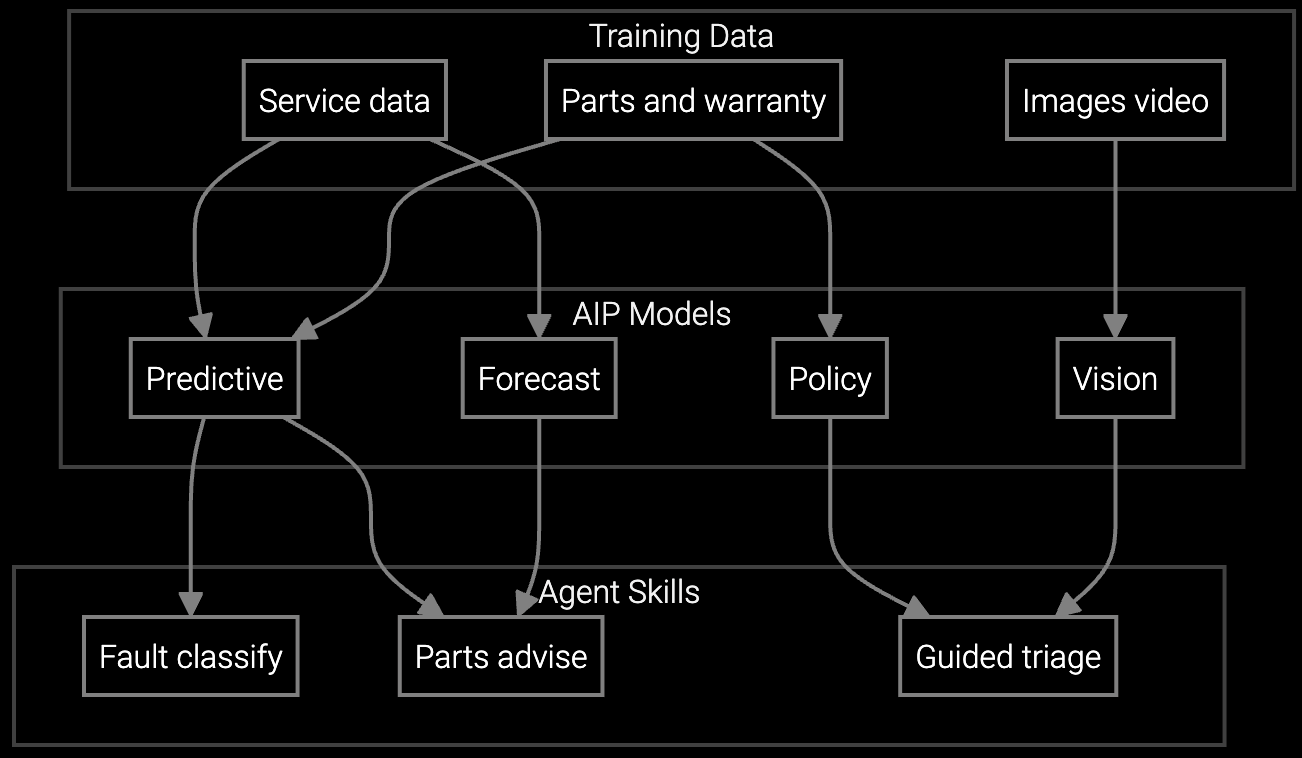
Mobile SDK delivers real-time repair guidance for legacy machinery—pulling OEM manuals, tribal knowledge, and similar failure resolutions directly to technician devices on-site.
Industrial equipment like CNC machines, turbines, and automation systems operates for 10-30 years across global installations. Work order volumes scale with installed base growth, but manual dispatch processes don't. Retiring technicians take expertise with them, leaving gaps in diagnosing obscure failure modes for older equipment.
Automated workflows triggered by SCADA alarms or predictive maintenance models let manufacturers scale service delivery without proportional headcount growth. APIs integrate with existing PLCs, FSM systems, and ERP platforms—preserving investments while adding intelligence for routing, parts prediction, and knowledge capture across decades-old machinery.
Bruviti provides RESTful APIs for work order creation, parts prediction, technician matching, mobile context delivery, and structured job completion capture. Python and TypeScript SDKs simplify integration with FSM systems like ServiceMax or SAP. Webhook support enables event-driven workflows triggered by external systems.
For older industrial machinery without telemetry, workflows can trigger based on manual work order creation or service interval rules. The platform uses historical failure patterns, parts consumption records, and technician notes to predict required parts and surface relevant troubleshooting guidance—even when real-time sensor data isn't available.
Yes. The platform provides base models for technician matching and parts prediction, but you write the orchestration layer. Define custom rules for SLA priority, regional travel costs, certification requirements, or customer contract terms using standard Python logic. Your code calls platform APIs for AI-powered recommendations but makes final routing decisions.
Minimum viable data includes equipment model/serial numbers, failure symptom codes, and historical parts consumption records. Adding sensor data (vibration, temperature, pressure), equipment runtime hours, and maintenance history improves prediction accuracy. The platform adapts to available data richness—starting with rule-based logic and advancing to predictive models as data quality improves.
Structured completion APIs capture root cause, parts used, time spent, and corrective actions in a queryable format. These records continuously retrain prediction models, improving dispatch accuracy and parts recommendations over time. Tribal knowledge from senior technicians becomes codified logic accessible to the entire workforce.

How AI bridges the knowledge gap as experienced technicians retire.

Generative AI solutions for preserving institutional knowledge.

AI-powered parts prediction for higher FTFR.
See how Bruviti APIs integrate with your existing FSM stack to automate dispatch, parts staging, and knowledge capture.
Talk to an Integration Engineer