Fab customers lose millions per hour when your tools fail. Can you deploy AI diagnostics without compromising data sovereignty?
Bruviti deployment data shows remote support AI streams equipment telemetry and moves from detection to alert in under 2 seconds. A secure, self-learning architecture with API integration into existing fab systems gives engineering teams real-time fault signals before a tool goes down, without exposing proprietary process data.
Fab customers refuse to share recipe parameters and process telemetry with third-party cloud platforms. Your support engineers can't deploy AI diagnostics if the data governance model isn't explicit and auditable.
Adding another platform means more technical debt. You need clean REST APIs that integrate with existing remote access tools and don't require ripping out your current stack.
Black box AI that can't improve from your support engineers' feedback won't stay accurate as your equipment and processes evolve. You need transparency into how the model learns and who controls retraining.
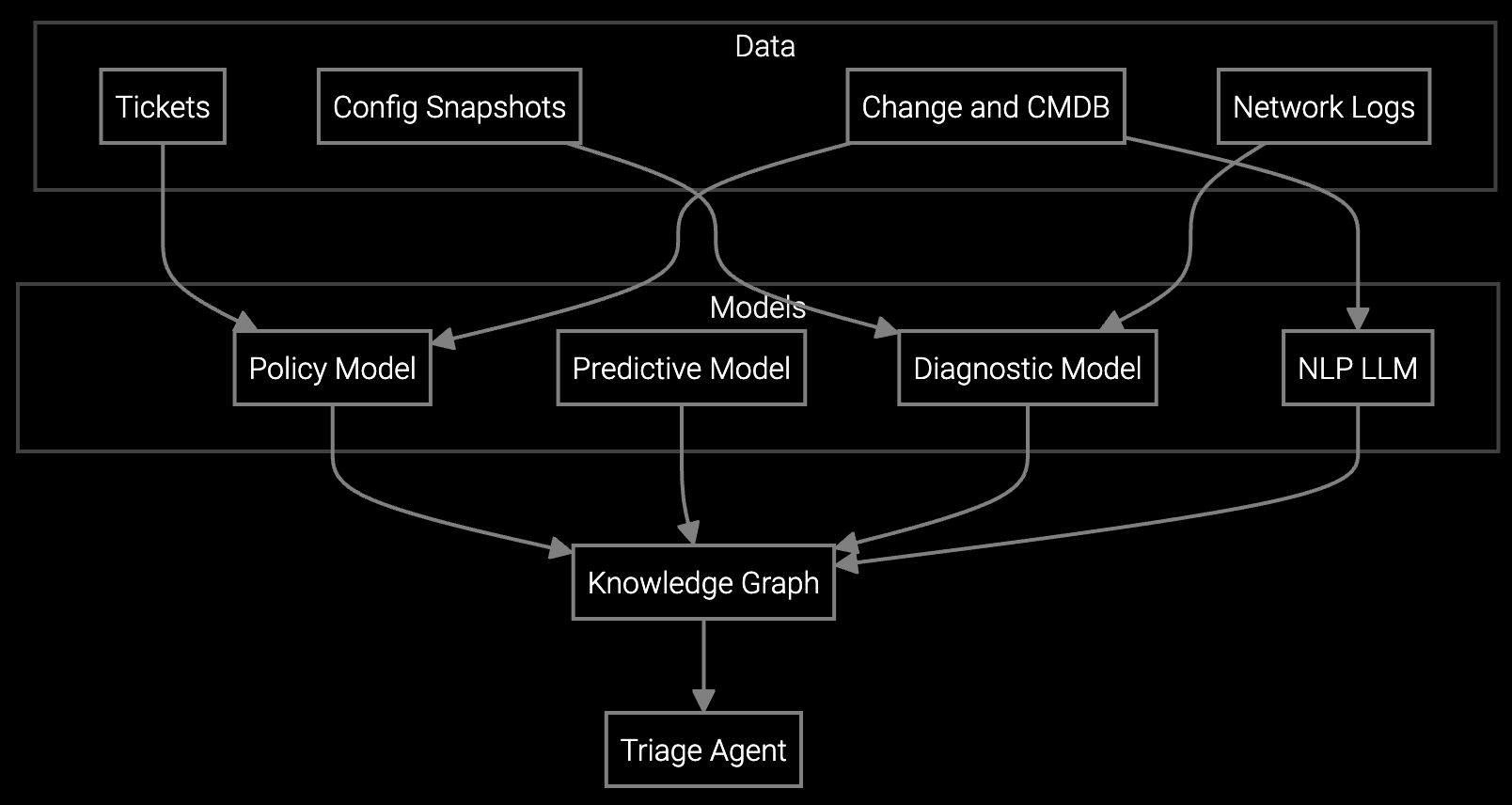
Bruviti's remote support AI deploys as a REST API layer that connects to your existing remote access platforms without replacing them. Telemetry and log data stay within your infrastructure—models run locally or in your private cloud environment, maintaining full data sovereignty. Your support engineers interact through the same tools they use today; the AI layer analyzes chamber sensor data, recipe drift patterns, and resolution outcomes in real time without exposing proprietary fab information.
The system learns continuously from feedback loops. When a support engineer corrects a diagnosis or documents a resolution, that input retrains the model. You control the learning pipeline—specify which data feeds the model, set confidence thresholds for automated suggestions, and audit every model update. The architecture uses Python SDKs for custom extensions, allowing your team to build equipment-specific diagnostics without vendor lock-in.
Semiconductor OEMs face unique implementation constraints. Your fab customers operate sub-5nm processes where recipe parameters and chamber sensor data constitute competitive intellectual property. Standard cloud-based AI diagnostics violate data sovereignty requirements, blocking deployment before technical evaluation begins.
Local execution architecture solves this. Models analyze FOUP handling telemetry, etch chamber drift, and lithography alignment logs within the customer's network perimeter. Your support engineers gain AI-assisted diagnostics without transmitting proprietary process data to external systems. The architecture scales across tool types—lithography, deposition, metrology—using the same API framework with equipment-specific models trained on your historical service data.
Models execute within your infrastructure or the fab's private cloud—telemetry never leaves their network perimeter. Your support engineers see diagnostic outputs, not raw process parameters. API calls are encrypted and logged for audit trails. You maintain full control over which data feeds the model and can segment by customer or tool type.
Initial accuracy depends on historical service data volume. With 6-12 months of resolution logs and telemetry, models typically achieve 60-70% diagnostic accuracy at launch. Continuous learning from support engineer feedback improves this 15-20% within 90 days as the system learns equipment-specific failure patterns and recipe drift signatures unique to your customer base.
REST APIs connect to TeamViewer, LogMeIn, proprietary remote platforms, and service ticketing systems. The AI layer ingests telemetry and logs, returning diagnostic suggestions to your support engineers within their current interface. No screen changes or new logins—the integration presents as an enhanced feature within existing workflows.
Your team governs the learning pipeline. Support engineers flag incorrect diagnoses through a feedback interface, which triggers model review. You set confidence thresholds—suggestions below your threshold require engineer validation before display. Model updates deploy on your schedule after testing, not automatically. Every retraining event is logged with data lineage for compliance audits.
Python SDKs allow custom model development. You can build diagnostics for proprietary equipment features, integrate chamber-specific sensor arrays, or create automated workflows unique to your service methodology. Models and code remain your intellectual property—the platform provides infrastructure and base models, not lock-in.
Software stocks lost nearly $1 trillion in value despite strong quarters. AI represents a paradigm shift, not an incremental software improvement.
Function-scoped AI improves local efficiency but workflow-native AI changes cost-to-serve. The P&L impact lives in the workflow itself.
Five key shifts from deploying nearly 100 enterprise AI workflow solutions and the GTM changes required to win in 2026.
Schedule a technical walkthrough to evaluate API design, data governance, and integration requirements for your semiconductor service infrastructure.
Request Technical Review