
Chamber kit shortages can idle $100M+ lithography tools—automated workflows eliminate manual lookups that delay critical orders.
Automated parts inventory workflows integrate demand forecasting, substitute matching, and cross-location visibility into ordering and replenishment systems, reducing manual lookups and improving fill rates for semiconductor fab operations.
Parts planners toggle between SAP, Oracle, and local spreadsheets to check availability across warehouse tiers. Each emergency order requires manual verification of substitutes and lead times.
Demand forecasts live in data lakes; purchase orders flow through ERP. No automated trigger converts predicted chamber kit depletion into replenishment orders, creating manual handoff risk.
When preferred chamber parts are unavailable, engineers manually review datasheets and compatibility matrices. Approval workflows add days to urgent orders for alternative components.
Bruviti's platform provides API-first workflow automation that connects demand forecasting models directly to inventory management and ordering systems. When the platform detects chamber kit consumption trending above forecast thresholds, it triggers automated workflows: checking multi-tier warehouse availability, evaluating pre-approved substitute parts, and routing purchase orders with complete context to the appropriate approval queue.
Developers integrate using RESTful APIs or Python SDKs to customize workflow rules, approval thresholds, and escalation paths. The architecture avoids vendor lock-in by maintaining open data formats and supporting Oracle, SAP, and custom ERP connectors. All workflow state and decision logic remain accessible via API, enabling teams to build custom dashboards, extend automation rules, or integrate with existing ITSM platforms without rearchitecting core systems.

Automated workflows trigger replenishment orders when chamber kit forecasts predict depletion windows, eliminating manual planning cycles for high-value consumables.
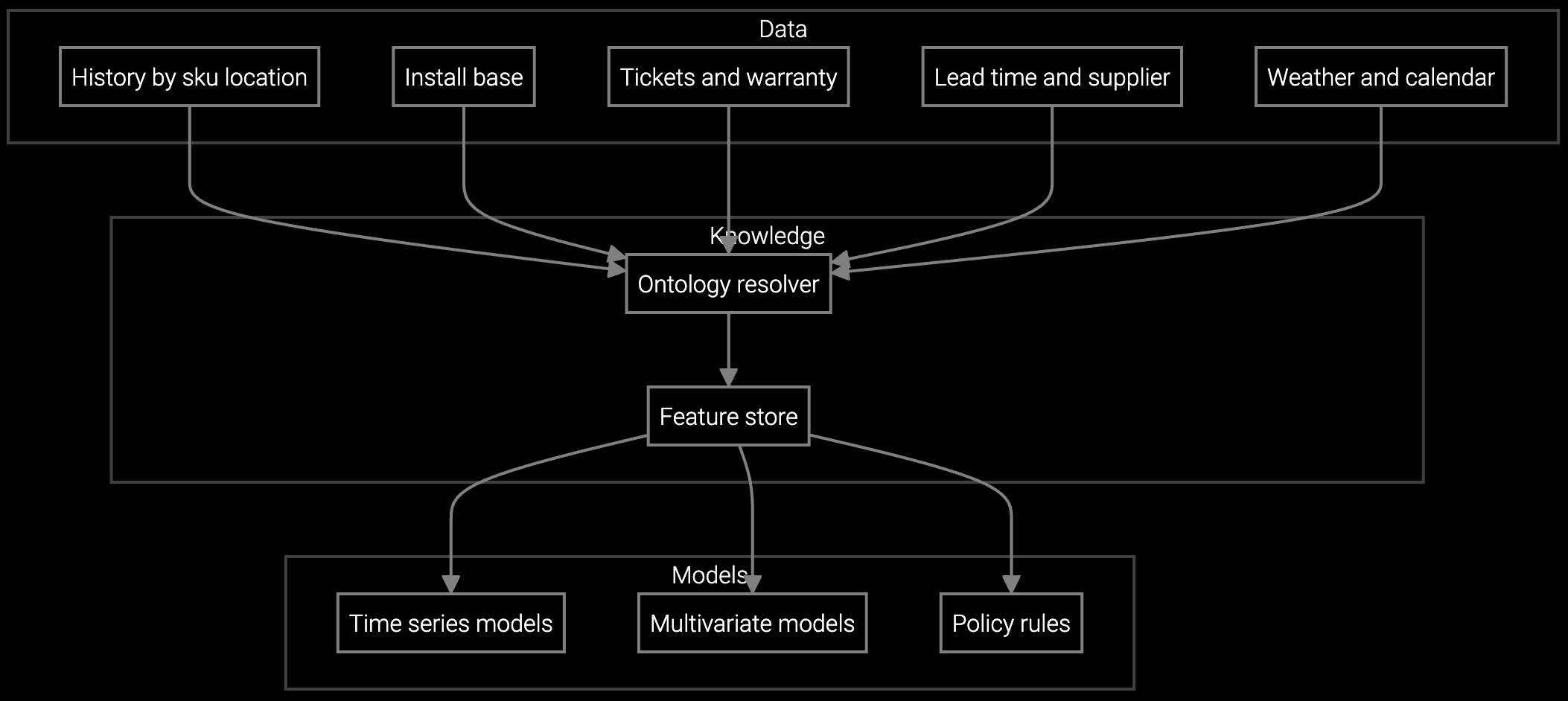
Integrates installed base telemetry and process recipe changes to predict consumable demand by tool type, feeding automated ordering workflows with multi-week lead time visibility.

Field engineers snap photos of failed chamber components; automated workflow identifies part numbers, checks availability across warehouse tiers, and routes orders without manual lookup delays.
Semiconductor manufacturers face unique workflow complexity: a single 300mm fab consumes thousands of chamber kits, process chemicals, and metrology consumables monthly, each with precise compatibility requirements tied to nanometer-scale process recipes. Traditional manual workflows cannot keep pace with EUV tool uptime demands—when a lithography system requires an urgent chamber kit replacement, planners need instant visibility across global warehouse tiers, automated substitute evaluation against current recipes, and zero-touch ordering to approved vendors.
Automated workflows integrate with fab MES systems to detect consumption patterns, trigger predictive orders before stockouts occur, and route approvals based on tool criticality and process risk. For high-value components like EUV source modules or deposition chamber assemblies, workflows automatically pull compatibility matrices, verify supplier certifications, and escalate to engineering only when automated substitute matching falls outside recipe tolerance windows.
Integration requires RESTful APIs for inventory queries, purchase order creation, and workflow state management. Bruviti provides Python and TypeScript SDKs with connectors for SAP, Oracle, and custom ERP systems. The platform exposes webhook endpoints for event-driven triggers and supports OAuth2 authentication. All API responses use standard JSON formats to avoid proprietary data structures.
Workflows use pre-configured compatibility matrices tied to process recipes and tool configurations. When preferred parts are unavailable, the system automatically evaluates approved substitutes based on specification match, supplier certification, and past usage history. Only substitutes outside pre-approved tolerance ranges trigger manual engineering review, reducing approval bottlenecks by 78% for routine component swaps.
Yes, the platform ingests telemetry via MQTT, OPC UA, or custom REST endpoints to track real-time chamber kit usage, process recipe execution counts, and preventive maintenance schedules. Consumption patterns feed demand forecasting models that trigger automated replenishment workflows before stockouts occur. Integration supports both cloud-based and on-premises MES architectures with data residency controls.
Developers define workflow logic using declarative YAML configurations or Python scripts within the SDK. Rules can specify approval routing based on part cost, tool criticality, lead time, or custom business logic. Threshold parameters for automated ordering, escalation paths, and substitute evaluation criteria are fully configurable via API. All workflow state is version-controlled and auditable.
The platform maintains open data formats and standard API protocols to ensure portability. All workflow definitions, decision logic, and historical data remain accessible via API export. Integration uses open-source connectors where possible, and custom connectors are provided as source code. Organizations retain full ownership of forecasting models, approval rules, and inventory data, enabling migration to alternative systems without vendor-specific dependencies.

SPM systems optimize supply response but miss demand signals outside their inputs. An AI operating layer makes the full picture visible and actionable.

Advanced techniques for accurate parts forecasting.

AI-driven spare parts optimization for field service.
See how Bruviti's API-first platform enables custom parts inventory workflows with zero vendor lock-in.
Schedule Technical Demo