
When fab downtime costs exceed $1M per hour, manual dispatch and parts staging workflows are too expensive to tolerate.
Bruviti deployment data shows AI auto-triaging 60% of faults and speeding resolution 20 to 30%. Builders automate field-service workflows by routing equipment telemetry through guided diagnostics and parts prediction, so most fab tool faults move from alert to dispatch-ready without a human re-keying the same fault data twice.
Schedulers manually parse work orders and match technicians based on spreadsheets. Tool failures escalate while the right technician is located, costing production time.
Technicians arrive without chamber kits or consumables because parts prediction relies on manual job notes. Second truck rolls extend downtime and erode customer trust.
Technicians spend hours per week manually entering job notes, part numbers, and labor codes into FSM systems. Time that should go to repairs goes to paperwork instead.
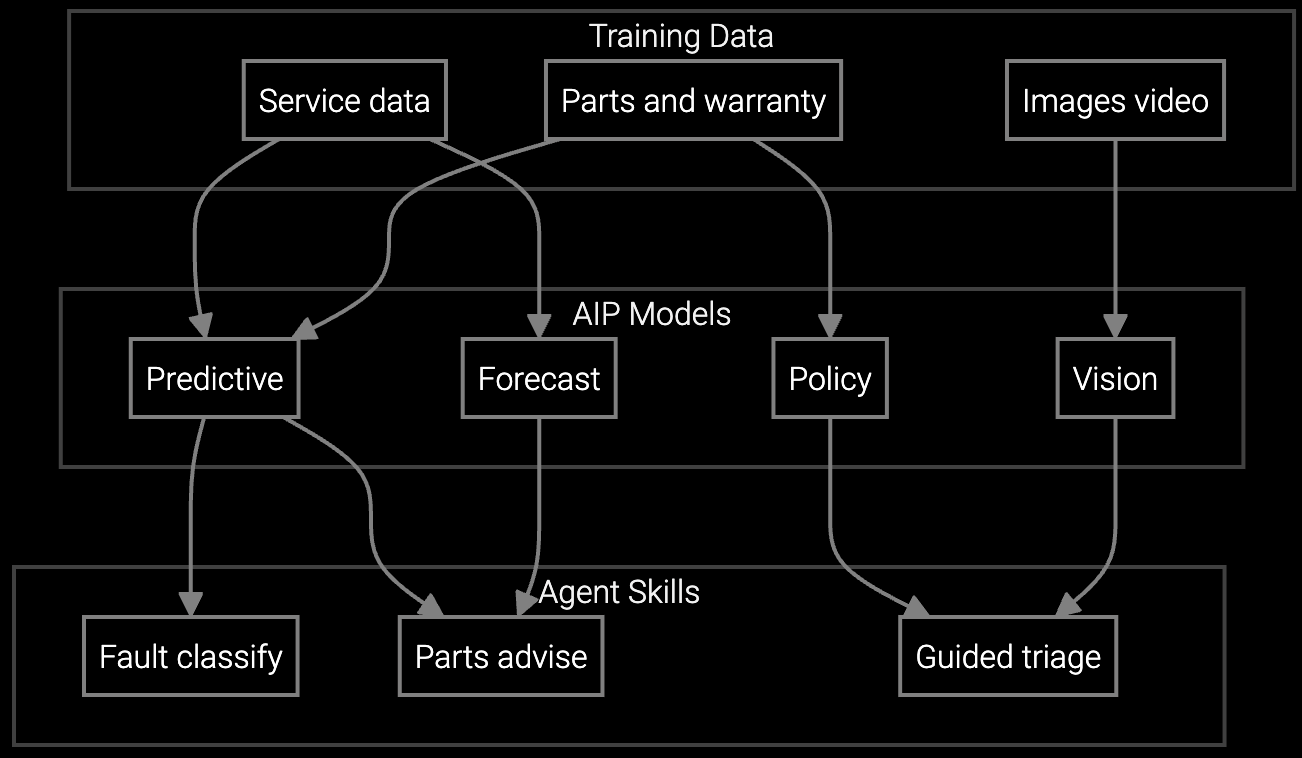
Bruviti provides Python and TypeScript SDKs that let you integrate pre-trained models into existing FSM workflows without replacing your stack. The platform exposes event-driven APIs that trigger predictions at each workflow stage: work order creation triggers parts prediction, technician assignment triggers route optimization, job completion triggers knowledge capture from telemetry and notes.
Models are trained on historical service data and equipment telemetry from semiconductor fabs, so they understand lithography recipe drift, chamber component wear patterns, and FOUP handling failures out of the box. You customize prediction thresholds and workflow rules via configuration files, not vendor professional services. Data stays in your SAP or Oracle environment; the API consumes context and returns predictions without moving equipment records to a third-party cloud.

Predicts chamber kits, consumables, and spares needed for lithography and etch tool repairs before technician dispatch, reducing repeat visits to semiconductor fabs.

Correlates process sensor data and error logs with historical failure patterns from senior technicians to identify root cause of wafer throughput degradation faster.
Mobile SDK delivers real-time repair procedures, calibration steps, and diagnostic recommendations on-site based on tool type, failure symptom, and install base configuration.
Semiconductor field service operates under extreme constraints: sub-5nm process tools require nanometer-precision calibration, recipe drift can cascade across the entire fab, and unplanned downtime costs exceed $1M per hour. Traditional FSM workflows assume generic equipment; they cannot parse lithography log files, predict chamber component wear from telemetry signatures, or prioritize jobs based on wafer throughput impact.
Bruviti's models are pre-trained on EUV systems, etch chambers, and metrology tools, so the API understands FOUP handling errors, contamination sources, and PM cycle deviations without custom training data. The platform ingests process sensor streams, correlates them with historical part replacements, and predicts which consumables will fail during the next scheduled PM window. This lets you automate parts staging workflows specific to semiconductor tool maintenance patterns.
Use the Bruviti REST API to trigger predictions at workflow transition points. When a work order moves to "Ready for Dispatch" status, your FSM system calls the parts prediction endpoint with job details and equipment serial number. The API returns a ranked list of parts with confidence scores. You map this response to your parts staging workflow via standard SAP BAdI or custom middleware.
Yes. Bruviti supports federated learning patterns where models train locally on your data and only send model weight updates to the platform. Equipment telemetry and install base configurations never leave your network. You can also deploy models in your private cloud or on-premises environment via containerized inference endpoints.
Automated parts prediction before dispatch, priority-based technician assignment using fab production impact scores, and knowledge capture from completed PM jobs yield fastest results. Start with preventive maintenance workflows where failure patterns are predictable, then expand to break-fix scenarios as models learn from edge cases. Avoid automating workflows with high variability until you have 6+ months of training data.
All integrations use standard REST APIs with OpenAPI specifications. You own the integration code written in Python or TypeScript using open-source SDKs. Model inference runs on your infrastructure if required. Data contracts are documented so you can switch providers or build internal models without rewriting downstream workflows. No proprietary protocols or closed runtime dependencies.
Track first-time fix rate improvement, reduction in truck roll count per tool install, and technician admin time saved per week. For semiconductor fabs specifically, measure downtime minutes saved from faster dispatch and improved parts accuracy, then multiply by your hourly fab downtime cost. A 10% improvement in first-time fix rate typically delivers 6-month payback on API integration costs.

How AI bridges the knowledge gap as experienced technicians retire.

Generative AI solutions for preserving institutional knowledge.

AI-powered parts prediction for higher FTFR.
See how Bruviti integrates with your FSM stack to reduce truck rolls and capture technician knowledge.
Talk to an Integration Engineer