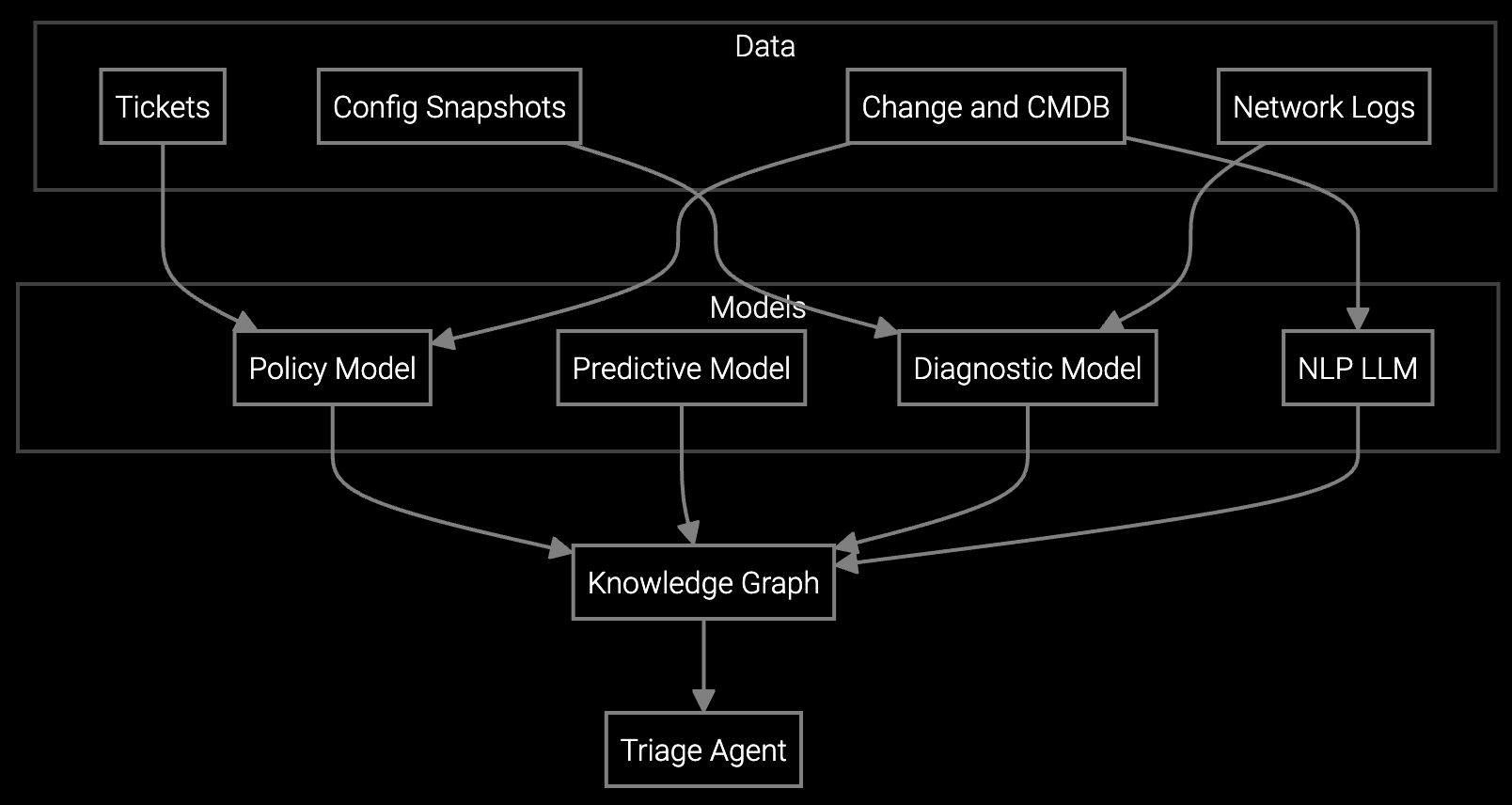
Five-nines uptime demands force network OEMs to choose between building custom remote diagnostics or adopting turnkey platforms.
Network equipment OEMs face a choice: build custom remote diagnostics in-house or adopt vendor platforms. Hybrid approaches offer API-first flexibility with pre-trained models for network telemetry, reducing time-to-value while avoiding lock-in.
Building in-house gives complete customization over SNMP parsing, firmware analysis, and log correlation. But training models on router telemetry requires labeled datasets covering diverse failure modes across product lines.
Vendor platforms accelerate deployment but often assume generic network architectures. Proprietary APIs and closed model training create technical debt when your product roadmap diverges from the vendor's.
API-first platforms combine pre-trained foundation models with open integration points. Python SDKs allow custom telemetry parsers while leveraging proven anomaly detection without rebuilding from scratch.
Bruviti's platform provides foundation models trained on network equipment telemetry while exposing Python and TypeScript SDKs for custom log parsing and escalation workflows. Support engineers access guided troubleshooting built on your proprietary knowledge base, not generic decision trees.
The architecture separates model inference from data integration. Your team controls SNMP trap parsing, firmware update orchestration, and session handoff logic through open APIs. Pre-trained anomaly detection accelerates remote resolution without requiring months of in-house model training.
Network OEMs typically pilot with carrier-grade routers where remote resolution rate directly impacts SLA penalties. Support engineers analyze BGP convergence failures, optical transport errors, and firmware CVE impacts using AI-parsed logs rather than manual grep searches.
Integration connects to existing NOC tools through REST APIs. Python scripts ingest SNMP MIBs and syslog formats specific to your product lines, training custom parsers on top of foundation models that already recognize common network failure patterns.
Building from scratch typically requires 12-18 months to collect labeled failure datasets across product lines. Hybrid platforms reduce this to 30-60 days by using pre-trained foundation models that recognize common network anomaly patterns, then fine-tuning on your SNMP MIBs and syslog formats through SDK-based integration.
Core integrations include telemetry ingestion (SNMP, syslog, CLI scraping), remote access tool APIs (TeamViewer, LogMeIn), knowledge base systems, and case management platforms. API-first architectures allow custom parsers for proprietary log formats and escalation workflows without vendor dependency.
Prioritize platforms offering open SDKs (Python, TypeScript) for custom telemetry parsing and workflow extensions. Ensure model training uses your data in formats you control, not proprietary schemas. Test data export capabilities and API backward compatibility policies before committing to multi-year contracts.
Buy accelerates CVE impact analysis using pre-trained models on public vulnerability databases. Build if you need proprietary firmware patching workflows or compliance requirements preventing external API calls. Hybrid approaches allow custom firmware update orchestration on top of purchased CVE correlation models.
Track remote resolution rate improvement, mean time to resolution reduction, and escalation rate decrease over a 90-day pilot. Compare development timeline and engineering costs against platform licensing fees. Factor in opportunity cost of delaying deployment by choosing in-house development.
Software stocks lost nearly $1 trillion in value despite strong quarters. AI represents a paradigm shift, not an incremental software improvement.
Function-scoped AI improves local efficiency but workflow-native AI changes cost-to-serve. The P&L impact lives in the workflow itself.

Five key shifts from deploying nearly 100 enterprise AI workflow solutions and the GTM changes required to win in 2026.
See how API-first architecture accelerates remote diagnostics deployment without sacrificing technical flexibility.
Schedule Technical Demo