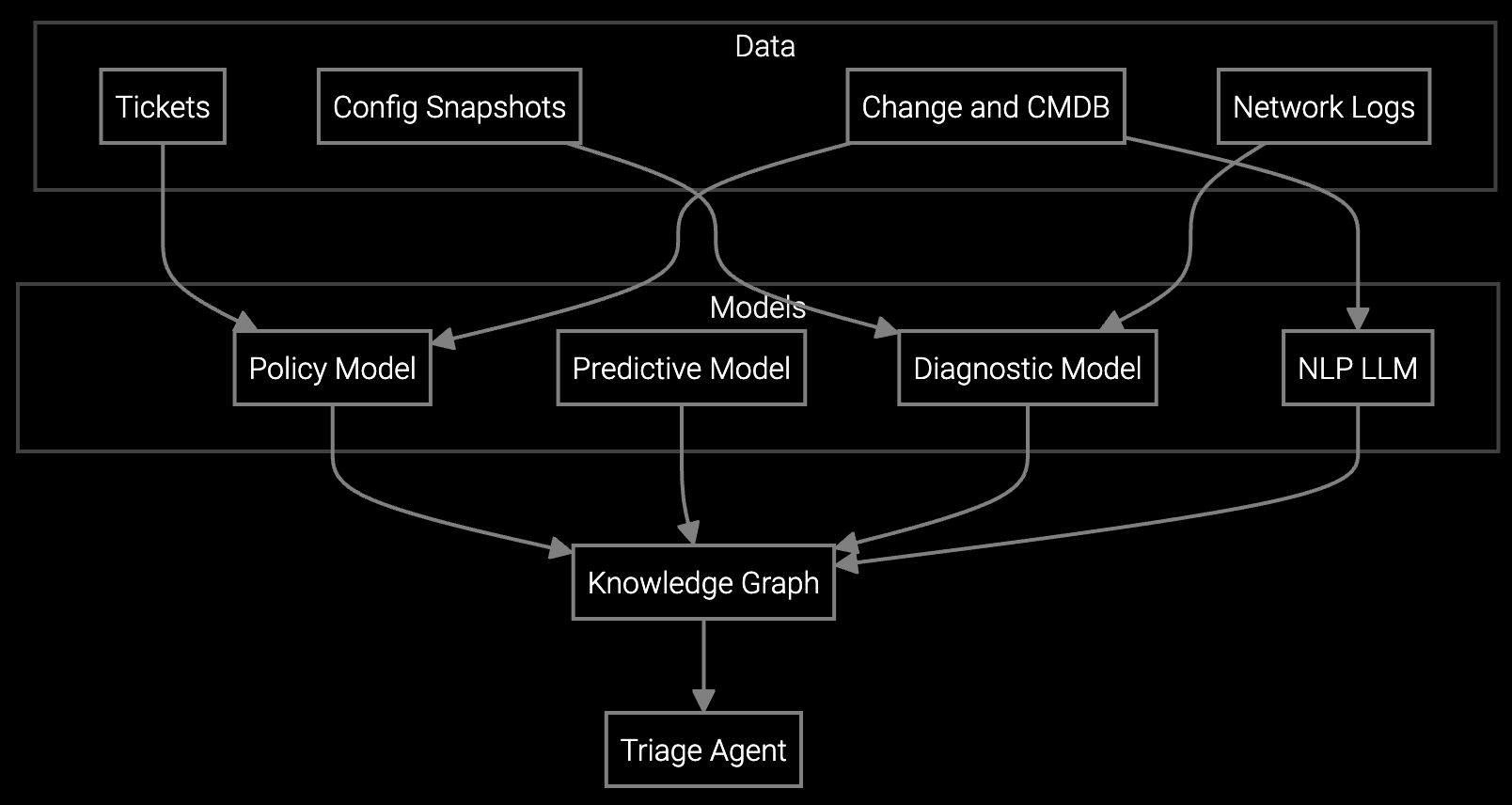
Hyperscale customers demand 99.99% uptime, making remote diagnostics architecture a competitive differentiator, not just a cost center.
Data center OEMs face a choice: build custom remote diagnostics tools requiring ML expertise and ongoing maintenance, buy closed platforms risking vendor lock-in, or adopt API-first solutions that offer pre-built models with full extensibility and data sovereignty.
Custom-built remote diagnostics require dedicated ML engineers, ongoing model retraining as hardware evolves, and infrastructure for BMC telemetry ingestion at hyperscale volumes. Most OEMs underestimate long-term maintenance burden.
Closed vendor platforms force you to migrate existing IPMI parsing logic, rewrite custom workflows, and store telemetry data in third-party systems. When the vendor changes pricing or limits API calls, you're trapped.
Support engineers need intelligent log parsing and guided troubleshooting workflows now, but your team wants to customize escalation logic and integrate with existing remote access tools without rebuilding the entire stack.
Bruviti's platform provides pre-trained models for BMC telemetry analysis, IPMI log parsing, and thermal anomaly detection—eliminating the 18-month ramp to production ML. Python and TypeScript SDKs let you extend the platform with custom rules, integrate with existing remote access tools like TeamViewer or LogMeIn, and keep all telemetry data in your own data lake.
The architecture is headless: APIs for ingestion, analysis, and session management integrate with your support portal, ticketing system, and identity provider. You control where data flows, how models are invoked, and which workflows trigger escalation. When a new server generation launches, ingest the updated BMC schema via API without vendor approval or migration downtime.
Data center OEMs process millions of BMC health checks daily from geographically distributed installations. API-first remote diagnostics must ingest IPMI telemetry streams without introducing latency, parse diverse firmware versions across server generations, and integrate with existing remote access infrastructure that support engineers already use.
The platform connects to your IPMI data lake via streaming APIs, analyzes thermal patterns and drive health metrics in real-time, and surfaces anomalies through your existing support portal. Support engineers receive guided troubleshooting workflows that reference specific PDU circuits, cooling zones, or RAID controller logs—contextual to the exact hardware configuration in the customer's rack.
Most data center OEMs complete initial integration in 6-8 weeks using provided Python SDKs and IPMI parsing templates. Time varies based on firmware diversity across server generations and whether you're migrating from existing telemetry infrastructure or starting fresh.
Yes. API-first platforms ingest telemetry from your existing data infrastructure, analyze it in real-time, and return diagnostic insights without storing raw BMC logs externally. You control data residency, retention policies, and access permissions throughout the remote session lifecycle.
Python SDKs allow you to add new IPMI field mappings and thermal threshold rules without vendor approval or platform migration. Ingest updated BMC telemetry via API, validate parsing accuracy in staging, and deploy new diagnostic workflows to production support engineers in hours instead of waiting for vendor release cycles.
Use pre-trained models for common patterns like drive failures or thermal anomalies to get immediate value. Extend with custom rules via SDKs for OEM-specific scenarios—such as escalating when PUE exceeds threshold or automatically engaging cooling teams for hot aisle alerts. The platform handles standard diagnostics while your code manages strategic differentiation.
Building requires dedicated ML engineers, GPU infrastructure for model training, ongoing maintenance as hardware evolves, and 18-24 months before production deployment. API-first platforms eliminate upfront ML investment, deploy in weeks, and charge based on usage—typically 40-60% lower TCO over 3 years while preserving technical flexibility through open APIs.
Software stocks lost nearly $1 trillion in value despite strong quarters. AI represents a paradigm shift, not an incremental software improvement.
Function-scoped AI improves local efficiency but workflow-native AI changes cost-to-serve. The P&L impact lives in the workflow itself.

Five key shifts from deploying nearly 100 enterprise AI workflow solutions and the GTM changes required to win in 2026.
Talk to our technical team about integrating with your BMC telemetry infrastructure and existing support workflows.
Schedule Technical Review