
Network OEMs face margin pressure as truck roll costs spiral while uptime expectations reach 99.999%.
Rising field service costs stem from repeat technician visits, missing parts at site, and inefficient dispatch. AI-driven parts prediction, knowledge capture from retiring technicians, and automated triage reduce truck rolls by 30-40% while improving first-time fix rates and protecting service margins.
Technicians arrive on-site without complete diagnostic context or necessary replacement parts. Repeat visits drive up labor costs and expose OEMs to SLA penalties when network uptime falls below contracted 99.999% availability targets.
Senior network engineers who understand legacy router configurations and optical transport troubleshooting are retiring. Their tribal knowledge walks out the door, leaving junior technicians without the expertise to diagnose complex multi-vendor environment issues efficiently.
Inadequate remote diagnostics and triage lead to expensive on-site visits for issues that could be resolved through firmware updates, configuration changes, or remote troubleshooting. Each unnecessary truck roll erodes service margins and wastes technician capacity.
Bruviti's platform analyzes historical service data, telemetry from network devices, and captured technician expertise to predict which parts will be needed before dispatch and identify issues solvable remotely. The AI learns from every completed service ticket, continuously improving parts prediction accuracy and root cause identification.
For network equipment OEMs, this transforms field service from a cost center into a margin protection engine. Technicians arrive with the right parts based on failure pattern analysis. Automated triage screens out firmware and configuration issues before dispatching expensive on-site labor. Senior technician knowledge is captured and made available to the entire workforce through AI-assisted diagnostics.

AI analyzes failure patterns across routers, switches, and optical transport to predict which line cards, transceivers, or power supplies technicians need before dispatch to data centers and network operations centers.

Correlates syslog entries, SNMP trap sequences, and configuration drift with historical network failures to identify root causes faster, reducing mean time to repair for carrier-grade equipment.
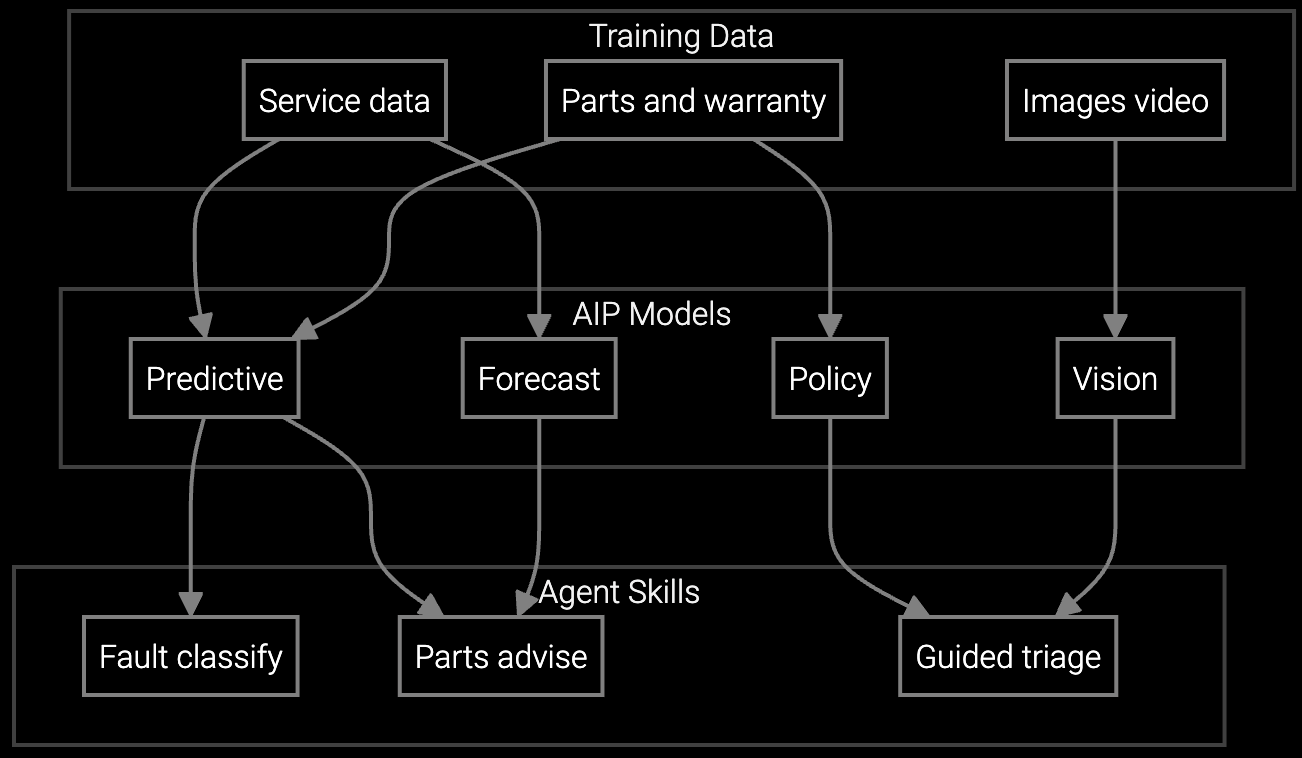
Mobile copilot provides real-time firmware compatibility checks, BGP routing troubleshooting steps, and optical power level diagnostics for network technicians in remote telecommunications sites.
Network equipment OEMs serve customers where downtime directly impacts business operations. A failed core router or firewall can halt enterprise operations. Carrier-grade telecommunications infrastructure operates under strict five-nines availability SLAs where minutes of downtime trigger financial penalties.
Field technicians must diagnose issues across multi-vendor environments involving routers, switches, firewalls, and optical transport systems. Each device generates telemetry through syslog, SNMP traps, and performance counters. Technicians need immediate access to failure pattern knowledge and parts availability to meet aggressive MTTR targets while managing travel time to distributed NOCs and remote cell sites.
AI analyzes telemetry patterns from routers and switches to predict failures before they trigger customer-impacting events, enabling preventive part replacement during scheduled maintenance windows. Automated triage identifies firmware and configuration issues solvable remotely, avoiding truck rolls while maintaining faster response times than manual dispatch processes.
The reduction comes from three sources: remote resolution of firmware and configuration issues that currently trigger dispatches, predictive maintenance that prevents emergency calls, and improved first time fix rates that eliminate repeat visits. Network equipment telemetry provides rich failure signatures that AI correlates with historical service outcomes to filter out unnecessary on-site visits.
Bruviti's knowledge capture workflow integrates into existing service ticketing systems, recording senior technician diagnostic steps, decision patterns, and repair procedures in real time as they complete jobs. This builds the AI knowledge base continuously rather than requiring separate documentation efforts. Most OEMs see meaningful knowledge transfer within 60-90 days as the system observes expert technicians on typical service calls.
Reducing truck roll costs protects existing margins, but the larger impact comes from improving first time fix rates and technician utilization. When technicians carry correct parts based on AI prediction, they complete more jobs per day and avoid the margin-eroding cost of repeat visits. Combined with remote resolution filtering, OEMs typically see 12-18% service margin improvement within the first year.
The platform ingests telemetry from any device that generates syslog entries or SNMP traps, regardless of OEM. It learns failure patterns specific to each device type and vendor, building diagnostic models that account for interactions between routers, switches, firewalls, and optical transport from different manufacturers. This cross-vendor pattern recognition is what enables accurate parts prediction and root cause analysis in real-world heterogeneous networks.

How AI bridges the knowledge gap as experienced technicians retire.

Generative AI solutions for preserving institutional knowledge.

AI-powered parts prediction for higher FTFR.
See how network equipment OEMs reduce field service costs while maintaining five-nines uptime commitments.
Schedule Executive Briefing