
Senior technicians are retiring faster than new hires can learn complex machinery repair—threatening your first-time fix rates and margin.
Capture retiring technician knowledge into AI models that guide remaining field staff through complex repairs. Preserve decades of tribal knowledge as structured decision support, maintaining first-time fix rates despite workforce turnover.
Junior technicians lack the experience to diagnose complex failures on CNC machines, turbines, or legacy PLCs. Repeat visits erode margin and damage customer relationships.
With fewer senior technicians available, escalation queues grow. Field staff wait hours for guidance while customer equipment sits idle, triggering SLA penalties.
New hires take 18-24 months to reach proficiency on equipment with 10-30 year lifecycles. Documentation gaps and outdated manuals slow ramp-up further.
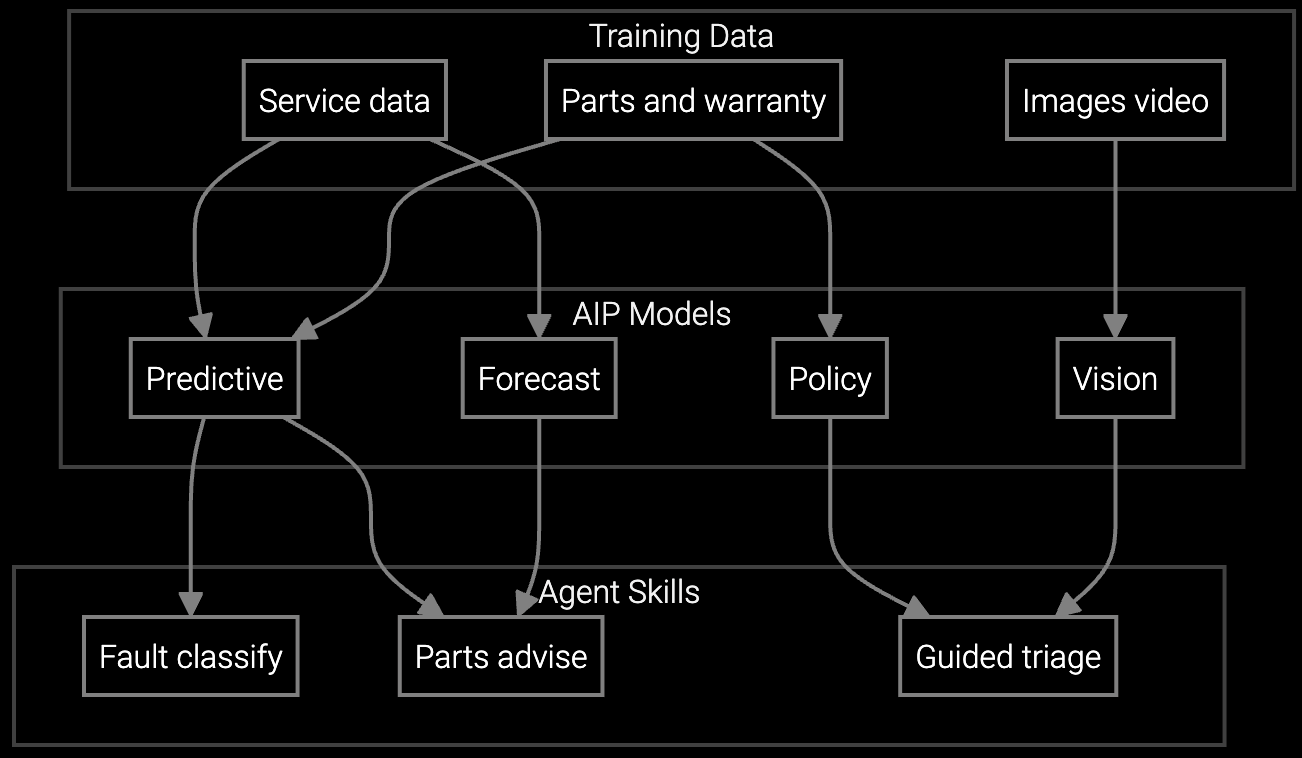
The platform ingests historical work orders, failure reports, sensor telemetry, and repair notes to build decision models that replicate senior technician reasoning. These models guide less-experienced field staff through complex diagnostics—identifying root cause, recommending corrective action, and predicting required parts before dispatch.
Unlike static documentation, the AI adapts as new failure patterns emerge. Each resolved case strengthens the model, turning every technician into a contributor to the institutional knowledge base. Your workforce becomes more capable over time, even as individual team members retire.

Predict required parts for CNC spindle repairs or compressor overhauls before dispatch, reducing repeat visits and improving first-time fix for industrial equipment.

Correlate vibration signatures, run hours, and maintenance history to identify why a turbine or pump failed—preserving senior technician diagnostic logic.
Mobile copilot guides less-experienced technicians through complex machinery repairs, providing real-time recommendations drawn from decades of tribal knowledge.
Industrial OEMs support CNC machines, turbines, pumps, and automation systems with 10-30 year operational lives. Senior technicians accumulate decades of experience diagnosing failures in legacy models no longer documented in official manuals. When these experts retire, their knowledge of obscure failure modes, vibration patterns, and repair shortcuts disappears—leaving less-experienced staff to rediscover solutions through costly trial and error.
AI models trained on historical work orders, sensor telemetry, and repair notes preserve this institutional knowledge. Junior technicians gain access to diagnostic reasoning that previously took 20 years to develop, maintaining service quality and first-time fix rates despite workforce transitions.
The AI learns from historical work orders, repair notes, and sensor data accumulated over decades—not interviews or manual documentation. As long as work history exists, the platform extracts diagnostic patterns and decision logic. Retiring technicians can optionally validate model recommendations during transition periods, but the bulk of knowledge is already embedded in past cases.
The platform replicates pattern recognition, not intuition. It correlates symptoms with historical outcomes across thousands of cases—surfacing likely root causes and recommended actions. For routine failures, AI guidance matches or exceeds human accuracy. For novel failure modes, the system flags uncertainty and escalates to senior staff, ensuring safety and quality.
Legacy equipment often has the richest work order history—decades of repair notes and failure patterns. The AI thrives on this data, learning from every past incident. Even equipment no longer manufactured becomes trainable if sufficient service records exist. Obscurity is an advantage, not a barrier, because it represents undocumented tribal knowledge ripe for preservation.
Traditional ramp-up takes 18-24 months for complex industrial equipment. With AI decision support, technicians achieve 70-80% of senior-level diagnostic accuracy within 6-9 months. They learn faster by handling real cases with real-time guidance rather than classroom training alone. The AI acts as an on-site mentor, accelerating experience accumulation.
Technicians validate AI recommendations before acting, just as they would confirm senior technician advice. Incorrect suggestions surface during execution and feed back into the model as corrective training data. Over time, the AI learns from its mistakes, reducing error rates. The platform tracks recommendation accuracy by equipment type, flagging low-confidence predictions for human review.

How AI bridges the knowledge gap as experienced technicians retire.

Generative AI solutions for preserving institutional knowledge.

AI-powered parts prediction for higher FTFR.
See how Bruviti preserves decades of field expertise as AI-powered decision support.
Schedule Demo