
When installed base doubles but contact center headcount can't, case backlog becomes margin erosion.
Network equipment OEMs face escalating case volumes as their installed base grows while agent capacity remains fixed. AI-assisted triage and knowledge retrieval reduce average handle time by 40% and improve first contact resolution to 85%+, turning case volume from a cost spiral into a margin opportunity.
Agents waste 12-18 minutes per case searching disconnected systems for firmware bulletins, configuration guides, and RMA procedures. Knowledge silos force escalations that could be resolved at first contact.
Every inbound email, chat, and call requires human triage to route between firmware, hardware, configuration, and security teams. Misrouted cases bounce between queues, tanking SLA performance.
Different agents give conflicting answers on warranty coverage, firmware compatibility, and configuration best practices. Customers escalate to senior support demanding clarity, driving up cost per contact.
Bruviti ingests your complete support corpus—firmware release notes, configuration templates, RMA procedures, NOC runbooks—and makes it instantly retrievable. When a case arrives via email, chat, or phone transcript, the platform classifies the issue type, correlates it with device telemetry from SNMP logs, and surfaces the exact knowledge article the agent needs. No more toggling between systems.
The AI drafts initial responses using historical case resolutions and approved documentation, eliminating the blank-page problem. Agents review, adjust for customer-specific context, and send—cutting handle time in half. For firmware-related inquiries, the system cross-references CVE databases and deployment schedules to flag compatibility risks before the customer asks. This shifts contact centers from reactive firefighting to proactive guidance, protecting margins while installed base scales.
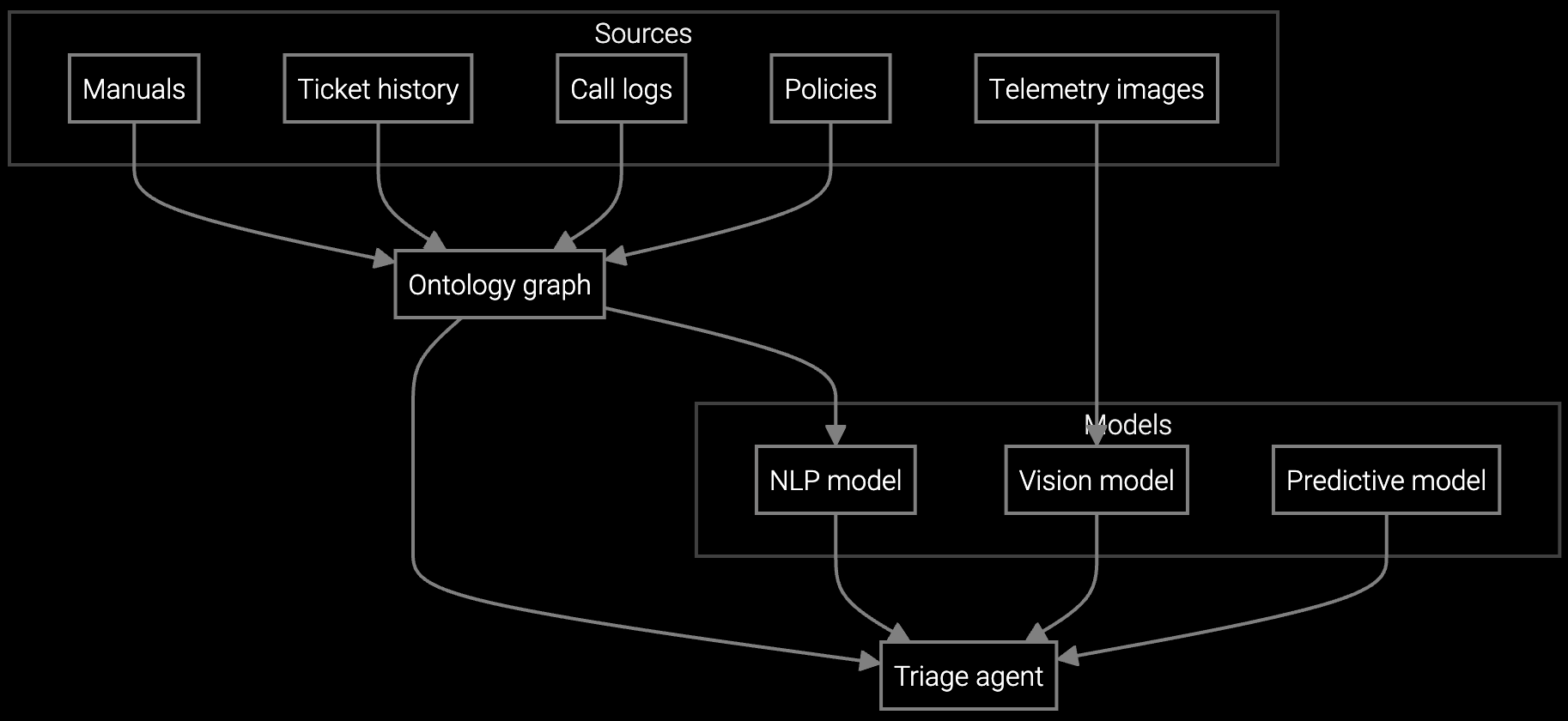
Autonomous case classification analyzes router error codes, correlates SNMP trap patterns, and routes firmware vs. hardware issues to the right NOC team with full diagnostic context.
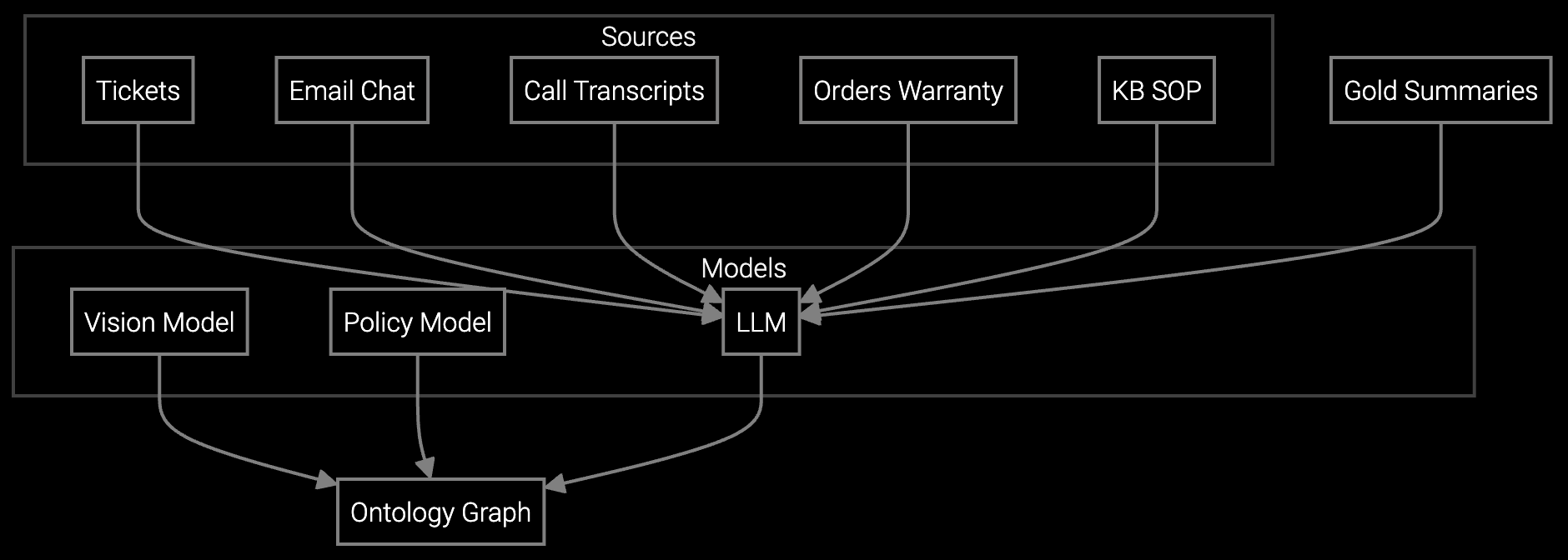
Instantly generates case summaries from multi-channel histories—email threads, chat logs, call transcripts—so agents understand network outage timelines without reading 40 messages.

AI reads firmware update inquiries and PoE configuration questions, drafts responses using approved documentation, and auto-populates case notes—agents just review and send.
Network equipment OEMs serve enterprise and carrier customers running thousands of routers, switches, and firewalls in mission-critical environments. When a firmware CVE drops or a power supply batch shows early failure patterns, case volume spikes 300% overnight. Traditional contact centers can't flex fast enough—backlog grows, SLA penalties trigger, and CSAT craters.
The root cause is information asymmetry. Customers running multi-vendor environments need cross-reference answers: "Does this firmware version conflict with our existing load balancer config?" Agents can't answer without toggling between internal wikis, partner portals, and NOC escalation queues. Each search adds 8-12 minutes to handle time. At 50,000 annual cases, that's 250,000 wasted agent-hours—$6.2M in fully-loaded labor cost.
The platform ingests your official release notes, compatibility matrices, and CVE bulletins—never inventing information. Agents review all AI-drafted responses before sending, catching edge cases. Version control ensures the knowledge base updates instantly when new firmware ships, eliminating stale advice.
Typical network OEMs see 40% handle time reduction within 90 days of go-live. At $62 fully-loaded cost per agent hour and 50,000 annual cases, that's $1.8M annual savings. Implementation cost amortizes in 6-8 months. First contact resolution improvements deliver additional margin protection by reducing escalation costs.
Yes. The platform ingests partner documentation and industry standards (SNMP MIBs, syslog formats, IETF RFCs) to answer interoperability questions. When customers ask about configuration conflicts with third-party load balancers or firewalls, the AI surfaces compatibility notes and tested configurations from your NOC knowledge base.
The system correlates customer-reported symptoms with device telemetry patterns—SNMP traps, syslog error codes, interface statistics. Firmware bugs show signature error patterns across multiple devices. Hardware failures manifest in thermal or power supply anomalies. Misconfigurations appear as isolated issues with non-standard settings. This context routes cases to the right specialist team immediately.
Track first contact resolution rate (target 85%+), average handle time (target 40% reduction), and cost per contact. Monitor SLA compliance to measure penalty avoidance. Survey CSAT to confirm quality isn't degrading. The goal is margin expansion—handling more cases with the same agent count as installed base grows—not eliminating jobs.

Transforming appliance support with AI-powered resolution.

Understanding and optimizing the issue resolution curve.

Vision AI solutions for EV charging support.
See how Bruviti helps network equipment OEMs scale contact center capacity without scaling headcount.
Schedule Executive Briefing