
When hyperscale operators demand 99.99% uptime, repeat truck rolls become margin killers that threaten SLA compliance.
Bruviti deployment data shows AI adds 10 to 15 first-time-fix-rate percentage points and cuts repeat truck rolls by 30% for data center equipment service. Executives solve the cost of failed visits by giving technicians AI-predicted parts and fix guidance up front, so fewer faults need a second trip.
Technicians arrive at hyperscale facilities without the correct memory module, power supply, or BMC replacement. The truck roll was wasted. Parts must be sourced. The customer waits. SLA clock keeps ticking.
Dispatch sends a technician based on a vague IPMI alert without correlating BMC logs, thermal sensor data, or recent firmware updates. Root cause remains unknown until on-site, delaying resolution and burning labor hours.
Senior technicians who can diagnose cooling anomalies or RAID controller edge cases are retiring. Their pattern recognition exists nowhere except their heads. Junior technicians lack this context and require multiple visits for complex issues.
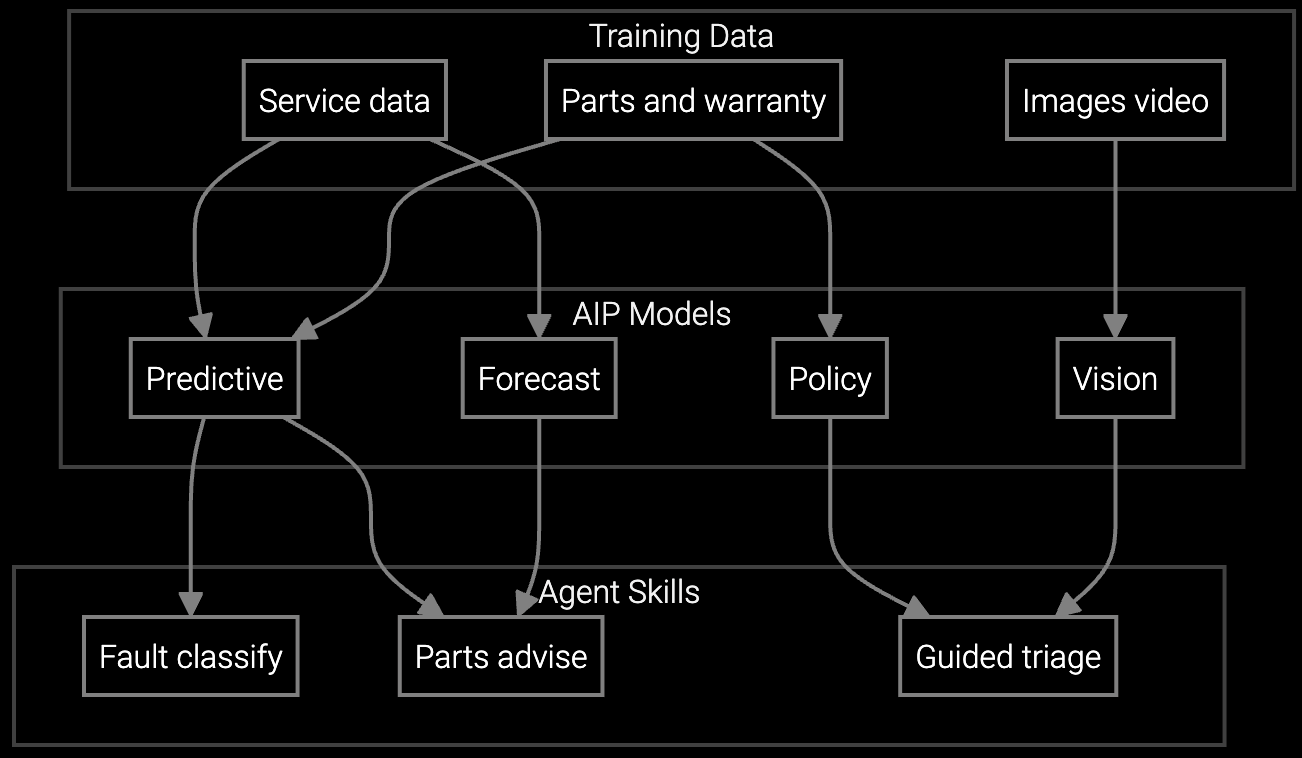
Bruviti's platform ingests BMC telemetry, IPMI alerts, thermal sensor patterns, and historical service records to predict failure modes before dispatch. The AI correlates symptoms across similar server configurations and identifies root cause with the precision previously available only to your most experienced engineers.
When a work order is created, the platform automatically predicts which parts the technician will need based on failure signature, generating a pre-staged kit. Technicians arrive on-site with complete diagnostic context and the right components. First-time fix rates improve immediately, truck roll costs drop, and your service margins expand.

Predicts which server components, power supplies, and cooling parts technicians will need before dispatch to hyperscale and colocation facilities.

Correlates BMC telemetry, thermal patterns, and IPMI alerts with historical failure signatures to identify root cause faster than manual diagnosis.
Mobile copilot provides real-time guidance for diagnosing cooling anomalies, RAID failures, and power distribution issues on-site.
Data center OEMs face a unique margin pressure: hyperscale customers demand four nines availability while simultaneously negotiating down service contract pricing. Every repeat truck roll to diagnose a power supply that could have been predicted from BMC logs erodes profitability. When a technician arrives without the replacement PDU or UPS component, the customer sees the SLA clock ticking toward penalty thresholds.
The complexity layer: modern racks contain servers from multiple generations, diverse storage configurations, and interdependent cooling systems. A thermal anomaly might originate from hot aisle airflow, a failing BMC sensor, or RAID rebuild heat. Senior technicians recognize these patterns instantly. Junior technicians require multiple visits, documentation searches, and escalations. As your most experienced engineers retire, this knowledge gap becomes a direct threat to service margins and customer retention.
Three primary factors drive repeat visits: technicians arriving without the correct replacement components, incomplete diagnostic context at dispatch that prevents accurate root cause identification, and expertise gaps as experienced engineers who understand complex thermal and power interdependencies retire. Each factor compounds the others—wrong parts mean return visits, incomplete diagnostics waste the first visit, and inexperienced technicians struggle with both.
The platform analyzes BMC telemetry patterns, IPMI alert sequences, thermal sensor data, and failure histories from similar server configurations to identify the failure signature. By correlating these signals with historical parts consumption data from thousands of previous service events, the AI predicts which components will be required with 87% accuracy. This allows pre-staging the correct parts kit before dispatch, eliminating the most common cause of repeat visits.
Most data center OEMs see measurable FTF improvement within 60-90 days of deployment. The financial impact becomes clear immediately: each avoided repeat truck roll saves $1,850 in direct costs, plus SLA penalty avoidance and improved technician utilization. For a service organization managing 100 technicians, eliminating 200 unnecessary repeat visits annually translates to $370K in direct savings, with additional margin protection from reduced SLA exposure.
Bruviti continuously learns from every service interaction, capturing the diagnostic patterns and decision logic that experienced technicians apply. When a senior engineer correctly diagnoses a cooling anomaly by correlating hot aisle temperature spikes with RAID rebuild schedules, that pattern becomes part of the AI's knowledge base. The platform then provides this guidance to junior technicians facing similar symptoms, effectively distributing expert-level pattern recognition across your entire workforce.
Yes. The platform connects to existing field service management systems via API to receive work orders and push predicted parts requirements. It integrates with your parts inventory system to verify component availability and trigger pre-staging. Technicians receive diagnostic guidance and parts lists through their existing mobile tools—no workflow disruption. The AI layer adds intelligence to your current infrastructure rather than requiring a replacement.

How AI bridges the knowledge gap as experienced technicians retire.

Generative AI solutions for preserving institutional knowledge.

AI-powered parts prediction for higher FTFR.
See how Bruviti eliminates repeat truck rolls and protects service margins.
Schedule Demo