
Proprietary warranty platforms trap you in closed ecosystems—but hyperscale customers demand custom integrations your IT team can maintain.
API-first warranty automation connects claims validation, RMA generation, and entitlement verification to your existing systems using Python SDKs and REST endpoints, avoiding proprietary platforms while reducing NFF rates and processing time.
Data center customers operate thousands of servers across multiple SKUs and contract types. Manual warranty status verification creates bottlenecks when failures spike during capacity expansions or thermal events.
Server components flagged by BMC sensors often pass post-return testing. Without automated correlation between telemetry patterns and actual defects, your RMA pipeline processes unnecessary returns at scale.
Warranty SaaS platforms force you into their workflow logic and data models. When hyperscale customers require custom claim validation rules or integration with their CMDB systems, you face expensive professional services engagements.
Bruviti provides headless warranty automation through Python and TypeScript SDKs that integrate with your existing warranty database, ERP, and CRM systems. The platform exposes REST endpoints for entitlement verification, fraud detection scoring, and NFF prediction—allowing your engineering team to embed warranty intelligence directly into your service portal, RMA workflow, or customer-facing APIs without migrating to a proprietary system.
Warranty claim validation rules are defined as code in your repository, not configured in a vendor UI. When a hyperscale customer requires custom entitlement logic tied to their procurement system, your developers extend the validation pipeline using the SDK rather than waiting for vendor roadmap prioritization. The architecture separates AI inference (hosted by Bruviti) from workflow orchestration (controlled by your codebase), ensuring you retain ownership of the integration layer and can swap underlying models as your needs evolve.
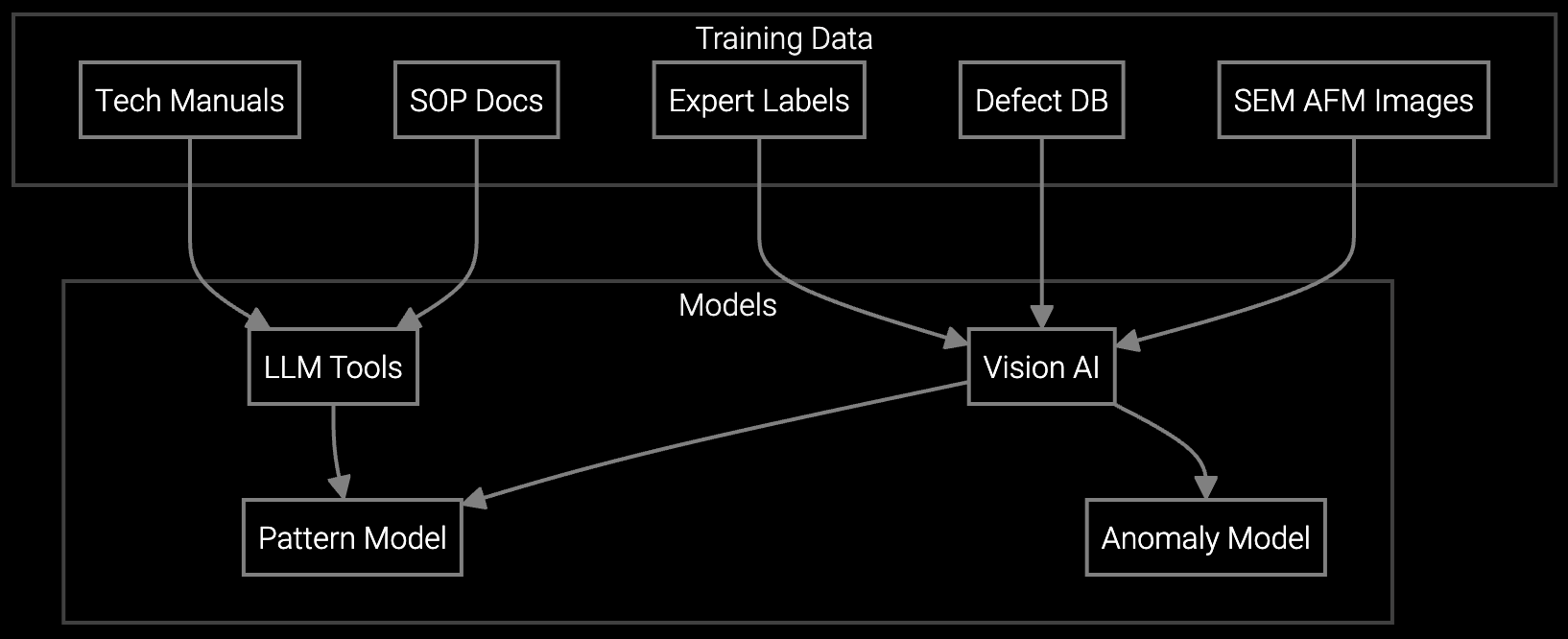
Analyze microscopic failure images from returned server components to validate warranty claims and identify manufacturing vs. operational defects at scale.
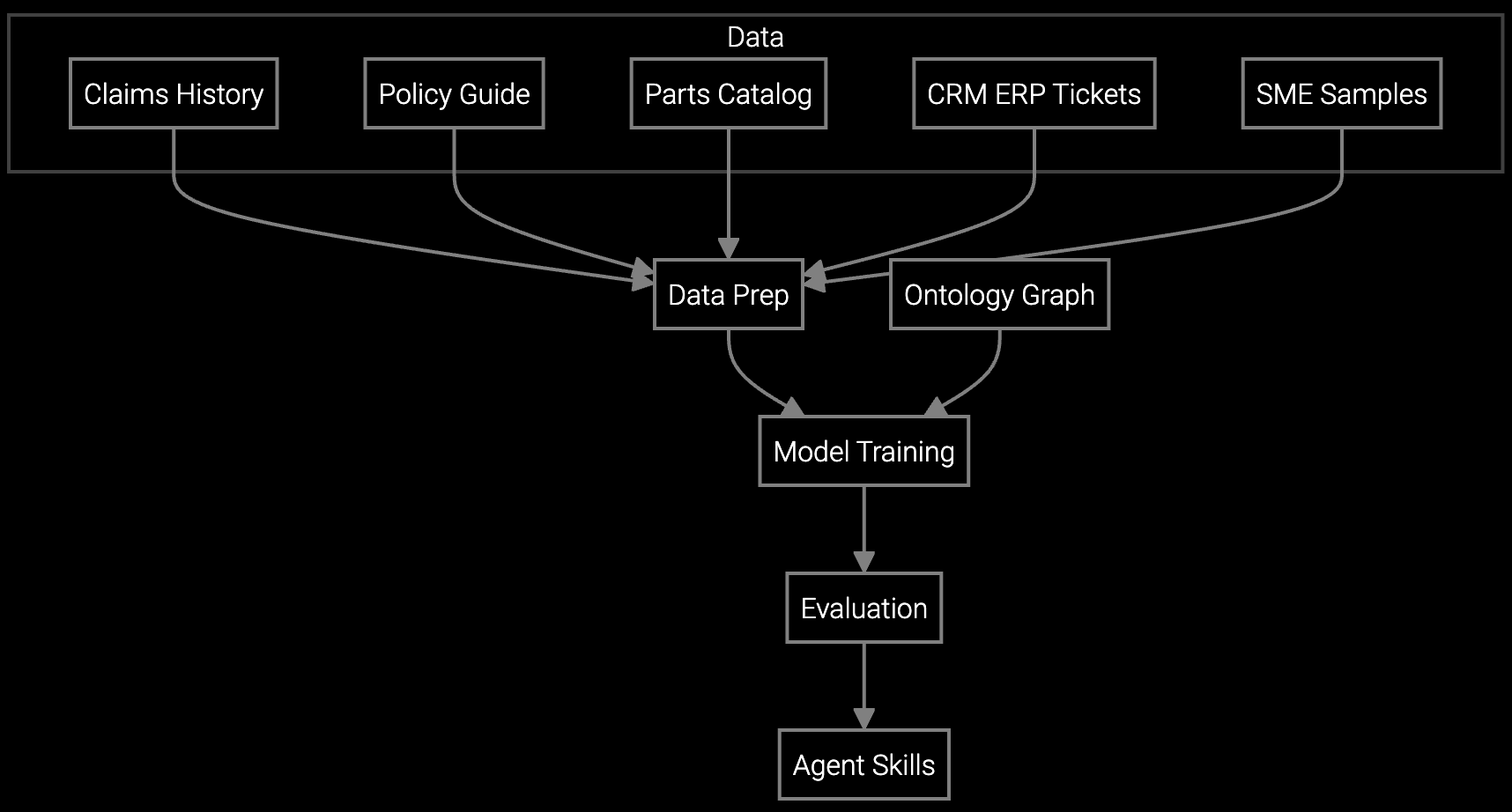
Automatically classify and code data center hardware claims using BMC telemetry patterns and failure symptom descriptions, reducing manual review cycles.
Data center OEMs serve customers managing tens of thousands of servers where warranty claims arrive in batches during hardware refresh cycles or after thermal incidents. Traditional warranty systems struggle with this volume and require manual triage to distinguish component-level failures (memory, drives, PSUs) from systemic issues like firmware bugs or cooling design flaws.
API-first warranty automation connects BMC telemetry streams, asset databases, and entitlement systems to pre-validate claims before RMA generation. When a customer reports a drive failure, the system checks SMART log patterns against known defect signatures, verifies warranty coverage via serial number lookup, and flags potential NFF cases based on historical return data—all before a shipping label is issued. For hyperscale customers with custom SLA requirements, developers extend the validation pipeline to enforce contract-specific rules without modifying core platform logic.
Yes. Bruviti supports hybrid deployment where entitlement verification and claim validation run in your data center while model training occurs in Bruviti's cloud environment. The Python SDK handles secure model synchronization, allowing you to keep warranty claim details and customer serial numbers within your infrastructure while benefiting from continuously updated fraud detection algorithms.
The SDK exposes a rule engine where you define validation logic as Python functions in your codebase. Each function receives claim attributes (serial number, failure code, customer ID) and returns a validation decision. This approach allows per-customer rule sets without vendor configuration tools—your engineering team maintains the logic alongside other business rules in version control.
The SDK includes automatic failover to cached entitlement data and local NFF prediction models. When the primary API is unreachable, the system falls back to last-known-good warranty status and conservative fraud scoring—allowing RMA processing to continue with slightly reduced accuracy rather than halting completely. Configurable timeout thresholds let you tune resilience vs. prediction quality based on operational priorities.
Yes. The platform provides a feature engineering API where you submit raw BMC event sequences and receive structured feature vectors suitable for model training. This allows your data science team to experiment with custom telemetry patterns specific to your server architectures without managing inference infrastructure. You control which telemetry fields are analyzed while Bruviti handles model serving and versioning.
The SDK supports parallel operation where new claims flow through Bruviti APIs while existing claims remain in your legacy system. Historical data can be imported incrementally via batch endpoints to train fraud detection models without requiring a cutover date. This phased approach lets you validate API performance on new claims before decommissioning legacy integrations—reducing migration risk for high-availability warranty operations.
Software stocks lost nearly $1 trillion in value despite strong quarters. AI represents a paradigm shift, not an incremental software improvement.
Function-scoped AI improves local efficiency but workflow-native AI changes cost-to-serve. The P&L impact lives in the workflow itself.

Five key shifts from deploying nearly 100 enterprise AI workflow solutions and the GTM changes required to win in 2026.
See how Bruviti's API-first platform integrates with your existing systems—no vendor lock-in, no proprietary schemas.
View API Documentation