
Balancing HVAC seasonal spikes and decades of SKUs without tying up capital or delaying service.
AI-driven demand forecasting analyzes install base age, seasonal patterns, and failure modes to optimize parts inventory. Predict consumption by SKU and location, reducing both stockouts and carrying costs without vendor lock-in.
HVAC and refrigeration parts see 3-4x demand surges during extreme weather. Stock too little and service SLAs slip. Stock too much and carrying costs erode already thin margins.
Supporting 20+ years of refrigerator, washer, and dryer models means thousands of active SKUs. No single ERP gives real-time visibility across all warehouses and distribution centers.
Parts go end-of-life while older appliances remain in service. Finding compatible substitutes manually is slow and error-prone, delaying fulfillment and frustrating customers.
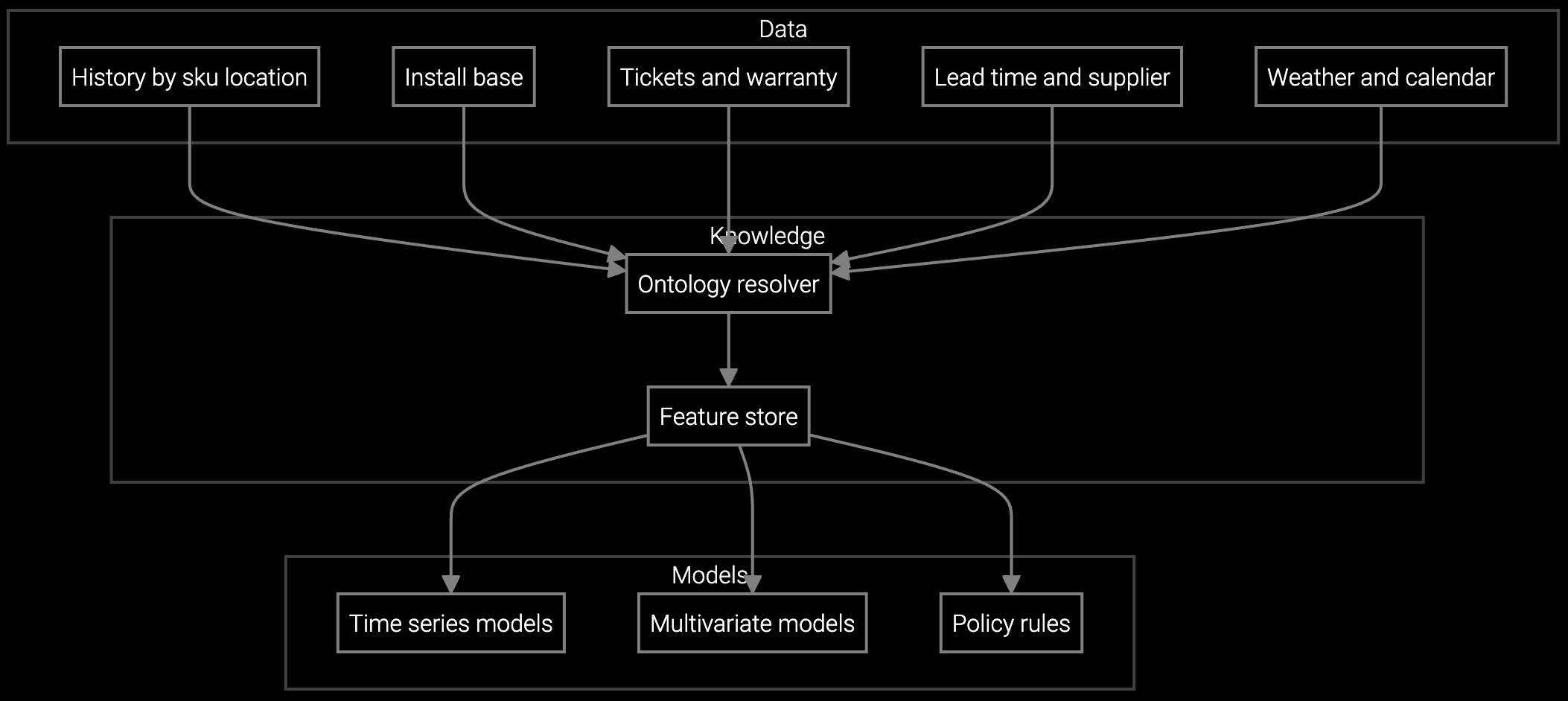
Bruviti's platform exposes inventory optimization through REST APIs and Python SDKs, letting you build forecasting into your existing SAP, Oracle, or custom data lake without replacing your ERP. The AI layer ingests install base telemetry, warranty claims history, and seasonal weather patterns to predict parts consumption at SKU and location level.
You control the integration logic. Connect the data feeds you trust, customize forecast horizons per product category, and tune substitute matching rules using standard Python. No black box, no proprietary query language. The model trains on your historical data and outputs JSON predictions you can route however you need.
Projects refrigerant, compressor, and control board consumption for HVAC and refrigeration based on install base age and seasonal climate data.

Snap a photo of a dishwasher pump or dryer belt and get instant part number identification, stock availability, and substitute options.

Optimizes stocking levels for water heater elements, microwave magnetrons, and other high-volume parts across regional distribution centers.
Appliance manufacturers face inventory challenges unlike other industries. A refrigerator compressor failure in July drives 10x the parts demand of the same failure in January. Water heater elements fail predictably with age, but HVAC control boards fail unpredictably with power surges. The platform accounts for these differences.
Connect your IoT telemetry feeds for connected appliances to detect early failure signals. Ingest regional weather forecasts to anticipate HVAC demand surges. Link warranty claims data to identify high-failure SKUs needing deeper stock. The REST API structure lets you feed the model exactly the context it needs without forcing a rigid data schema.
The forecasting model ingests historical weather data, install base age distribution, and past seasonal consumption patterns. It detects correlations between temperature extremes and specific SKU demand, then adjusts predictions as climate forecasts update. You control the forecast horizon and retraining frequency through API parameters.
Yes. The platform supports on-premises deployment where your data never leaves your infrastructure. Alternatively, use federated learning in the cloud deployment to train on encrypted data. You own the model weights and can export them to your own S3 bucket or data lake.
At minimum, it needs your parts catalog with specifications (dimensions, electrical ratings, compatibility metadata). Optionally, feed it historical substitution decisions made by experienced parts specialists to improve match accuracy. The API accepts JSON or CSV uploads and returns ranked alternatives with confidence scores.
Use the Python SDK to pull daily or weekly forecasts by SKU and location, then write those values to SAP custom fields or planning tables via SAP's BAPI or OData APIs. Bruviti provides sample integration code for common ERP systems. Your IT team controls the orchestration logic.
The API contract is model-agnostic. Input and output schemas remain stable even if you swap the underlying algorithm. You can A/B test Bruviti's model against your own or a third-party alternative by running both in parallel and comparing forecast accuracy over time.

SPM systems optimize supply response but miss demand signals outside their inputs. An AI operating layer makes the full picture visible and actionable.

Advanced techniques for accurate parts forecasting.

AI-driven spare parts optimization for field service.
Talk to our integration team about API access and sandbox environments for testing forecasts against your historical data.
Schedule Technical Demo