
Manual parts lookups across disconnected systems waste hours daily and delay critical machinery repairs.
Automate parts identification, availability checking, and ordering through natural language queries and image recognition. AI handles lookup, substitute matching, and order placement while you validate and approve, eliminating swivel-chair work across multiple systems.
Checking parts availability means logging into ERP, then warehouse management, then supplier portals. Each lookup requires navigating different interfaces, searching with different syntax, and manually comparing results.
Legacy CNC machines and decades-old compressors need parts no longer manufactured. Finding compatible substitutes requires tribal knowledge or hours of manual cross-referencing that stalls critical repairs.
Field photos show damaged bearings or worn gears without visible part numbers. Manual lookups through 500-page catalogs or guessing based on machine model wastes time and increases order errors.
Bruviti consolidates parts identification, availability checking, and ordering into one interface. Natural language search lets you type questions like "bearing for hydraulic pump model HP-3400" instead of navigating hierarchical menus. Image recognition identifies parts from field photos automatically, matching them to catalog numbers and suggesting compatible substitutes when originals are obsolete.
The platform connects to your ERP, warehouse management system, and supplier APIs to show real-time availability across all locations. When you approve an order, the system handles requisition creation, routing, and tracking automatically. You validate decisions instead of executing repetitive data entry tasks.

Snap a photo of a worn gear or damaged bearing on a CNC machine and get instant part number identification with availability across your warehouse network.

Forecasts demand by location and equipment age for industrial machinery parts, automatically triggering replenishment before stockouts delay production lines.
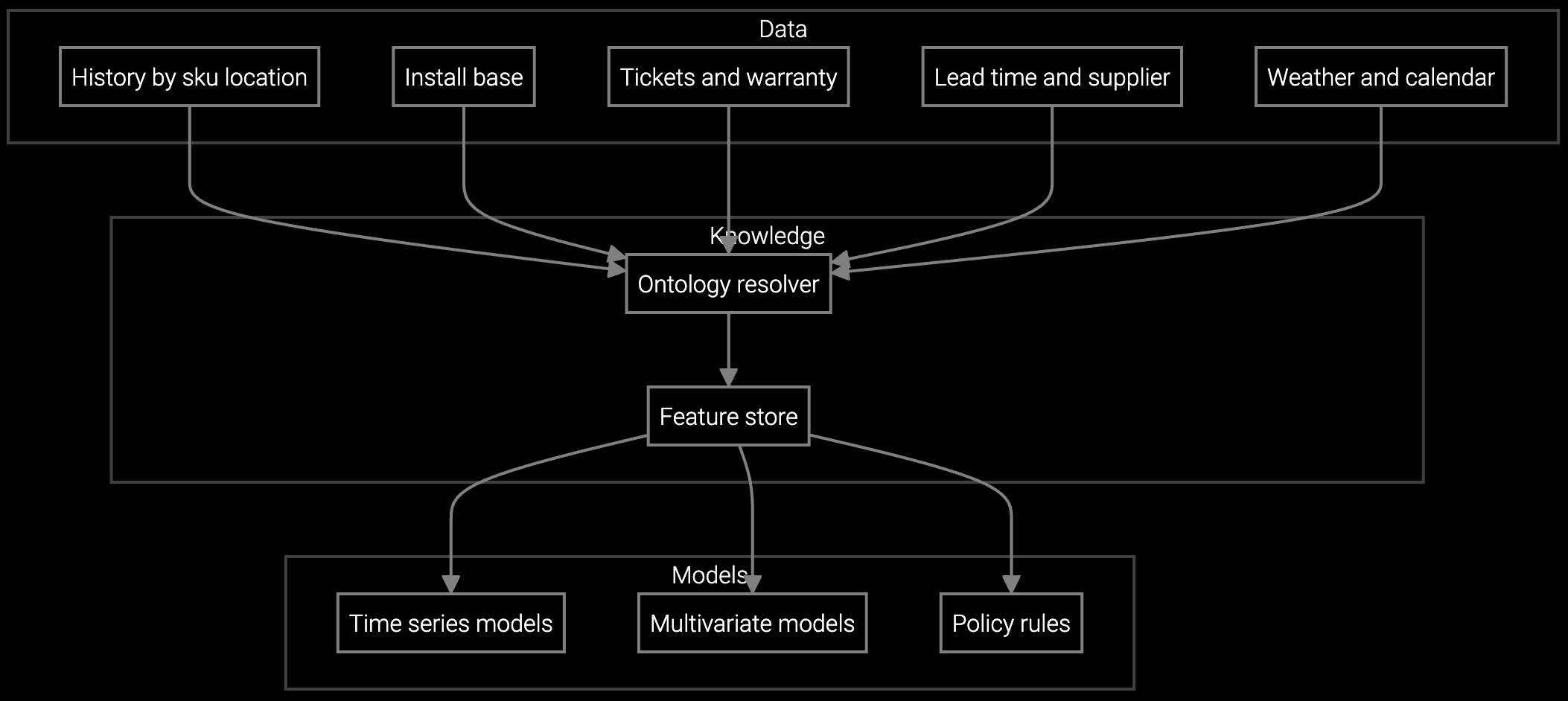
Projects consumption patterns for pump seals, compressor valves, and motor components based on installed base age, run hours, and seasonal maintenance cycles.
Industrial manufacturing equipment operates for decades, creating parts management challenges unique to the sector. A CNC machine installed in 1998 still needs maintenance, but original suppliers may have disappeared and part numbers changed hands multiple times. Pumps and compressors undergo iterative design changes, making cross-compatibility difficult to determine without deep product knowledge.
Automated parts intelligence learns these relationships from service history, engineering change orders, and supplier catalogs. When a part is obsolete, the system suggests validated substitutes used successfully in similar installations. Image recognition trained on industrial components identifies bearings, seals, and gears from field photos even when part numbers are worn off or hidden by grime.
The platform indexes service history, engineering change orders, and supplier cross-reference tables to identify valid substitutes when original parts are obsolete. It learns from successful replacements recorded in past work orders, building a knowledge base of proven alternatives specific to your installed base.
Yes. Image recognition trained on industrial components identifies bearings, gears, seals, and other parts from field photos. The system matches visual characteristics to catalog entries and suggests part numbers, even when labels are worn or damaged. It works best with clear photos showing distinctive features like dimensions or mounting patterns.
The platform prepares complete order requests with part numbers, quantities, and preferred suppliers, then presents them for your approval. You validate the recommendation and click to execute. This keeps you in control while eliminating manual data entry across multiple systems.
The system connects to your warehouse management and ERP systems via API to pull real-time inventory data across all locations. Search results show availability at each site, estimated lead times, and shipping costs, letting you choose the fastest or most cost-effective source.
You can manually add suppliers and part information, which the system then incorporates into future searches. Over time, it learns which suppliers provide specific part categories and suggests them automatically based on past usage patterns and performance.

SPM systems optimize supply response but miss demand signals outside their inputs. An AI operating layer makes the full picture visible and actionable.

Advanced techniques for accurate parts forecasting.

AI-driven spare parts optimization for field service.
See how automated parts workflows eliminate system-switching and speed up order fulfillment.
Schedule Demo