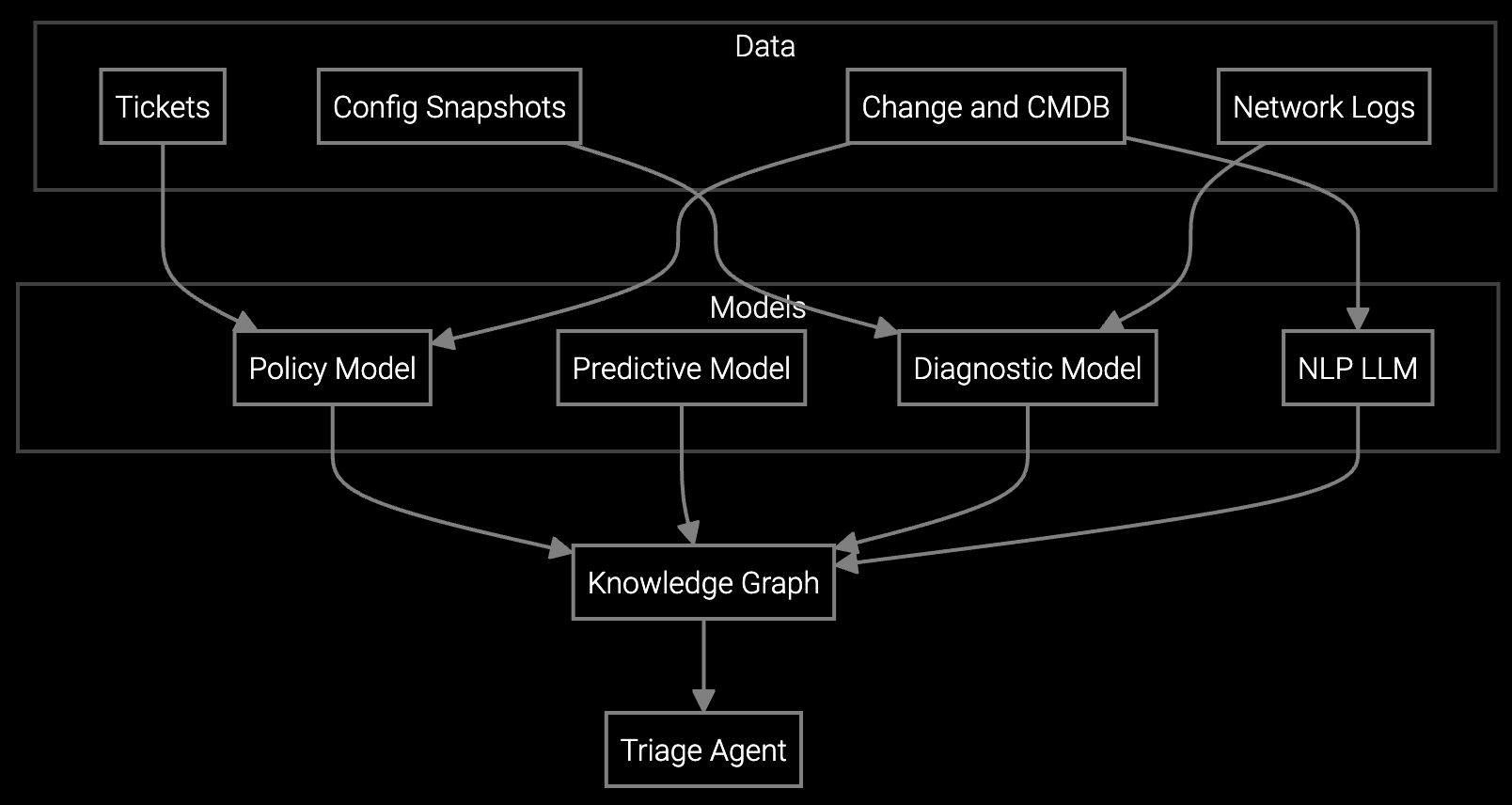
When fab equipment fails at $1M per hour downtime, every minute spent escalating between support tiers destroys margin.
Semiconductor OEMs reduce escalations by 60% through AI-guided remote diagnostics that analyze fab telemetry, identify root causes in complex tool chains, and resolve issues without field dispatch. Support engineers get instant context from process logs and equipment sensors.
Support engineers lack access to process engineer expertise for lithography, etch, and deposition tools. Each escalation burns 90+ minutes waiting for specialists who understand chamber behavior and recipe interactions.
Support engineers toggle between remote access platforms, log viewers, and telemetry dashboards. Critical context gets lost in handoffs when remote sessions fail and field service must start diagnosis from scratch.
Parsing gigabytes of sensor data from vacuum systems, gas flow controllers, and RF generators takes hours per incident. Support engineers escalate because they cannot identify which of 500+ parameters caused the alarm.
Bruviti's platform captures decades of process engineer knowledge and applies it during remote support sessions. The AI ingests telemetry from chamber sensors, RF generators, and gas delivery systems—correlating pressure deviations, temperature drift, and recipe parameter changes that human support engineers cannot process in real time.
When an EUV lithography tool throws an alignment error or a plasma etch chamber triggers a contamination alarm, the platform surfaces the three most likely root causes ranked by historical pattern match. Support engineers resolve issues in a single remote session instead of escalating to field service, protecting fab uptime and reducing service costs per incident by 60%.
Semiconductor OEMs face unique remote support challenges tied to nanometer precision and astronomical downtime costs. A lithography tool misalignment or etch chamber contamination event can idle $500M worth of wafers in process. Support engineers must diagnose across interdependent systems—vacuum subsystems, RF power delivery, gas flow controllers, and recipe management—where a single parameter drift cascades into yield loss.
The platform ingests sensor telemetry specific to semiconductor capital equipment: chamber pressure curves, RF match network impedance, gas flow ratios, and temperature profiles across dozens of zones. AI pattern recognition identifies which consumable is failing or which recipe parameter drifted, enabling remote resolution without dispatching field service to the cleanroom.
The AI analyzes telemetry from chamber sensors, RF generators, and gas delivery systems to identify root causes that support engineers cannot detect manually. It correlates pressure deviations, temperature drift, and recipe parameter changes across hundreds of variables, surfacing the top three likely failures ranked by historical pattern match. This gives remote support engineers the diagnostic confidence to resolve issues without escalating to field service.
Semiconductor OEMs typically reduce escalation rates by 60-65%, translating to $420K annual savings per support team through avoided field dispatches. Additional margin protection comes from faster mean time to resolution, which reduces customer downtime exposure and SLA penalty risk. The platform typically pays for itself within 6 months through direct cost reduction in service delivery.
Yes. The platform connects via APIs to existing remote access systems and equipment data collection infrastructure. It ingests telemetry from tool controllers, enriches remote sessions with AI-driven diagnostics, and auto-populates case notes with root cause analysis—all while preserving your current remote support workflows and security policies.
The platform learns from your existing service history across lithography, etch, deposition, metrology, and other tool categories. It captures process engineer expertise specific to each equipment type and recipe family. As new tool platforms enter your installed base, the AI adapts by analyzing telemetry patterns and service resolution data unique to those systems.
Track remote resolution rate, escalation rate to field service, mean time to resolution, and cost per support incident. Leading semiconductor OEMs also monitor customer-facing KPIs like equipment availability and unplanned downtime to quantify how faster remote resolution protects fab productivity. The platform provides dashboards that correlate AI-assisted resolutions with these business outcomes.
Software stocks lost nearly $1 trillion in value despite strong quarters. AI represents a paradigm shift, not an incremental software improvement.
Function-scoped AI improves local efficiency but workflow-native AI changes cost-to-serve. The P&L impact lives in the workflow itself.

Five key shifts from deploying nearly 100 enterprise AI workflow solutions and the GTM changes required to win in 2026.
See how semiconductor OEMs use Bruviti to resolve equipment issues remotely and protect fab uptime.
Schedule Executive Briefing