
Fab downtime costs $1M per hour—technicians need instant root cause answers, not 500-page manuals.
Install AI diagnostics in 3 phases: connect tool telemetry feeds, train models on historical PM data, deploy mobile copilot for technicians. Start with high-downtime tools, validate with FTF metrics.
Etch tool logs in one system, metrology data in another, PM records in paper binders. Technicians waste 20+ minutes per job hunting down context before they can diagnose.
Senior process engineers hold tribal knowledge of recipe correlations and failure patterns. When they retire, FTF rates drop 15-20% as junior technicians rely on trial-and-error.
Technicians spend 30 minutes post-job logging parts used, actions taken, and resolution steps—reducing billable time and delaying the next dispatch.
Deploy AI diagnostics in phases to minimize disruption. Phase 1 connects existing telemetry feeds from EUV lithography, etch, and deposition tools—no rip-and-replace. Historical PM logs, failure tickets, and process engineer notes train models to recognize chamber wear patterns, gas flow anomalies, and recipe drift.
Phase 2 deploys a mobile copilot for technicians on tablets. Natural language queries like "EUV source power drop 12%" return root cause analysis, recommended chamber kit parts, and step-by-step procedures—without switching apps. Phase 3 automates job documentation: AI pre-fills work orders, logs parts consumption, and updates equipment history as technicians validate findings.

AI analyzes tool telemetry to predict which chamber kits, RF generators, or gas flow controllers need replacement before dispatch—reducing repeat visits by 28%.

Correlates EUV source performance logs with historical failure patterns and captured process engineer notes to pinpoint contamination sources in minutes instead of hours.
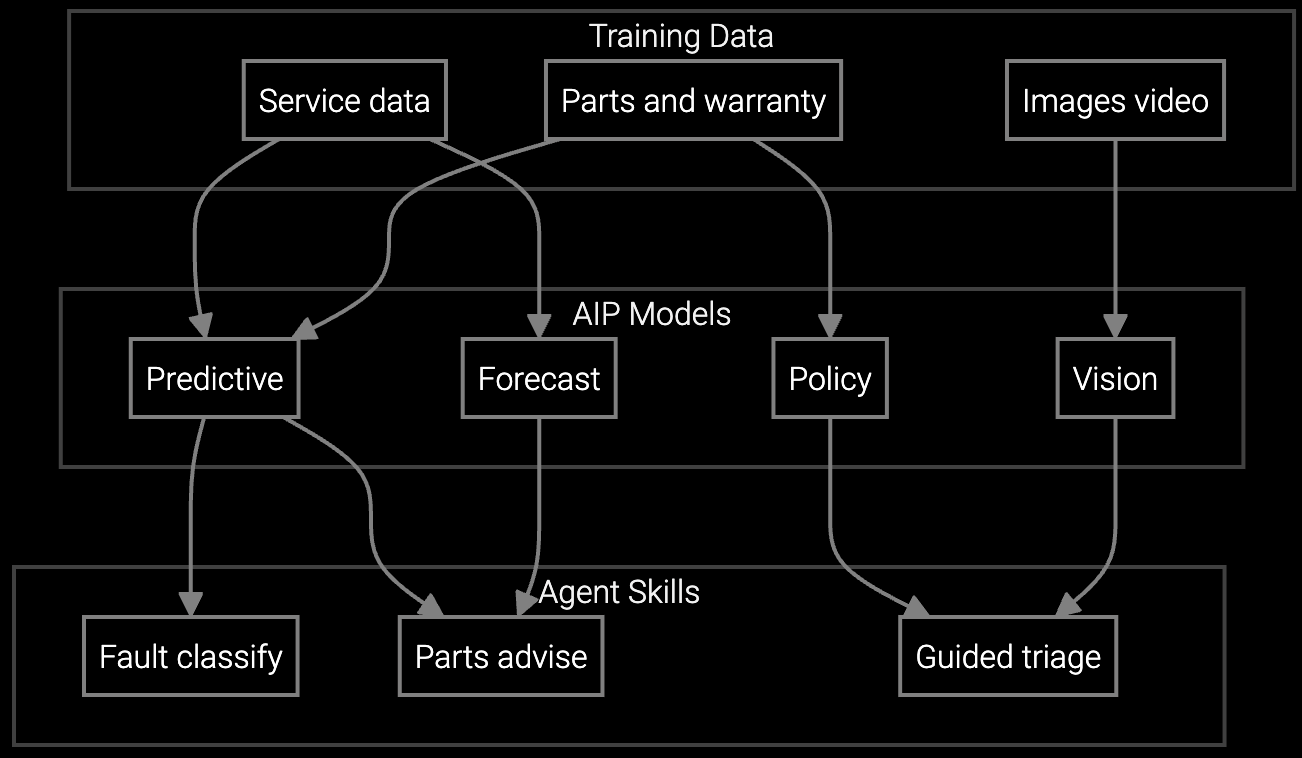
Mobile copilot provides real-time guidance on recipe adjustments, chamber cleaning procedures, and replacement part specs—eliminating manual searches during critical downtime events.
Semiconductor fabs run 24/7 with zero tolerance for production disruption. AI deployment must integrate with existing Manufacturing Execution Systems (MES), Equipment Interface systems (SECS/GEM), and Fab-wide Automation protocols without forcing tool downtime or workflow changes.
Start with tools that drive the highest unplanned downtime costs—typically EUV lithography systems where every hour offline costs $2M+ in lost wafer throughput. Connect telemetry from chamber sensors, gas flow monitors, and process recipe logs. Train models on 12-18 months of historical data to recognize wear signatures before catastrophic failure.
Connecting telemetry feeds and training initial models takes 2-3 weeks per tool type. Once the first lithography system is live, deploying to similar tools takes 3-5 days. Most fabs complete a 20-tool pilot in 8-10 weeks.
Core sources include equipment telemetry logs (SECS/GEM), preventive maintenance records, work order history, and parts consumption data. Optional sources like recipe parameter logs and yield correlation data improve model accuracy by 15-20%.
Bruviti's mobile copilot runs on standard fab tablets. Technicians type natural language queries or scan tool error codes. Results appear in seconds—no app switching or manual lookups required. Offline mode caches common diagnostics for clean room areas without network access.
No. AI provides diagnostic guidance and ranked recommendations, but technicians always validate and approve actions. The system learns from technician corrections to improve future suggestions—human expertise trains the model, not the reverse.
Track FTF rate, mean time to repair (MTTR), and unplanned downtime hours before and after deployment. Most fabs see 18-25% FTF improvement and 30-40% MTTR reduction within 90 days. Post-job admin time drops by 60-70% as auto-documentation replaces manual logging.

How AI bridges the knowledge gap as experienced technicians retire.

Generative AI solutions for preserving institutional knowledge.

AI-powered parts prediction for higher FTFR.
See how Bruviti deploys AI diagnostics without disrupting production.
Schedule Demo