
Your senior technicians retire in 18 months. Legacy CNC machines and turbines still need service for another decade.
Deploy AI-powered guidance by integrating telemetry feeds, uploading service manuals, and embedding mobile copilot APIs into your dispatch system. Technicians get instant diagnostics and repair steps without changing their workflow.
Your technicians already toggle between FSM, ERP, and legacy documentation systems. Adding another login screen means it won't get used. Integration must be seamless or adoption fails.
Decades of service manuals, tribal knowledge, and repair bulletins sit unusable. Technicians can't find the right page in a 500-page manual while standing in front of a failed compressor.
Operations can't pause for a six-month rollout. Technicians need immediate value or they'll ignore the new tool and stick with phone calls to senior staff.
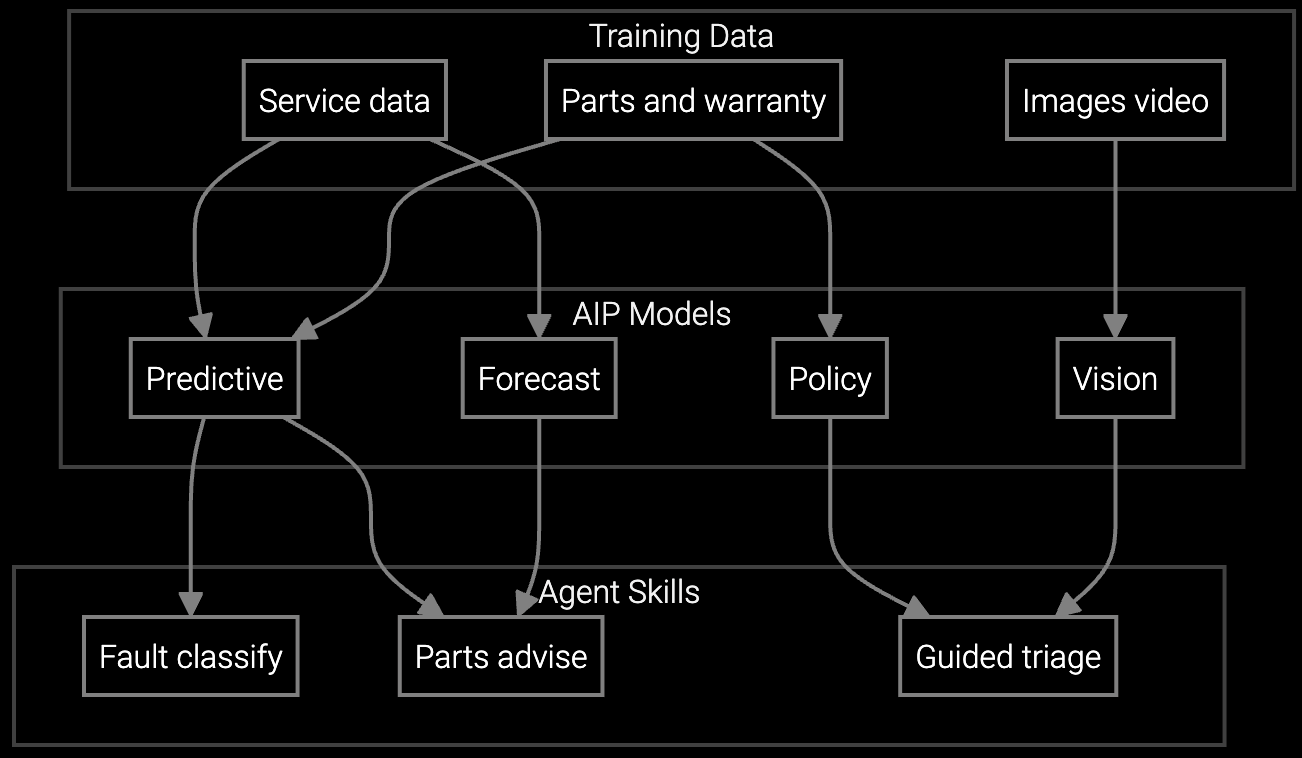
Implementation starts with data ingestion, not system replacement. Connect PLC feeds, SCADA logs, and IoT sensors to build a real-time equipment state model. Upload existing service manuals, technical bulletins, and warranty claims data to create the knowledge base. The platform learns failure patterns from historical work orders without requiring technicians to change how they document jobs.
Embed the mobile copilot API directly into your existing field service app or provide a lightweight native interface. Technicians see AI-generated diagnostics and repair steps alongside the work order they're already viewing. No separate login, no app switching, no disruption to dispatch workflows. The system suggests parts before the technician arrives, references the exact manual page for the equipment model, and auto-populates job notes after repair completion.

Predicts bearing, seal, and motor parts needed for industrial machinery before dispatch, reducing repeat visits to remote factory sites.
Mobile copilot provides step-by-step repair procedures for CNC machines, pulling exact torque specs and alignment tolerances from equipment manuals.

Correlates vibration sensor data with historical compressor failures to identify bearing degradation before catastrophic failure.
Industrial machinery has decades-long lifecycles with evolving documentation. The platform ingests legacy manuals for older CNC machines alongside real-time telemetry from newer IoT-enabled turbines and compressors. It maps part numbers across obsolete and current inventory systems, ensuring technicians see correct substitutes when original components are discontinued.
For OEMs serving distributed manufacturing sites, deployment prioritizes equipment with highest downtime costs first. High-criticality assets like material handling systems and power generation equipment get AI-assisted diagnostics before lower-priority machinery. This staged rollout proves ROI quickly while minimizing implementation risk.
Data connection and knowledge base upload typically complete in 2-3 weeks. First technicians start using AI diagnostics within 48 hours of integration. Full team adoption across all equipment types usually takes 6-8 weeks with phased rollout.
Minimal training required because the interface embeds in existing FSM tools. Technicians see AI suggestions alongside standard work orders. Most teams need only a 30-minute walkthrough of how to review AI-generated diagnostics and part recommendations.
Minimum viable deployment requires historical work orders and equipment manuals. Adding telemetry feeds from SCADA or PLC systems significantly improves predictive accuracy. Parts inventory data enables automated part recommendations. The more data sources connected, the better the AI performs.
Yes. The platform uses historical failure patterns, work order notes, and manual documentation to assist with legacy equipment. Technicians get repair procedure guidance and parts recommendations even without live telemetry. Adding sensors later enhances predictive capabilities but isn't required for initial value.
All uploaded manuals and technical data remain private to your organization. The AI model trains only on your equipment documentation and work order history. No proprietary information is shared across customers or used to train general models.

How AI bridges the knowledge gap as experienced technicians retire.

Generative AI solutions for preserving institutional knowledge.

AI-powered parts prediction for higher FTFR.
See how Bruviti integrates with your existing FSM and delivers immediate technician value.
Schedule Implementation Walkthrough