
When routers fail and the part's not on the van, your customer's network stays down—costing credibility and revenue every hour.
Operators using AI parts forecasting reach 95-98%+ fill rate with 40% fewer stockouts, per Bruviti deployment data, so technicians arrive with the right network equipment part instead of rescheduling. The model predicts what each call needs and keeps van and depot stock aligned to actual demand, not averages.
Critical router components missing from field inventory force costly overnight freight. Service teams wait hours while customers experience extended downtime and SLA violations mount.
Legacy stocking models over-provision slow-moving optical modules while critical power supplies run out. Capital is tied up in parts that rarely fail while high-turnover items stockout.
When original line cards are unavailable, finding compatible alternatives requires manual catalog searches and engineering consultations. Service calls stall while teams hunt for substitutes.
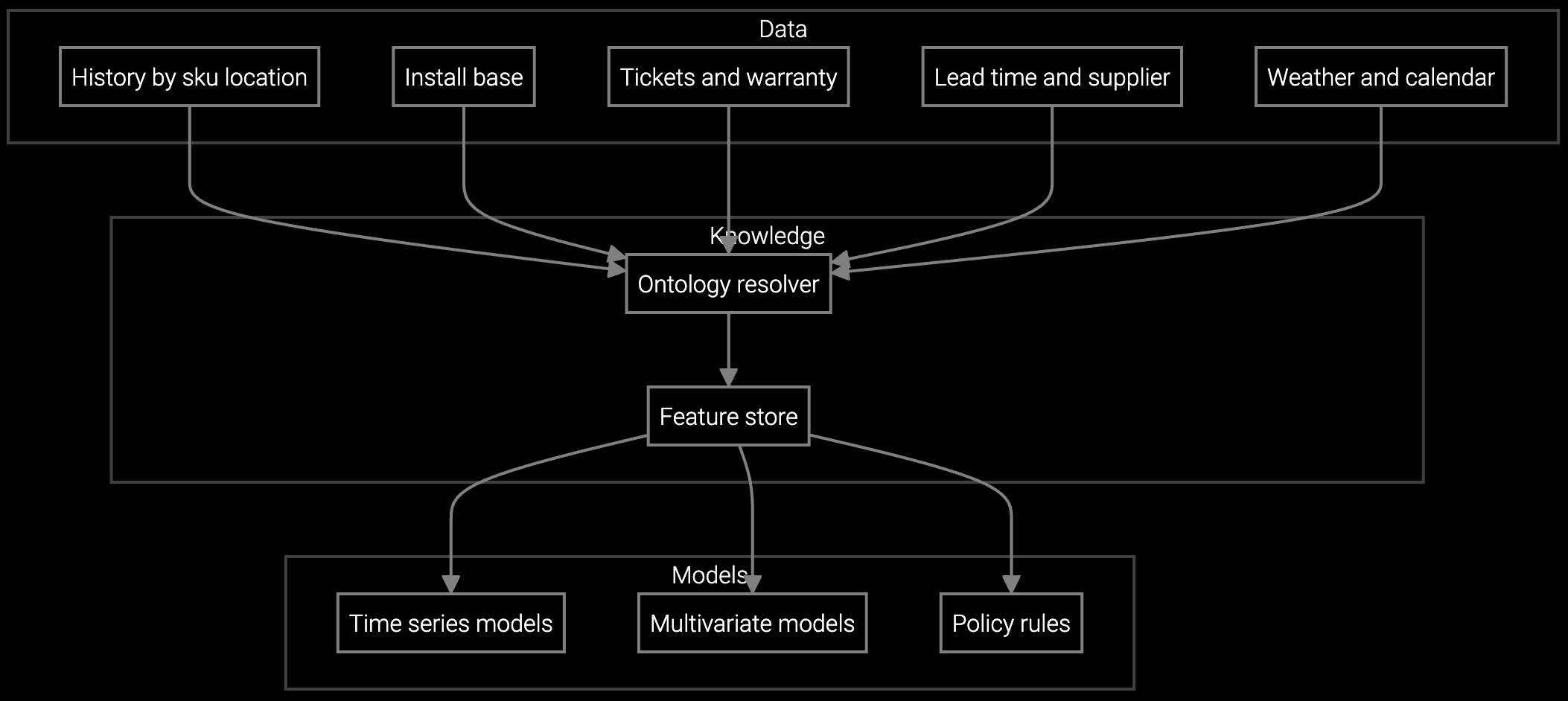
Bruviti's platform analyzes your installed base telemetry, failure patterns, and service history to predict which network equipment parts will fail where and when. Instead of reacting to stockouts, you stock the right parts at the right locations before failures occur.
The system automatically suggests substitute parts when originals aren't available, pulling from your parts catalog and engineering specifications to match compatibility. Service teams get instant answers on alternatives without swivel-chair searches across multiple systems or waiting for engineering approval.

Forecast power supply and fan failures across router deployments by geographic region, optimizing field stock levels to prevent service delays.
Project line card and optics consumption based on installed base firmware versions, usage patterns, and historical RMA rates.

Snap a photo of a failed switch module and instantly get part number identification, substitute options, and local availability.
Router and switch failures create immediate business impact for your customers—enterprise networks go down, data centers lose connectivity, and telecom infrastructure service degrades. Your customers measure downtime in lost revenue per minute, making parts availability a direct driver of customer retention.
Network equipment has complex interdependencies: line cards must match chassis firmware, optics must be compatible with cable plant, power supplies vary by deployment altitude. Generic parts databases don't capture these nuances. Your service teams need instant access to compatibility rules and substitute options that preserve network performance.
The platform analyzes SNMP traps, syslog data, and telemetry from your installed base to identify early failure indicators like temperature spikes, fan speed degradation, and power supply voltage drift. It correlates these signals with historical RMA patterns to forecast failure probability by location and time window, directing inventory to the regions with highest predicted demand.
The system maintains your engineering compatibility matrix and automatically suggests substitute parts that match form factor, firmware compatibility, and performance requirements. Service teams see substitute options ranked by availability and compatibility score directly in the ordering interface, eliminating manual catalog searches.
Yes. It analyzes service call density, installed base concentration, and failure forecasts by geography to recommend optimal stocking levels per location. Slow-moving parts consolidate to central hubs while high-turnover items distribute to field locations, reducing total inventory investment while improving fill rates.
Bruviti provides pre-built connectors for major ERP platforms that sync part availability, reorder points, and demand forecasts. The platform operates as an intelligence layer on top of your existing systems, enhancing forecasting accuracy without requiring ERP replacement or complex data migrations.
Typical deployments achieve 85-92% forecast accuracy within 90 days of implementation, improving as the model learns from your specific installed base patterns. Accuracy varies by part type—power supplies and fans stabilize quickly while optics require longer training periods due to environmental factors affecting failure rates.

SPM systems optimize supply response but miss demand signals outside their inputs. An AI operating layer makes the full picture visible and actionable.

Advanced techniques for accurate parts forecasting.

AI-driven spare parts optimization for field service.
See how AI-driven inventory optimization eliminates stockouts and cuts emergency shipment costs.
Schedule Demo