
Hyperscale operations demand instant responses across thousands of daily cases—manual workflows create bottlenecks that erode margins.
Data center OEMs automate customer service workflows by deploying AI to execute case triage, knowledge retrieval, and resolution workflows end-to-end—reducing average handle time while maintaining consistency across thousands of daily customer interactions.
When agents manually classify cases across server, storage, cooling, and power teams, misrouting creates unnecessary escalations. Each handoff adds delay, frustrating customers expecting four-nines availability.
Agents search across multiple systems—CRM, ticketing, IPMI logs, firmware databases—to find relevant context. Time spent searching extends handle time and increases cost per contact.
Different agents provide different answers for identical issues—BMC alerts, thermal anomalies, RAID rebuilds. Inconsistency drives repeat contacts and lowers First Contact Resolution rates.
Bruviti deploys AI to execute entire customer service workflows autonomously—from case intake through triage, knowledge retrieval, and resolution recommendation. The platform ingests BMC telemetry, IPMI logs, firmware versions, and historical case data to classify issues, route to the correct team with full diagnostic context, and surface resolution paths without human intervention.
For executives managing hyperscale contact center operations, this shifts workflow design from labor-intensive manual processes to autonomous AI execution. Agents transition from searching and classifying to reviewing AI-generated resolution cases—validating recommendations rather than building them from scratch. The result: predictable handle times, consistent response quality, and direct cost reduction per contact.
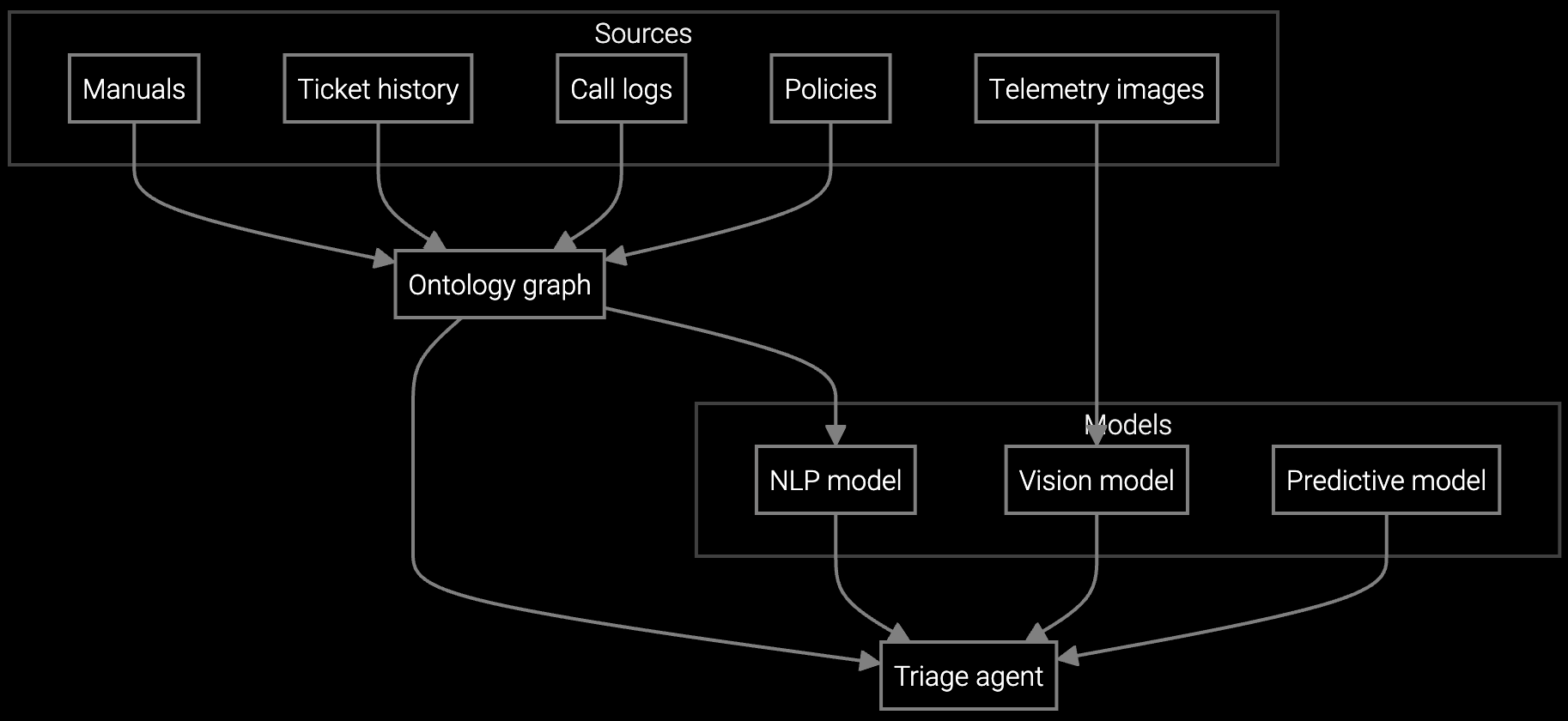
Autonomous case classification analyzes BMC alerts, correlates telemetry from power and cooling systems, and routes issues to server, storage, or infrastructure teams with complete diagnostic context.
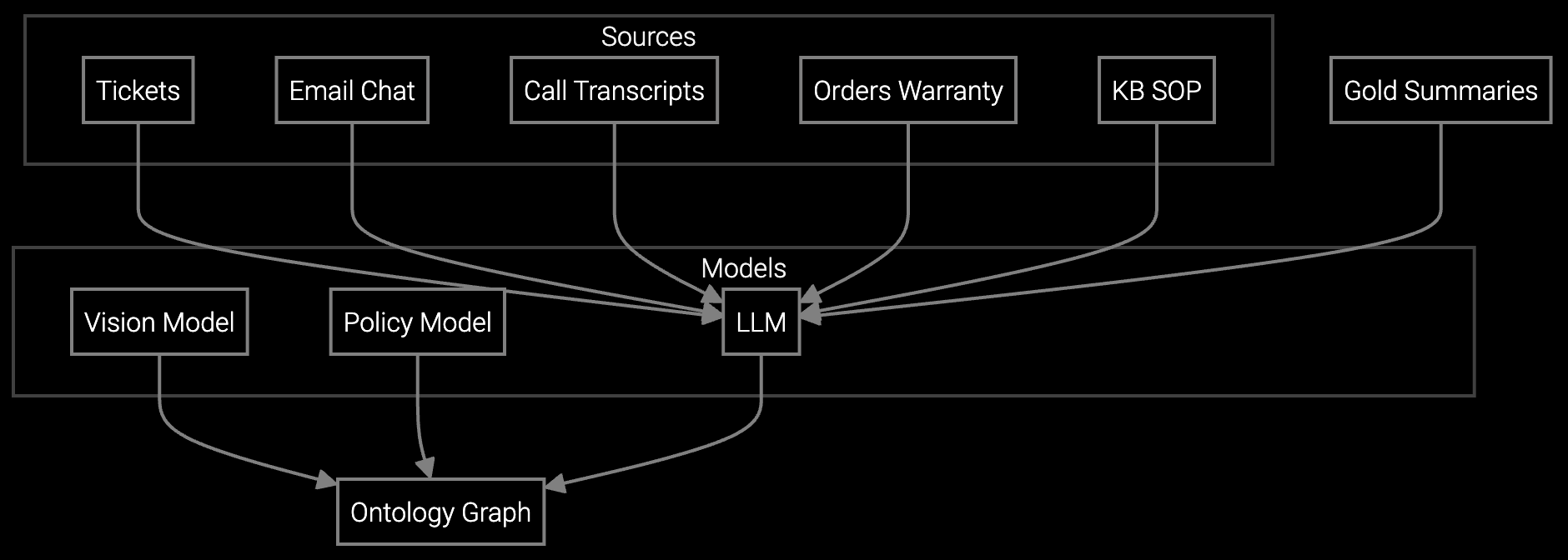
Instantly generates case summaries from customer emails, chat logs, and IPMI telemetry streams so agents understand hardware failure history and configuration drift without reading every interaction.

AI automatically reads customer emails describing thermal issues or drive failures, classifies problem types, and drafts responses using historical resolution data from thousands of similar data center incidents.
Data center OEMs face unique workflow complexity: thousands of daily cases spanning server failures, storage RAID rebuilds, cooling hot spots, and power distribution anomalies. Traditional manual workflows require agents to parse IPMI alerts, correlate BMC telemetry, and search firmware databases—creating bottlenecks that extend average handle time and increase cost per contact.
Automated workflows ingest telemetry directly from customer data centers—BMC alerts, thermal sensor readings, drive SMART data, PDU metrics—and execute triage logic autonomously. The platform classifies issues by subsystem (compute, storage, power, cooling), correlates symptoms with historical resolution patterns, and routes cases to specialized teams with full diagnostic context already assembled. Agents receive resolution cases, not raw incidents.
AI executes the most time-consuming workflow steps—case classification, telemetry correlation, knowledge base search—autonomously. Agents spend less time per case while maintaining higher resolution quality. Lower average handle time directly reduces cost per contact, especially at hyperscale volumes where small efficiency gains compound into significant margin protection.
AI can fully execute case intake, triage classification, telemetry analysis, knowledge retrieval, and resolution recommendation. Human agents remain in the loop for final validation, customer communication, and exception handling. The workflow shifts from agents building resolution cases to agents reviewing AI-generated cases—a fundamentally different labor model.
The platform connects via API to major CRM and ticketing systems, pulling case data and pushing workflow outputs without requiring agents to switch tools. SLA timers, escalation paths, and audit trails remain intact. Integration preserves existing operational processes while accelerating the workflow steps that drive handle time.
The AI trains on historical case data specific to your data center equipment portfolio—server models, storage configurations, cooling systems, power infrastructure. It learns which symptoms map to which teams and which resolutions succeed for which failure modes. Confidence scoring flags low-certainty cases for human review, preventing incorrect routing from reaching customers.
Most data center OEMs see measurable average handle time reduction within 60-90 days of deploying automated triage and knowledge retrieval workflows. Start with high-volume, well-documented case types to build confidence quickly, then expand to more complex workflows. Early wins in AHT reduction fund broader workflow automation rollout.

Transforming appliance support with AI-powered resolution.

Understanding and optimizing the issue resolution curve.

Vision AI solutions for EV charging support.
See how Bruviti transforms manual processes into autonomous AI-executed workflows that reduce cost per contact.
Schedule Executive Briefing