
Every delayed repair from missing parts erodes customer trust and extends downtime when refrigerators and HVAC systems fail.
Bruviti deployment data holds 4-week forecast error to 8% or less and 6-week error to 25% or less for service parts. Appliance service operators run tighter demand forecasts on A-class SKUs, so the parts that drive repeat truck rolls stay in stock and stockouts stop blocking same-visit fixes.
Compressor failures spike during heat waves. Pump assemblies fail more in hard-water regions. Manual forecasting can't account for these variables, leaving service centers stocked for average demand instead of actual need.
You have the part somewhere, but finding which warehouse holds it takes three phone calls and 20 minutes. By then, the technician has moved to the next appointment and marked the job incomplete.
A 10-year-old dishwasher needs a control board that's been discontinued. Engineers know the compatible replacement, but the ordering system doesn't, so service stalls while you track down tribal knowledge.
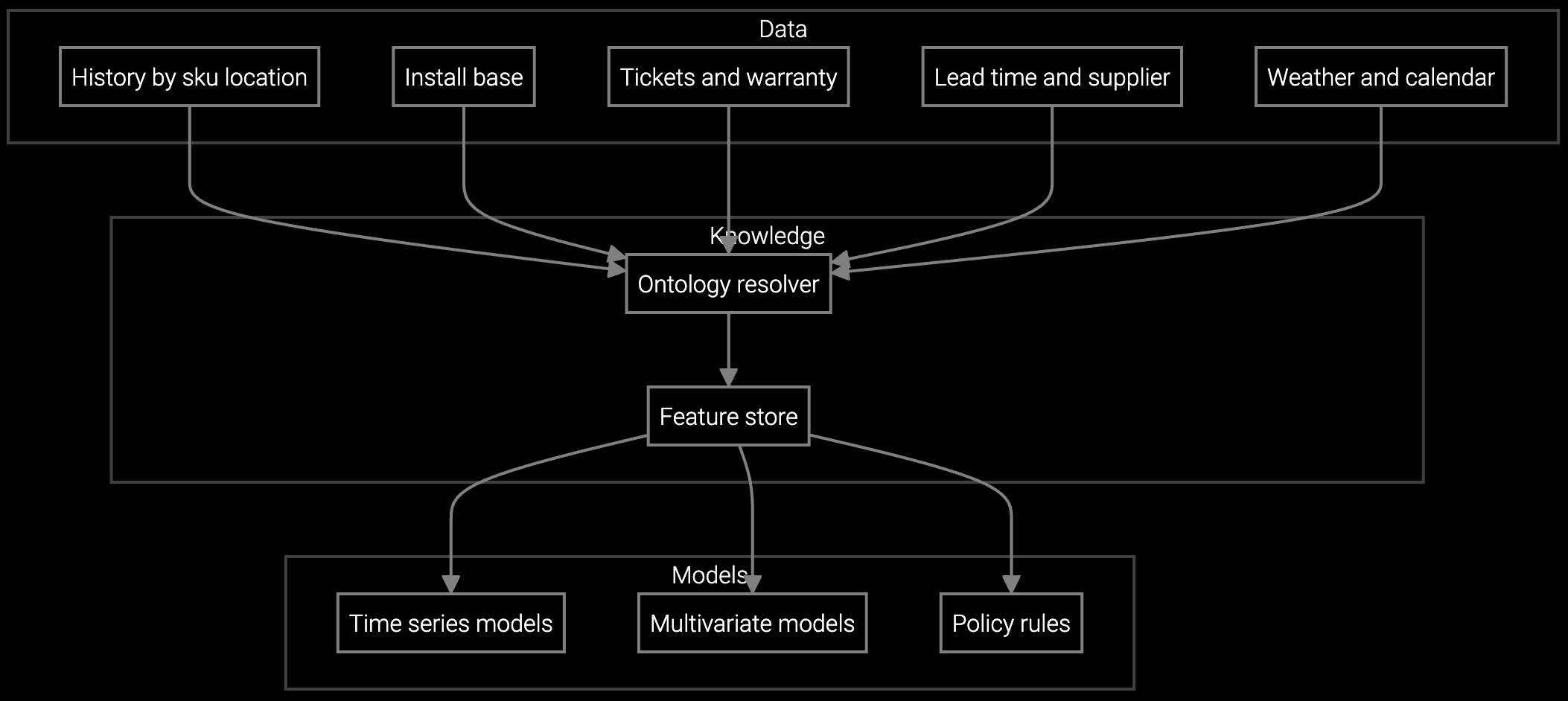
Bruviti ingests warranty claims, service history, and connected appliance telemetry to identify which parts fail most often for each model, geography, and season. The platform combines this with installation base age profiles to forecast demand at individual service center and warehouse locations.
When a technician receives a service assignment, the system automatically checks real-time inventory across all locations and reserves the predicted parts. If the primary warehouse is out, it finds the nearest alternate and triggers shipment before the technician requests it. For discontinued parts, the platform matches to approved engineering substitutes, eliminating the manual search.

Forecast refrigeration compressor demand by region and season, stocking service centers before summer HVAC failures spike.
Project washer drum seal replacements based on installation age and usage patterns from connected appliances.

Technician snaps a photo of a failed icemaker assembly and instantly gets the part number and nearest stock location.
Appliance manufacturers support thousands of SKUs across product lines spanning decades. A single refrigerator model might have 15 failure-prone parts, each with regional demand variations driven by water quality, climate, and usage intensity. Add seasonal spikes when air conditioners fail during heat waves, and manual inventory planning becomes guesswork.
Connected appliances provide real-time diagnostics, but most service operations lack the analytics to turn that telemetry into actionable inventory decisions. The result: overstocked slow-movers sitting in warehouses while high-demand compressors and control boards run out at service centers during peak season.
The platform analyzes historical warranty claims, service records, and connected appliance telemetry to identify failure patterns by model, age, geography, and season. It correlates these patterns with installation base data to forecast demand at specific service center locations, updating predictions as new failure data arrives.
The system maintains a substitute parts library built from engineering cross-reference data and service history. When a discontinued part is requested, it automatically suggests approved alternatives that fit the same application, showing availability and compatibility notes so you don't have to track down tribal knowledge.
Yes. The platform integrates with your ERP to track real-time inventory across all warehouses and service centers. When a technician needs a part, it checks all locations simultaneously and identifies the nearest source. If primary stock is depleted, it automatically suggests alternate locations and can trigger inter-warehouse transfers.
Most appliance manufacturers see measurable fill rate improvement within 60-90 days as the platform learns failure patterns and optimizes stock placement. Emergency shipment reduction typically follows within the first quarter as predictive stocking eliminates the need for expedited orders during seasonal demand spikes.
No. The platform integrates with your existing ordering system and presents recommendations within your current workflow. Technicians continue ordering parts the same way, but now they see real-time availability across all locations, substitute suggestions for out-of-stock items, and predictive alerts about parts they'll likely need based on the service assignment.

SPM systems optimize supply response but miss demand signals outside their inputs. An AI operating layer makes the full picture visible and actionable.

Advanced techniques for accurate parts forecasting.

AI-driven spare parts optimization for field service.
See how predictive inventory eliminates stockouts and reduces emergency shipment costs.
Schedule Demo