
Seasonal HVAC spikes and decades of SKUs create a margin trap—too much stock bleeds capital, too little stock delays service.
AI-powered demand forecasting predicts parts needs by model, location, and season while substitute matching prevents stockouts. This reduces carrying costs 20-30% while maintaining fill rates above 95%.
Summer AC failures and winter furnace breakdowns create unpredictable spikes. Manual forecasting misses these patterns, forcing emergency airfreight or leaving customers waiting days for parts.
Supporting appliances manufactured over 20 years means warehouses full of slow-moving parts. Without intelligent demand signals, inventory managers overprovision EOL components that never move.
Regional warehouses and service van stock operate independently. A compressor sits idle in Phoenix while a Phoenix tech expedites the same part from Chicago, doubling logistics costs.
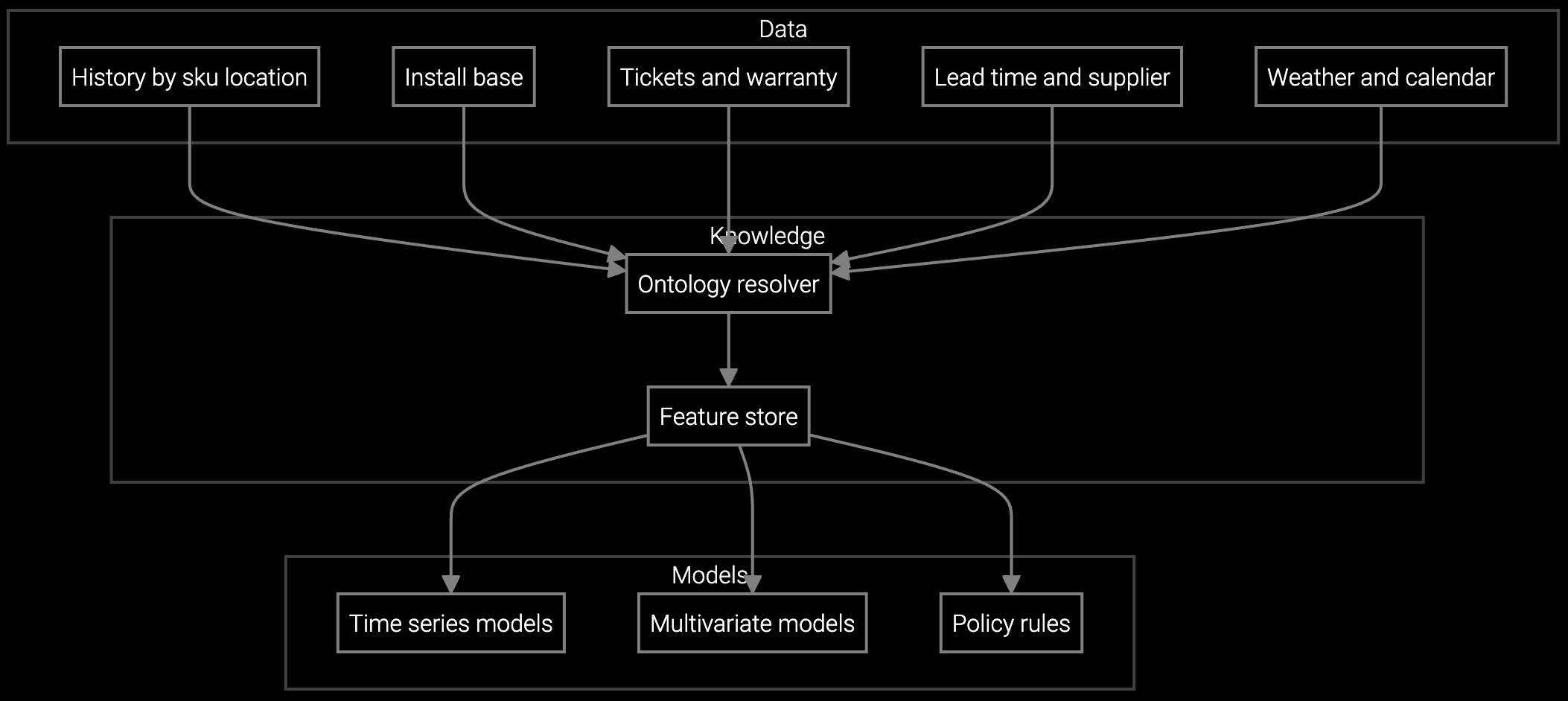
Bruviti ingests decades of warranty claims, service orders, and installed base data to identify which compressor models fail at year 8, which dishwasher pumps spike during holiday cooking, and which HVAC controls degrade in humid climates. The platform forecasts demand by SKU, location, and time window—accounting for installed base age distribution, regional weather patterns, and product lifecycle stage.
When an exact part is unavailable, the AI instantly suggests compatible substitutes based on technical specifications, warranty eligibility, and regional stock levels. This prevents service delays while reducing safety stock requirements. Inventory planners gain a single view across warehouse locations, service van inventory, and supplier lead times—eliminating the swivel-chair work of checking six systems to answer "where's the nearest part?"

AI forecasts HVAC compressor and refrigerator seal demand by region and season, optimizing stock levels before summer heat and winter cold drive service spikes.
Projects consumption for aging dishwasher pumps and washer control boards based on installed base age curves and historical failure rates.

Field technicians photograph a failed heating element or water valve and receive instant part number identification with substitute options and local availability.
Appliance manufacturers face a unique inventory challenge: supporting products with 10-20 year lifespans across thousands of SKUs while maintaining thin margins. A single refrigerator line may have 15 control board variations, 8 compressor types, and 20 door seal configurations—each with different failure curves and regional demand patterns.
The platform learns which ice maker assemblies fail early in hard-water regions, which washer bearings wear out faster in commercial laundromats, and which HVAC capacitors degrade predictably at year 12. By correlating installed base age, usage patterns, and service history, Bruviti identifies which models are entering their peak failure window—allowing you to preposition parts before call volumes spike. This intelligence extends to substitute matching: when a 2008 dishwasher pump is backordered, the AI instantly identifies compatible alternatives from newer model years that fit the same mounting bracket and electrical specs.
The platform analyzes historical failure curves by product cohort and installed base age distribution. If you have 50,000 Model X dishwashers entering year 12—when pump failures historically spike—the AI increases safety stock for that specific SKU while reducing inventory for newer cohorts still under warranty. This cohort-based forecasting prevents both stockouts and overprovisioning.
Appliance manufacturers typically see 20-30% reduction in total carrying costs within 12 months. The largest gains come from rightsizing slow-moving legacy parts—AI identifies which EOL components can be safely reduced based on actual failure rates rather than blanket safety stock rules. Emergency freight costs drop 40%+ as predictive replenishment positions parts before seasonal spikes.
The AI maintains a compatibility graph of mechanical fit, electrical specifications, and warranty eligibility across your entire parts catalog. When a 2005 oven igniter is backordered, it instantly identifies three newer igniter models that fit the same mounting holes and voltage requirements. Technicians see these options ranked by local availability and cost—eliminating the manual cross-reference work.
Yes. The forecasting model incorporates regional climate data alongside your service history. It learns that Phoenix AC compressors spike in June while Minneapolis furnace parts peak in November. This allows dynamic safety stock adjustments by location—you maintain higher compressor inventory in Sun Belt warehouses during summer while reducing Northern stock, then reverse the pattern in winter.
Bruviti connects via API to SAP, Oracle, or custom ERP systems to ingest service orders, inventory levels, and supplier lead times. The AI generates recommended replenishment orders that flow back into your existing procurement workflow—no rip-and-replace required. Most implementations complete the initial integration in 4-6 weeks with phased rollout across product lines.

SPM systems optimize supply response but miss demand signals outside their inputs. An AI operating layer makes the full picture visible and actionable.

Advanced techniques for accurate parts forecasting.

AI-driven spare parts optimization for field service.
Schedule a 30-minute analysis to quantify your carrying cost reduction and fill rate improvement potential.
Talk to an Expert