
Every unnecessary truck roll costs $150-300, and legacy FSM systems can't predict which parts technicians need before dispatch.
AI-assisted dispatch makes more than 60% of repair-versus-replace decisions automatically with explainable outcomes, each in under 5 minutes versus 20 to 45 minutes manually, per Bruviti deployment data. Building it means wiring fault history, parts data, and warranty status into one model so technicians arrive with the right call already made.
Proprietary FSM platforms force you to rebuild custom logic when switching vendors. You inherit their data model, their release schedule, and their integration limits.
Dispatchers assign jobs without knowing which parts to stage or which technician has relevant experience. Technicians arrive unprepared, extend truck rolls, and escalate simple repairs.
Work order history lives in ServiceMax, parts data in SAP, and IoT telemetry in a separate data lake. Your ML models can't correlate failure symptoms with parts consumption patterns.
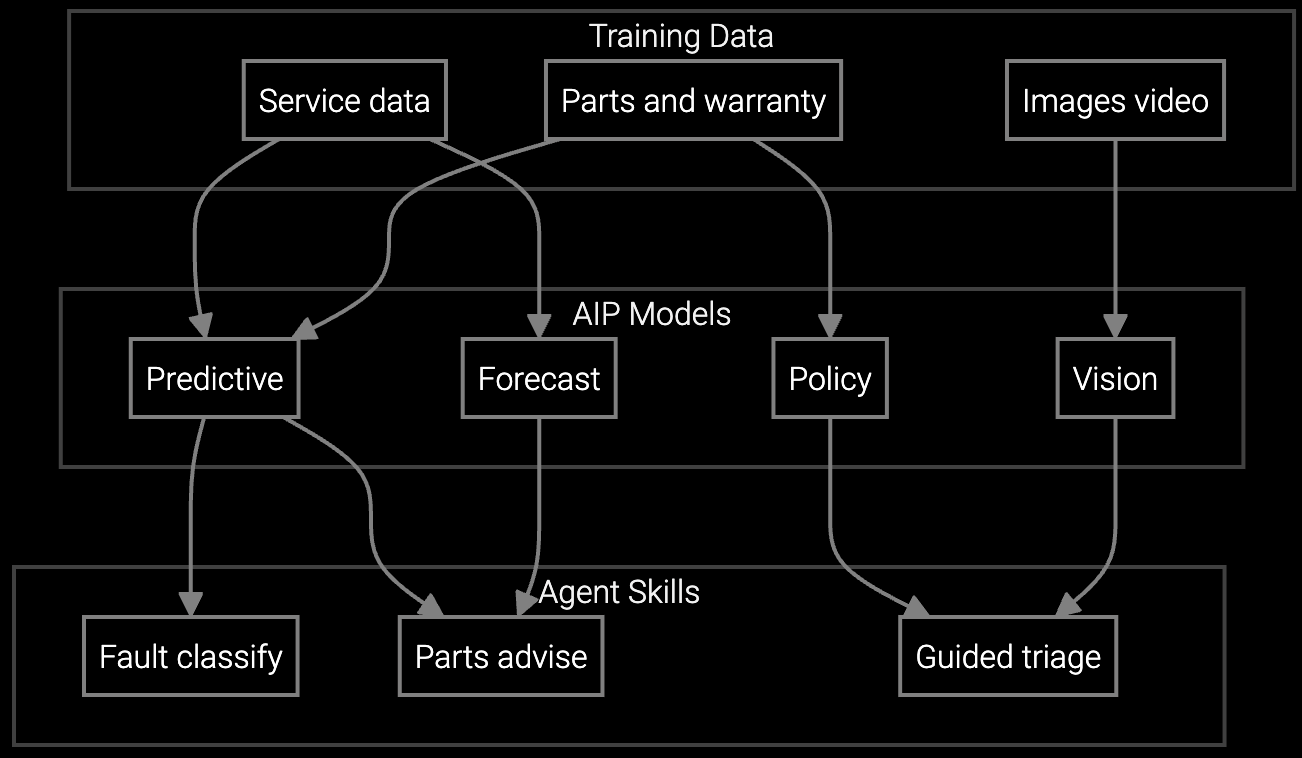
Bruviti provides Python and TypeScript SDKs that connect your existing FSM system to AI models trained on appliance failure patterns. The platform exposes RESTful APIs for dispatch optimization, parts prediction, and technician routing without requiring you to migrate data or replace ServiceMax, ClickSoftware, or custom dispatch tools.
The integration layer ingests work order events, correlates them with parts inventory and IoT telemetry streams, and returns recommendations your dispatch system can consume. You own the data pipeline, control model retraining schedules, and maintain independence from vendor ecosystems. The architecture supports hybrid deployment: cloud APIs for inference speed, on-premise model hosting for data sovereignty.

API predicts compressor, circuit board, or water valve requirements from symptom codes before dispatch, reducing repeat visits for refrigerators and dishwashers by 28%.
Mobile SDK delivers real-time diagnostic guidance for HVAC systems and commercial ovens, surfacing repair procedures from historical work orders via technician smartphone apps.

Machine learning correlates error codes from connected appliances with failure patterns across water heaters and ice machines, identifying root causes faster than technician experience alone.
Appliance manufacturers process 10,000-50,000 service calls daily across refrigerators, washers, dryers, dishwashers, and HVAC units. The integration must handle seasonal spikes during summer heat waves and holiday cooking periods without degrading dispatch speed or prediction accuracy.
The API layer connects to your existing ServiceMax or ClickSoftware instance via webhook subscriptions. When a work order is created, the system pulls historical service records for that model and serial number, correlates symptom codes with IoT telemetry if the appliance is connected, and returns a ranked list of likely parts and recommended technician skill level. Your dispatch team consumes these predictions through their existing UI without learning new tools.
The API accepts JSON payloads via REST endpoints or webhook subscriptions. Standard fields include work order ID, symptom codes, equipment model and serial number, customer location, and parts already attempted. The SDK includes adapters for ServiceMax, SAP CRM, and Salesforce Field Service data models, with custom mapping templates for proprietary FSM systems.
Yes. The Python SDK supports on-premise model training using your work order dataset. You control which data leaves your environment, and can deploy fine-tuned models to private cloud instances or edge servers. Bruviti provides pre-trained foundation models for appliance categories, which you adapt to your specific product lines and failure patterns.
The platform ingests time-series telemetry via Kafka, MQTT, or direct API integration. For refrigerators, this includes compressor run time, temperature deviations, and door open frequency. For HVAC systems, it tracks thermostat setpoints, runtime cycles, and fault codes. The AI correlates this telemetry with historical failure patterns to predict parts requirements before technician dispatch.
The architecture uses open API standards and exports all prediction data in JSON format that any system can consume. You can switch inference providers, deploy models to different cloud vendors, or migrate to an in-house ML stack without losing access to historical predictions or retraining pipelines. The SDK is open-source under Apache 2.0 license, ensuring you can fork and maintain integrations independently.
Initial integration with ServiceMax or ClickSoftware typically takes 4-6 weeks. This includes API authentication setup, webhook configuration for work order events, and custom field mapping for your symptom code taxonomy. The SDK includes Terraform templates for cloud deployment and Docker containers for local testing, reducing infrastructure setup time to under a week for teams with existing Kubernetes or serverless platforms.

How AI bridges the knowledge gap as experienced technicians retire.

Generative AI solutions for preserving institutional knowledge.

AI-powered parts prediction for higher FTFR.
Talk to our engineering team about API access, SDK documentation, and integration architecture for your FSM stack.
Schedule Technical Review