
Deploy once, eliminate manual tracking forever—your devices report their own status automatically.
Deploy AI asset tracking by connecting telemetry APIs to your equipment registry, enabling automated configuration monitoring and predictive lifecycle alerts with minimal workflow disruption.
Missing serial numbers, outdated firmware versions, and unknown configuration states force you to waste time hunting down basic device information before every support case.
Network devices accumulate unauthorized changes over time. Your records say one thing, the actual running config says another, and you only discover the gap during troubleshooting.
You learn about EOL equipment and expiring support contracts from customer complaints, not from your systems. No early warning means no time to plan upgrades or renewals.
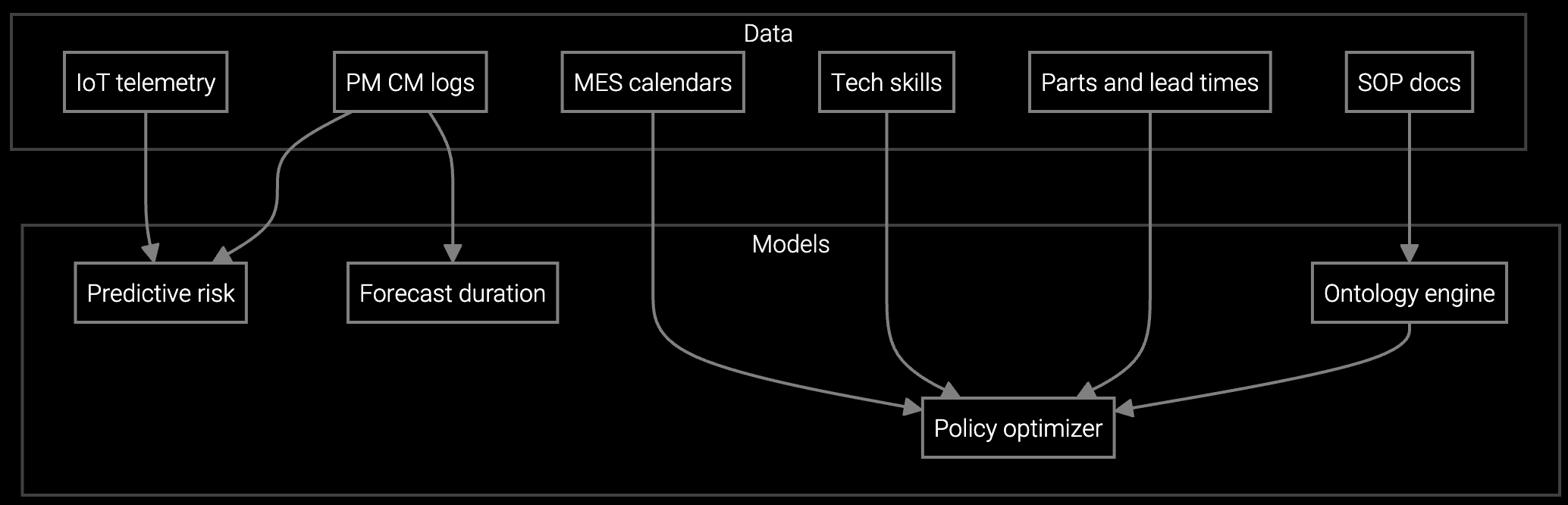
Bruviti connects directly to your network equipment via SNMP, syslog, and telemetry APIs to build a self-updating asset registry. Each device reports its serial number, firmware version, running configuration, and performance metrics automatically. The platform compares actual device state against your records, flags discrepancies, and alerts you to configuration drift before it causes outages.
Deploy the platform by configuring API endpoints, mapping device types to data sources, and setting alert thresholds. The system runs continuously in the background, ingesting telemetry streams and updating asset records in real time. You get complete equipment visibility in a single dashboard without manually tracking spreadsheets or querying devices one by one.

Monitor network equipment for performance deviations, alerting when router CPU spikes or switch port errors exceed thresholds.

Estimate when routers and switches will fail based on temperature trends and error logs, enabling planned maintenance.
Schedule firmware updates and hardware replacements during planned maintenance windows, not emergency outages.
Network equipment manufacturers support thousands of routers, switches, and firewalls deployed across geographically dispersed data centers, branch offices, and NOCs. Manual asset tracking breaks down at this scale. Devices get upgraded, replaced, or reconfigured without updating central records. Support teams waste hours verifying serial numbers and firmware versions before troubleshooting.
AI-powered asset tracking ingests SNMP traps, syslog streams, and telemetry data from every device automatically. The platform identifies configuration changes within minutes, tracks firmware compliance across the installed base, and flags devices approaching EOL before customers experience service disruptions. You see the entire network's health in one dashboard without querying individual devices.
Initial setup takes 2-4 weeks depending on the number of device types and data sources. You configure API connections, map device models to telemetry feeds, and set alert thresholds. The platform begins ingesting data immediately after configuration. Full historical analysis requires 30-60 days of telemetry for accurate baseline modeling.
The platform ingests SNMP traps, syslog streams, NetFlow data, CLI output from SSH sessions, and proprietary telemetry APIs. It supports standard network management protocols and can parse vendor-specific log formats. You can add custom data sources by defining parsing rules in the platform's configuration interface.
No, the platform augments your existing systems by providing real-time device intelligence. It continuously validates asset records against actual device state, flags discrepancies, and updates your CMDB or asset registry via API. You keep your existing workflows while gaining automated accuracy and predictive alerts.
The platform captures a baseline configuration for each device type and continuously compares running configs against that baseline. It uses AI to identify meaningful changes versus routine updates, filtering out noise like log rotations or transient interface states. You receive alerts only for changes that affect security, performance, or compliance.
Yes, the platform supports both cloud and on-premises deployments. For environments with strict data residency requirements, you deploy the platform within your own infrastructure. Telemetry data never leaves your network. The system operates identically in both deployment models with no feature differences.
Software stocks lost nearly $1 trillion in value despite strong quarters. AI represents a paradigm shift, not an incremental software improvement.
Function-scoped AI improves local efficiency but workflow-native AI changes cost-to-serve. The P&L impact lives in the workflow itself.

Five key shifts from deploying nearly 100 enterprise AI workflow solutions and the GTM changes required to win in 2026.
Deploy automated asset intelligence in weeks, not months—schedule a demo to see live network equipment tracking.
Schedule Demo