
Every unnecessary truck roll to a data center or remote site erodes margins. Workflow automation blocks waste before dispatch.
Automate dispatch, parts prediction, and on-site diagnostics end-to-end. AI orchestrates triage, schedules technicians, pre-stages parts, and captures job data—reducing truck rolls, improving first-time fix rates, and lowering cost per service visit.
Manual triage misses remote-fixable issues. Technicians arrive on-site for firmware updates or configuration errors that cost $500–$1,200 per visit.
Technicians arrive without the right parts or context. Second visits double labor costs and trigger SLA penalties for mission-critical network infrastructure.
Technicians spend 30–45 minutes per job completing paperwork. Time not spent fixing equipment is wasted utilization that compounds labor costs across the fleet.
The platform orchestrates the entire field service lifecycle from alert to resolution. AI ingests SNMP traps, syslog data, and telemetry from routers, switches, and optical transport systems to execute autonomous triage. The system determines whether the issue requires on-site intervention or can be resolved remotely—routing firmware updates and configuration errors to NOC teams while dispatching technicians only for physical failures.
When dispatch is required, the platform predicts needed parts based on failure signatures and historical patterns, pre-staging inventory at the technician's location. The mobile interface delivers complete equipment context—installation history, previous service tickets, firmware versions, and step-by-step repair procedures—eliminating guesswork on-site. Post-repair, the AI auto-generates job documentation, updates asset records, and flags recurring failure patterns that inform warranty negotiations and product engineering feedback.

Analyzes failure signatures from network equipment telemetry to predict which line cards, power supplies, or optics technicians will need before dispatch—cutting second visits for parts shortages.

Correlates SNMP traps and error logs with historical failure patterns across thousands of deployed routers and switches to identify root causes faster than manual troubleshooting.
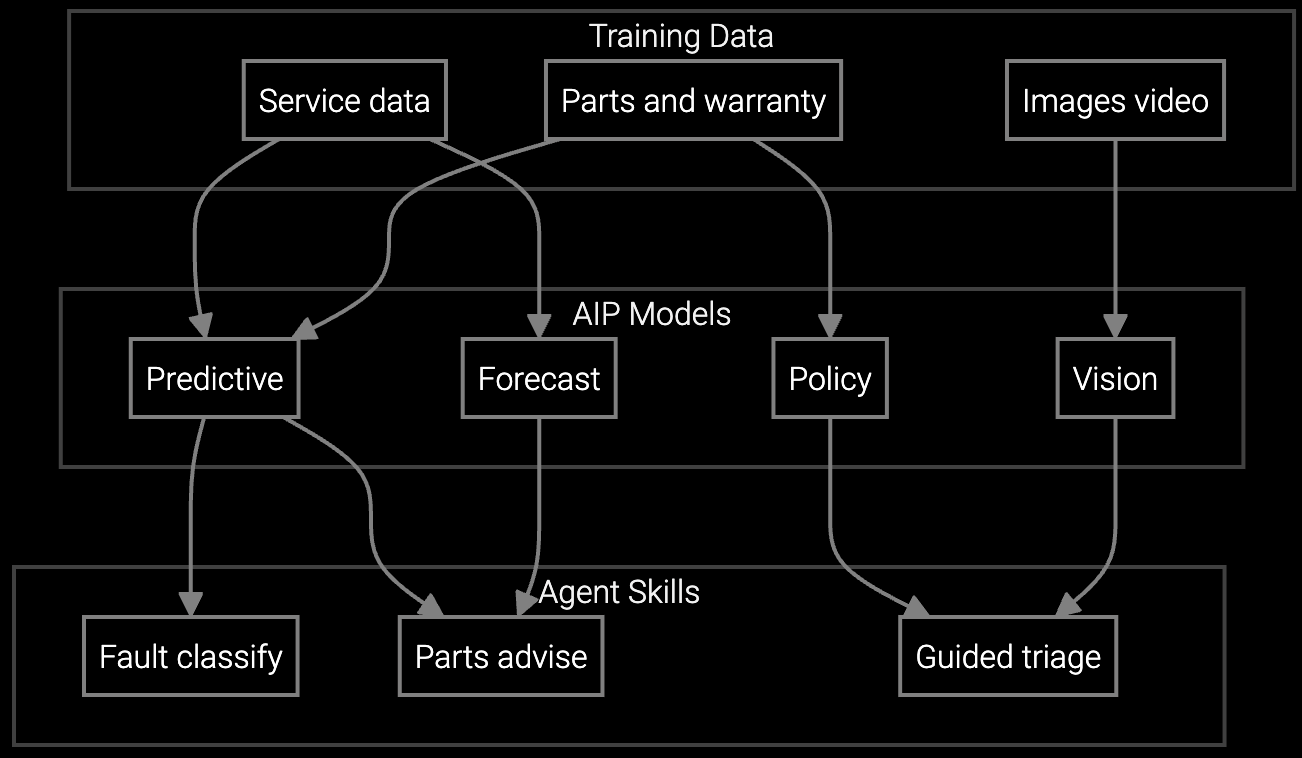
Mobile copilot provides real-time diagnostic guidance at data centers and remote cell sites—delivering step-by-step procedures for replacing optical transceivers or diagnosing PoE failures on-site.
Network equipment failures directly impact business operations for your customers—data centers, enterprises, and telecom carriers operating under five-nines SLAs. Every hour of downtime triggers contractual penalties and damages customer relationships. The economic pressure is dual: you must minimize MTTR while controlling the cost of 24/7 field service coverage.
Automated workflows address both. The platform triages alerts in real-time, routing firmware CVEs and configuration drift to NOC teams for remote resolution while dispatching technicians only for physical failures requiring on-site access. Parts prediction ensures first-time fix for line card replacements, power supply failures, and optical transceiver issues—the most common failure modes that account for 60% of truck rolls in carrier-grade networks.
The platform ingests telemetry, syslog data, and SNMP traps to identify remote-resolvable issues like firmware bugs or configuration errors. Automated triage routes these to NOC teams, dispatching technicians only when physical access is required. This cuts avoidable truck rolls by 20–30%, directly reducing the largest variable cost in field service operations.
Parts prediction analyzes failure signatures from routers, switches, and optical systems to determine which components a technician will need before dispatch. This eliminates second visits caused by missing line cards, power supplies, or transceivers—improving first-time fix rates from typical 65–70% to 85%+ and avoiding the compounded labor and SLA penalty costs of repeat visits.
Manual job documentation consumes 30–45 minutes per service call. AI-generated reports auto-populate work orders with parts replaced, diagnostic steps, firmware versions, and resolution notes—capturing this data passively from technician actions. Across a 100-person field service team handling 20 calls per week, this recovers 1,500–2,000 billable hours annually.
Bruviti ingests SNMP traps, syslog streams, telemetry data from DWDM and optical transport systems, firmware version databases, and historical service ticket data. Integration with existing FSM systems provides work order history and parts consumption records. This combination enables both real-time triage and predictive parts staging without requiring technicians to change tools.
Pilot deployments targeting high-cost equipment segments—carrier-grade routers or data center switches under strict SLAs—typically demonstrate measurable truck roll reduction within 60 days. Full ROI calculation includes avoided truck roll costs, improved FTF rates reducing SLA penalties, and labor savings from eliminated administrative tasks. Most OEMs achieve payback in 6–9 months at scale.

How AI bridges the knowledge gap as experienced technicians retire.

Generative AI solutions for preserving institutional knowledge.

AI-powered parts prediction for higher FTFR.
See how network equipment OEMs use Bruviti to automate triage, improve FTF rates, and reduce truck roll expenses.
Schedule Demo