
Manual forecasting and fragmented ordering across regional service centers cost appliance OEMs 18-30% in avoidable inventory expenses annually.
AI-powered automation replaces manual demand forecasting and parts ordering with end-to-end workflows that reduce carrying costs by 25-35% while maintaining 95%+ fill rates across distributed appliance service networks through predictive replenishment and automatic substitute matching.
Regional service centers stock parts based on historical averages rather than predictive demand signals. This results in capital tied up in slow-moving inventory while critical parts face stockouts during seasonal HVAC and refrigeration spikes.
When parts are unavailable locally, overnight shipping and expedited freight become the norm. For low-margin appliances, emergency logistics can consume the entire service margin on a single call.
Long appliance lifecycles mean parts must be stocked for decades. Manual tracking fails to identify slow-moving inventory or alert planners to engineering changes, leading to annual writedowns of obsolete components.
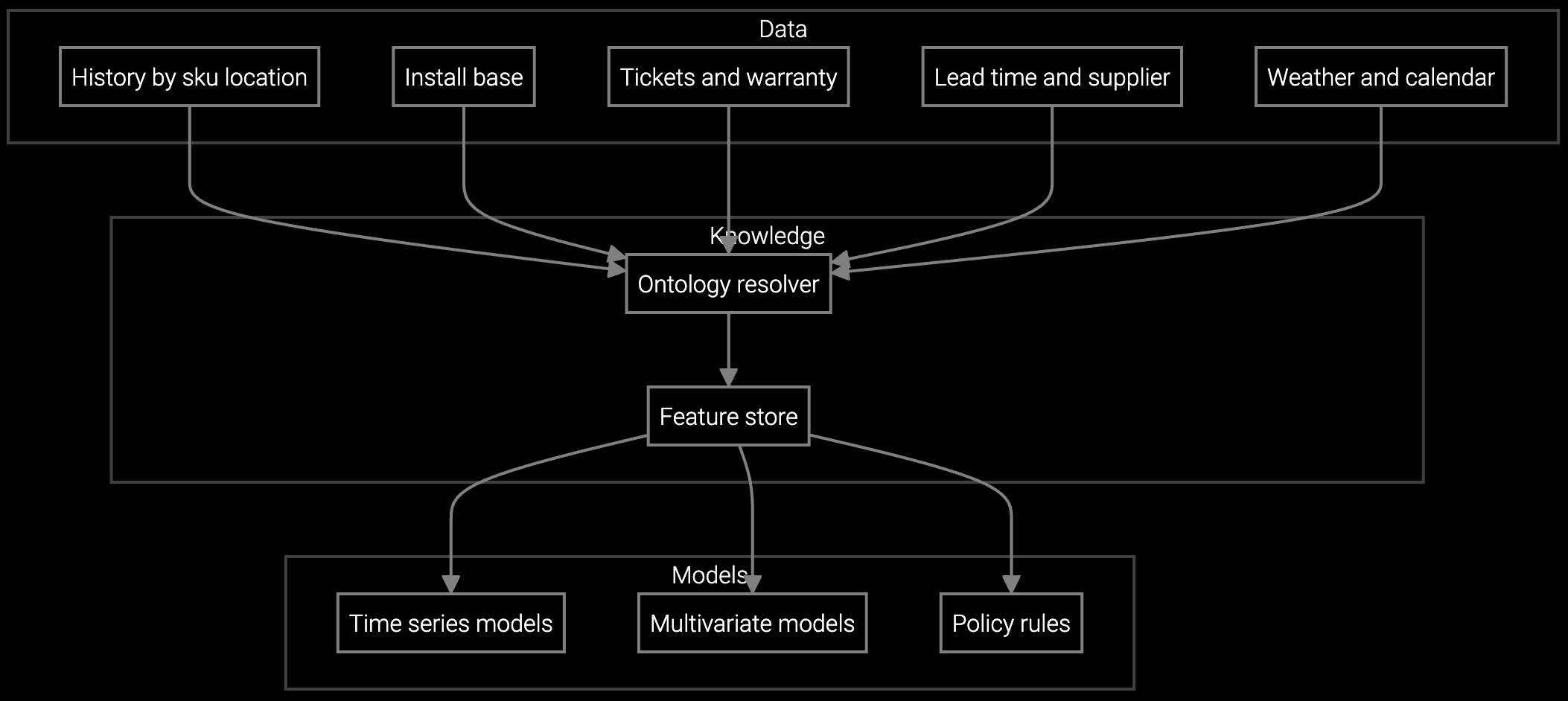
Bruviti orchestrates the complete parts lifecycle from demand sensing through replenishment. The platform ingests service history, warranty claims, installed base age, and IoT telemetry from connected appliances to forecast parts consumption by location and product line. When a service case opens, the system automatically checks multi-location availability, suggests equivalent substitutes for obsolete parts, and triggers replenishment orders when inventory falls below dynamically calculated reorder points.
This eliminates the manual forecasting spreadsheets, phone calls between warehouses, and reactive ordering that plague appliance service networks. Planners shift from firefighting stockouts to strategic decisions about which parts to stock regionally versus centrally, backed by predictive analytics that account for seasonal demand patterns and product mix changes.

Forecasts refrigerator compressor demand by region and time window based on installed base age and seasonal cooling loads, optimizing stock levels while reducing carrying costs.
Projects HVAC filter and fan motor consumption based on installed base usage patterns and seasonal service spikes, preventing summer stockouts.

Technicians snap a photo of a dishwasher pump assembly and instantly receive part number identification and multi-location availability across the service network.
Appliance manufacturers face unique inventory challenges from product lifecycles measured in decades. A washer sold in 2005 may require service in 2026, forcing OEMs to stock parts for hundreds of legacy models while managing current production. Consumer expectations compound the challenge: a refrigerator failure disrupts daily life, creating pressure for same-day or next-day parts availability even for low-frequency components.
Connected appliances add new complexity. IoT-enabled dishwashers and HVAC systems generate telemetry that reveals failure patterns before they trigger service calls, but only if inventory systems can interpret predictive signals and position parts accordingly. Manual forecasting cannot process this data volume or respond to the geographic variability in appliance usage patterns.
Traditional models set static reorder points based on historical averages and lead times. AI forecasting continuously adjusts predictions based on installed base age, seasonal patterns, warranty claim trends, and IoT failure signals. For appliances, this means anticipating HVAC demand spikes before summer heat waves rather than reacting after stockouts occur.
Most appliance manufacturers see 25-35% reductions in carrying costs within six months as excess inventory is right-sized. Emergency shipping costs typically drop 60-70% as predictive stocking prevents stockouts. The combined impact often delivers payback within one seasonal cycle, particularly for HVAC and refrigeration components with pronounced demand variability.
The system tracks engineering change notices and product lifecycle status to identify parts approaching obsolescence. When a discontinued part is requested, it automatically suggests compatible substitutes based on appliance model compatibility and functional equivalence. This prevents both emergency expediting for obsolete components and excess stocking of parts nearing end-of-life.
Yes. The platform connects to existing ERP and warehouse management systems via APIs to provide real-time visibility across all depot locations. It orchestrates inter-depot transfers when local stock is unavailable, optimizing for total logistics cost rather than treating each location as an isolated inventory island. This is critical for appliance networks with dozens of regional service centers.
IoT-enabled appliances generate telemetry on operating conditions, cycle counts, and component stress. The AI analyzes these signals to predict component failures before they occur, positioning parts in advance of service demand. For example, a compressor showing elevated current draw triggers preemptive stocking in the nearest depot before the refrigerator fails and generates a service call.

SPM systems optimize supply response but miss demand signals outside their inputs. An AI operating layer makes the full picture visible and actionable.

Advanced techniques for accurate parts forecasting.

AI-driven spare parts optimization for field service.
See how appliance OEMs use Bruviti to cut carrying costs while improving parts availability across distributed service networks.
Schedule Executive Briefing