
Seasonal demand spikes and decades of legacy models make parts planning critical—and expensive when wrong.
AI parts forecasting integrates with existing ERP systems to predict demand by model, location, and season—reducing carrying costs while preventing stockouts that delay service. Implementation requires telemetry access, historical parts consumption data, and API connectivity to your inventory management platform.
HVAC and refrigeration parts demand swings wildly with weather extremes. Manual forecasting leads to summer stockouts and winter overstock. Emergency air freight erodes service margins.
Appliance manufacturers support products for 15-20 years. Maintaining parts for thousands of SKUs ties up capital. Obsolescence planning is guesswork without failure pattern visibility.
Parts consumption varies by climate, usage patterns, and local service volumes. Central planning can't optimize for regional differences. Wrong-location inventory creates artificial stockouts.
Bruviti's forecasting engine connects to your ERP and service management systems via REST APIs, ingesting historical parts consumption, warranty claims, service ticket data, and connected appliance telemetry. The platform builds demand models by product family, geography, and time window—learning seasonal patterns like HVAC compressor failures in summer heat waves or ice maker valve replacements in hard water regions.
Implementation starts with a data audit to identify accessible sources: parts orders, service records, warranty claims, and IoT diagnostics if available. The platform requires read access to these systems and write access to your inventory planning module. Most appliance OEMs deploy in 8-12 weeks: four weeks for data pipeline setup, two weeks for model training on historical patterns, and four weeks for piloting recommendations in a single product line before full rollout.
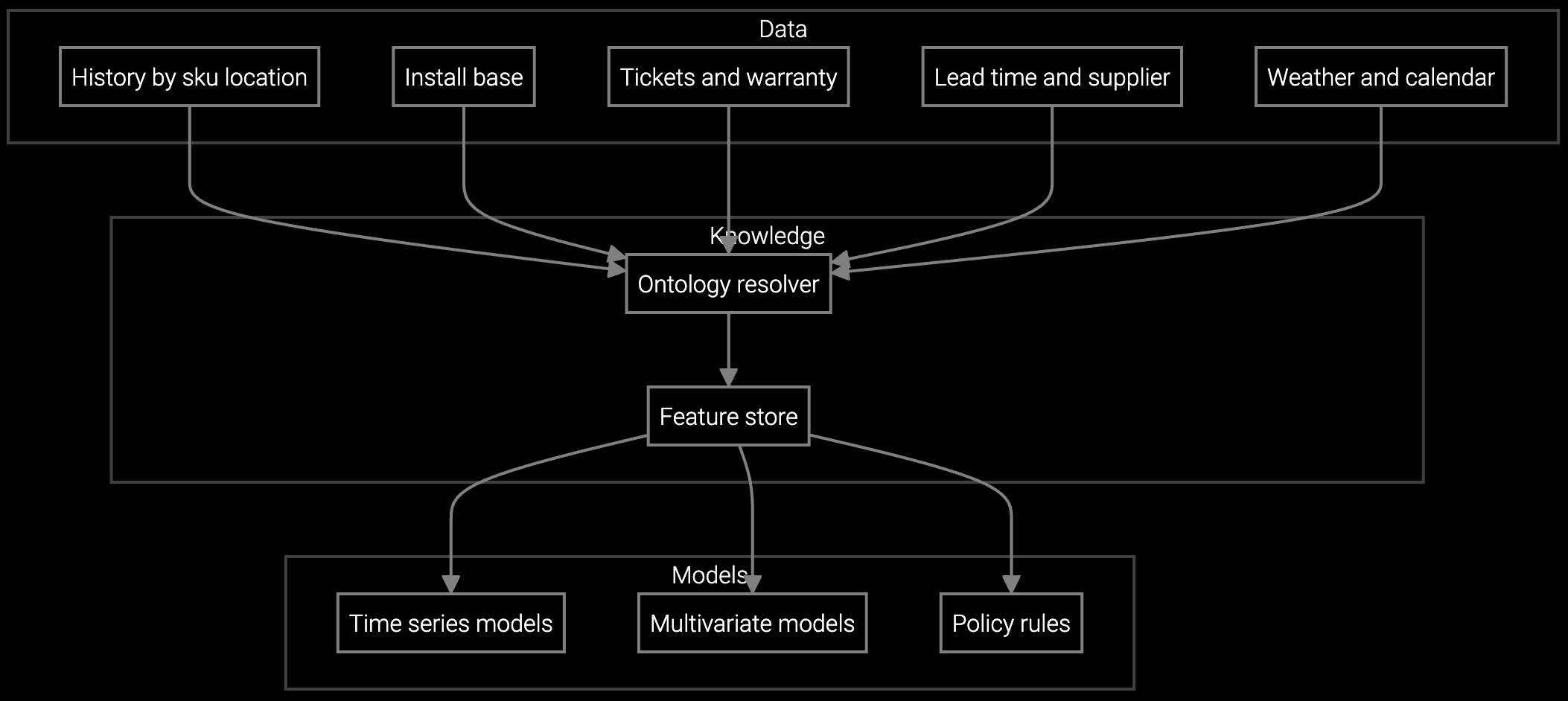
Projects appliance parts consumption based on installed base age, regional usage patterns, and seasonal failure trends to optimize inventory levels.

Forecasts demand by location and time window for HVAC and refrigeration components, reducing emergency shipments during seasonal peaks.

Technicians snap photos of failed components to get instant part number identification and regional availability, accelerating order accuracy.
Appliance OEMs typically maintain parts data across SAP or Oracle ERP systems, warranty management platforms, and field service applications. The AI forecasting platform requires API access to parts transaction history (3+ years preferred), service ticket records with part replacements, warranty claims data, and connected appliance diagnostic codes if IoT-enabled models exist.
Seasonal patterns are critical for accurate forecasting. HVAC compressor failures spike in summer; refrigerator defrost systems fail in high-humidity climates; dishwasher pumps wear faster in hard water regions. The platform ingests weather data, regional service volumes, and equipment age distribution to model these consumption drivers. Integration with your warranty reserve models allows finance teams to correlate parts spend forecasts with accrual planning.
The platform needs 2-3 years of historical parts consumption by SKU, service ticket records with part replacements, warranty claims data with failure codes, and product install dates by geography. Connected appliance diagnostics improve accuracy but aren't required. Most appliance OEMs have this data in ERP and service management systems already.
The platform ingests weather data, regional climate patterns, and historical consumption trends to predict seasonal failure rates. For HVAC compressors, it models summer heat wave impacts; for refrigeration, it accounts for humidity and ambient temperature effects on sealed system components. Forecasts update weekly as weather patterns evolve.
Most appliance manufacturers see measurable improvement in 90-120 days post-deployment. Early wins come from reduced emergency air freight costs and fewer service delays from stockouts. Sustained ROI accrues over 12-18 months as carrying costs decline and inventory turns improve. Expect 20-30% carrying cost reduction and 15-25% improvement in fill rates.
The AI tracks consumption decline rates by model year and product line to identify obsolescence windows. It flags SKUs with falling demand to inform buy-last-time decisions and substitute part recommendations. For appliances with 15-20 year support cycles, this prevents over-ordering parts that will sit unsold while avoiding premature discontinuation that creates service failures.
Yes. The platform models demand by geography based on installed base density, climate, and local service volumes. It recommends SKU placement by warehouse to minimize shipping distances while avoiding over-distribution. For example, dishwasher pump inventory concentrates in hard water regions; HVAC parts stock higher in southern heat-prone areas.

SPM systems optimize supply response but miss demand signals outside their inputs. An AI operating layer makes the full picture visible and actionable.

Advanced techniques for accurate parts forecasting.

AI-driven spare parts optimization for field service.
Schedule a technical walkthrough of the Bruviti platform with your data team and inventory planners.
Schedule Implementation Review