
When every hour of fab downtime costs $1M+, manual dispatch and guesswork-driven parts logistics destroy margins and erode customer trust.
Bruviti deployment data shows 65% of maintenance auto-scheduling once field-service workflows run on AI. For semiconductor manufacturers, automation shifts planners from manual booking to exception handling: the system books the routine windows and surfaces only the conflicts that need a human, cutting scheduling conflicts 20%.
Technicians arrive on-site without critical chamber components or consumables. The job stalls. A second truck roll is scheduled. The fab's lithography tool sits idle while waiting for the correct replacement parts to arrive.
Senior technicians retire, taking decades of tool-specific knowledge with them. Junior technicians lack the pattern recognition to diagnose complex recipe drift or contamination issues. First-time fix rates decline as tribal knowledge evaporates.
Manual work order routing sends the wrong technician or delays critical assignments. High-priority jobs miss SLA windows. Penalty clauses trigger. The service organization absorbs the cost while the customer relationship deteriorates.
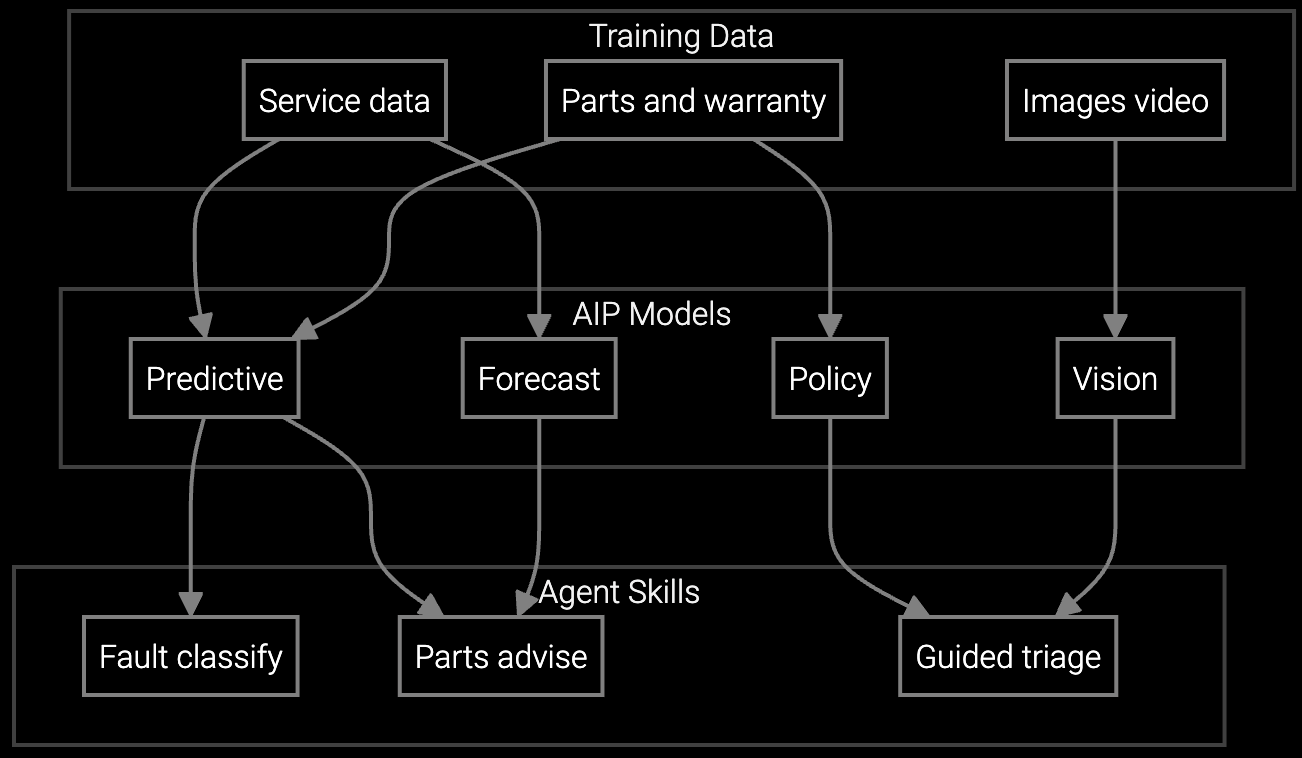
Bruviti embeds AI across the entire field service workflow—eliminating manual decision points that slow response times and drive up costs. When a work order arrives, the platform analyzes equipment telemetry, failure history, and parts inventory to predict the root cause and required components. It routes the job to the technician with relevant expertise and pre-stages parts at the local depot or loads them directly onto the truck.
On-site, technicians access a mobile copilot that surfaces diagnostic procedures, historical failure patterns, and resolution steps captured from senior engineers. The system auto-documents findings, consumes parts from inventory, and closes the loop with predictive recommendations for the customer. This end-to-end automation transforms field service from a reactive cost center into a margin-protecting, data-driven operation.

Predicts which chamber kits, consumables, and replacement components technicians will need before they leave the depot—reducing second visits and improving first-time fix rates for lithography and etch tools.

Correlates process telemetry, historical failure data, and tribal knowledge to identify contamination sources, recipe drift, and tool wear patterns—accelerating diagnosis for complex fab equipment issues.
Mobile copilot delivers real-time repair procedures, diagnostic recommendations, and senior engineer insights directly to technicians on-site at semiconductor fabs—preserving expertise as experienced staff retire.
Semiconductor manufacturing equipment operates in extreme environments—sub-5nm lithography processes, ultra-high vacuum deposition chambers, and precision metrology tools measuring features at atomic scale. When a tool fails, the fab's entire production line stalls. Downtime costs exceed $1 million per hour. Manual field service workflows—technicians guessing at required parts, dispatchers routing jobs based on availability rather than expertise, engineers repeating diagnostic steps already documented in past tickets—cannot keep pace with these stakes.
AI-driven workflow automation changes the equation. The platform ingests telemetry from lithography steppers, etch tools, and deposition systems. It learns failure signatures from historical data and captures tribal knowledge from retiring process engineers. When a work order arrives, the system predicts the root cause, identifies the required chamber components or consumables, routes the job to the technician with relevant tool experience, and pre-stages parts at the local depot. On-site, the mobile copilot surfaces diagnostic procedures and resolution steps specific to that tool model and failure mode. Post-repair, the platform documents findings and updates predictive models for future events.
The platform analyzes equipment telemetry, failure history, and parts inventory to predict the root cause and required components before dispatch. Technicians arrive with the correct chamber kits and consumables pre-staged, eliminating the guesswork that drives repeat visits. Mobile guidance surfaces diagnostic procedures specific to the tool model and failure mode, ensuring consistent execution even for junior staff.
Work order triage, parts prediction, and dispatch routing run autonomously—the AI orchestrates these steps end-to-end. On-site diagnostics and repair remain technician-executed, but the platform provides decision support and auto-documents findings. Post-repair analysis and predictive recommendations generate automatically. Human oversight focuses on validating complex diagnoses and approving high-impact recommendations rather than executing routine workflow steps.
The platform extracts knowledge from historical work orders, repair notes, and resolution patterns. Senior technicians review and validate AI-generated diagnostic procedures, adding context the system cannot infer from data alone. Their corrections and annotations train the model. Over time, the platform absorbs their pattern recognition—preserving expertise that would otherwise retire with them.
Bruviti connects via API to FSM platforms and ERP systems for real-time work order data, parts inventory visibility, and technician scheduling. The platform ingests equipment telemetry directly from tool sensors or via existing data historians. Mobile apps integrate with FSM job completion workflows. Most deployments complete API integration within 4-6 weeks without replacing incumbent systems.
Track first-time fix rate improvement, truck roll cost reduction, and SLA compliance gains. Measure parts carrying cost savings from improved consumption accuracy. Calculate FTE savings from automated triage and documentation. Monitor customer uptime improvements and warranty reserve reductions. Most semiconductor OEMs see positive ROI within 6-9 months, driven primarily by repeat visit elimination and penalty avoidance.

How AI bridges the knowledge gap as experienced technicians retire.

Generative AI solutions for preserving institutional knowledge.

AI-powered parts prediction for higher FTFR.
See how Bruviti automates dispatch, parts prediction, and technician guidance for semiconductor OEMs.
Schedule Executive Briefing